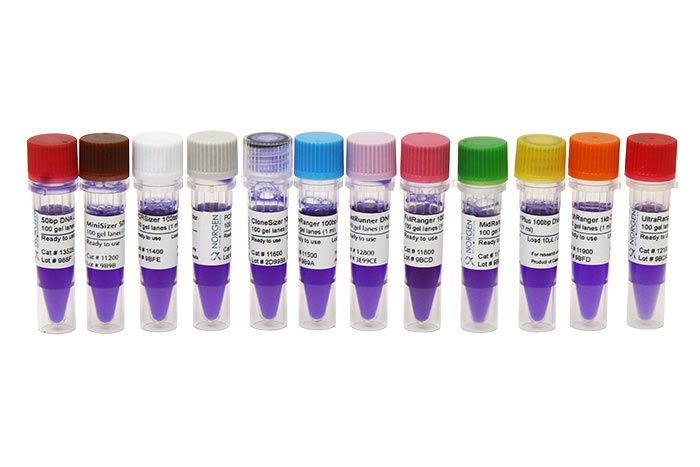
Thirteen discrete fragments ranging from 300 bp to 10000 bp
Higher intensity reference band at 5000 bp
The HighRanger 1 kb DNA Ladder is prepared to ensure quality and batch-to-batch consistency. This Ladder contains thirteen discrete fragments ranging from 300 bp to 10,000 bp with a higher intensity reference band at 5000 bp. This Ladder is ideal for quick sizing of PCR products and restriction digests.
Contents 1mL of premixed DNA ladder (0.5µg/10µL) in loading buffer (10mM EDTA, 10% glycerol, 0.015% bromophenol blue, and 0.17% SDS).
HighRanger 1kb DNA Ladder (Cat# 11900) – 100 loads
Ladder Properties: • Thirteen discrete bands, ranging from 300 bp to 10000 bp • Higher intensity band at 5000 bp for easy reference
Fragment
Size (bp)
Mass (ng)
1
10000
58
2
8000
53
3
6000
46
4
5000
67
5
4000
56
6
3000
47
7
2500
41
8
2000
34
9
1500
29
10
1000
18
11
700
13
12
500
23
13
300
14
Recommended Use:
Mix thoroughly. For best results, load 10µL of DNA ladder per well. For precise mass determination with a densitometer, stain gel after electrophoresis using 0.5µg/mL ethidium bromide for 30-40 minutes. The table above shows the size and mass for each band based on 10µL ladder per well.
Storage:
This kit is stable for 2 years after the date of shipment.
This ladder was standardized using 10µL of DNA per lane on a 0.8 cm thick, 13 x 15 cm, 1.0% agarose gel run in TAE buffer.
Other Products
Norovirus (NoV) TaqMan RT-PCR Detection Kits
Product Info
Document
Product Info
Overview
Detection kits for NoV
CE-IVD marked version available for in vitro diagnostic use
Available in TaqMan format for analysis
Norovirus is a single-stranded, non-enveloped RNA virus belonging to the Caliciviridae family. Norovirus is considered the major causative agent of non-bacterial gastroenteritis in the world. The main channel of transmittance is via contaminated food or water, as well as human-to-human contact. Most Noroviruses infecting humans belong to genogroup I and II (particularly genotype 4). Norovirus is very stable in the environment and is resistant to some surface disinfectants such as alcohols and detergents. Moreover, it is very difficult to culture Norovirus in vitro, making its identification by standard microbiological assays challenging.
NoV TaqMan RT-PCR Kit, 100 reactions
Ready to use format, including Master Mix for the target and PCR control to monitor for PCR inhibition and validate the quality
Specific Primer and Probe mix for the pathogen/virus/viroid of interest
Primer and Probe mix
Positive and negative control to confirm the integrity of the kit reagents
NoV TaqMan RT-PCR Probe/Primer Set and Controls, 100 reactions
Specific Primer/Probe mix and Positive Control for the pathogen/virus/viroid of interest
Nuclease-free water
Can be used together with Norgen’s RT-PCR Master Mix (#28113) or customer supplied master mix
Storage Conditions and Product Stability All kit components can be stored for 1 year after the date of production without showing any reduction in performance.
All kit components should be stored at -20°C upon arrival. Repeated thawing and freezing (> 2 x) of the Master Mix and Positive Control should be avoided, as this may affect the performance of the assay. If the reagents are to be used only intermittently, they should be frozen in aliquots.
Magnetic bead nucleic acid purification technology uses nano or micron superparamagnetic material as the matrix, generally black ferric oxide or yellowish brown ferricoxide as the magnetic material. The surface of bead is coated with appropriate functional groups, which can adsorb nucleic acid. Magnetic beads commonly used for nucleic acids, containing carboxyl groups, hydroxyl groups, or silicon groups. Silicon-based magnetic beads are the most common, and its principle of adsorbing nucleic acid is consistent with the classical glass milk purification technology or glass fiber filter membrane purification method. Magpure particle is a kind of polydisperse fast speed silica magnetic beads. The core is ferricoxide, accounting for 50%, and the surface coating is silica, accounting for 50%. The product can be used for plasmid extraction, gel DNA recovery, product purification, genomic DNA and RNA extraction, and viral nucleic acid extraction.
Details
Specifications
Features
Specifications
Concentration
10 mg/ml
Appearance
Suspension of yellowish brown particles
Surface functional group
Carboxyl, COOH
Dispersibility
Monodisperse, spherical
Particle size
0.8-1 μm
Preservation conditions
Room temperature, valid for up to 2 years.It is recommended to store in 2-8°C to prevent microbial growth.
Magnetic response speed
120 seconds
Settling velocity
>2 hours
High salt mediated binding
No adsorption
Alcohol mediated binding
1M NaClO4/ethanol(50%), DNA/RNA recovery up to 90%
PEG8000 mediated binding
The recovery of DNA/RNA was up to 90%
DNase/RNase
Not detected
DNA residue
Not detected
Recommended application
Plasmid extraction, gel DNA recovery, genomic DNA extraction and RNA extraction.
Principle
Highsalt mediated binding: in the solution containing 2-4M guanidine isothiocyanate, Magpure particles can selectively recover DNA molecules, and impurities such as protein polysaccharides are not adsorbed.
Alcohol mediated binding: in the solution containing guanidine salt and alcohol (>25%), Magpure particles can selectively recover DNA/RNA molecules, and proteins and other impurities are not adsorbed.
After biological samples are treated with digestive solution or lysis Buffer, DNA/RNA is released from cells, organelles and protein complexes (ribosomes and nucleosomes) into reagents. After Magpure particles and binding solution are added, DNA/RNA is adsorbed to the surface of Magpure particles to form DNA/RNA bead complex. Under the action of the magnetic field, the magnetic beads are separated and collected, and the impurities such as protein are removed with the waste liquid. After two or three steps of further cleaning, the DNA/RNA magnetic bead complex is resuspended in sterilized water or TE buffer, and the DNA/RNA falls off from the surface of the magnetic beads, so as to achieve the purpose of purification.
gDNA/RNA Isolation from Blood, Tissue, Plant, Swab, Spots, Stool, Soil and etc.Viral DNA/RNA IsolationAgarose Gel DNA Purification
DNA/RNA Isolation from low nucleic acid content samplesPlasmid IsolationDNA/RNA Clean Up
Circulating DNA IsolationViral Nucleic acid IsolationgDNA Isolation FFPE DNA/RNA Isolation
Plasmid extractiongel DNA recoverygenomicDNA/RNA extraction viral nucleic acid extractionCirculating DNA extraction
DNA/RNA Clean Up and concentrationDNA/RNA Isolation from low nucleic acid content samplesResearch immuno assays
The MagPure magnetic-particle technology combines the speed and efficiency of silica-based DNA purification with the convenient handling of magnetic particles. DNA binds to the silica surface of the magnetic particles in the presence of a chaotropic salt. DNA bound to the particles is then efficiently washed, considerably improving the purity of DNA. High-quality DNA is eluted. The automated purification procedure completely removes enzymes, nucleotides, and other contaminants and inhibitors. Purified DNA is suitable for direct use in downstream applications, such as sequencing and microarray analysis.
Document
Magnetic bead nucleic acid purification technology uses nano or micron superparamagnetic material as the matrix, generally black ferric oxide or yellowish brown ferricoxide as the magnetic material. The surface of bead is coated with appropriate functional groups, which can adsorb nucleic acid. Magnetic beads commonly used for nucleic acids, containing carboxyl groups, hydroxyl groups, or silicon groups. Silicon-based magnetic beads are the most common, and its principle of adsorbing nucleic acid is consistent with the classical glass milk purification technology or glass fiber filter membrane purification method. Magpure particle is a kind of polydisperse fast speed silica magnetic beads. The core is ferricoxide, accounting for 50%, and the surface coating is silica, accounting for 50%. The product can be used for plasmid extraction, gel DNA recovery, product purification, genomic DNA and RNA extraction, and viral nucleic acid extraction.