
Description
Specifications
| Clone | IHC583 |
| Source | Mouse Monoclonal |
| Positive Control | Breast Carcinoma, Urothelial Carcinoma |
| Dilution Range | 1:200 |

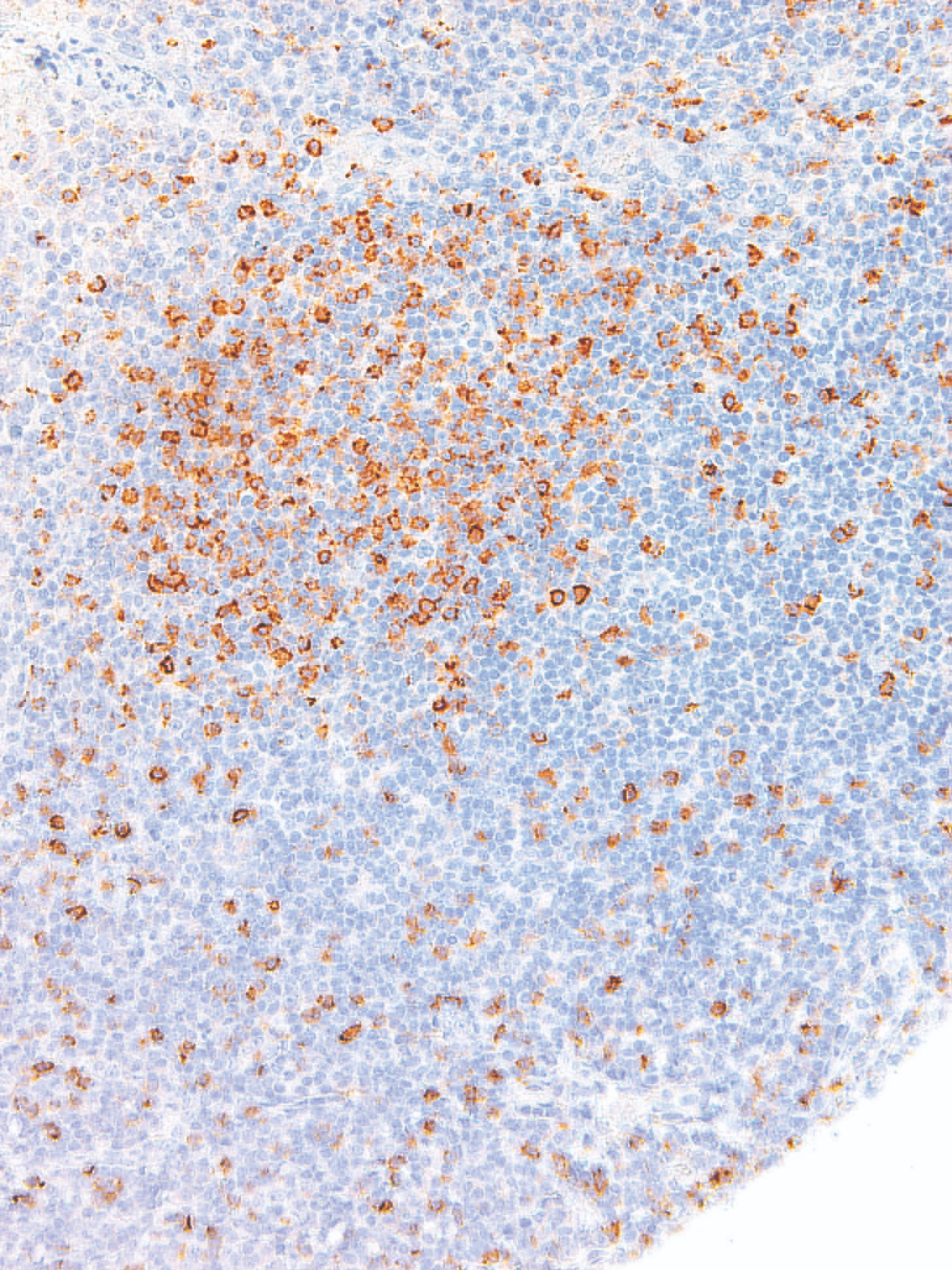
| Clone | IHC583 |
| Source | Mouse Monoclonal |
| Positive Control | Breast Carcinoma, Urothelial Carcinoma |
| Dilution Range | 1:200 |

Parvovirus B19 was the first known human virus in the family of Parvoviruses. B19 is a non-enveloped, icosahedral virus that contains a single-stranded linear DNA genome. It is classified as an erythrovirus because of its capability to invade red blood cell precursors in the bone marrow. B19 virus causes a childhood rash called fifth disease or erythema infectiosum which is commonly called “slapped cheek” syndrome due to the appearance of erythema across the cheeks. The virus is primarily spread by infected respiratory droplets, but some cases of blood-borne transmission have been reported. Parvovirus infection in pregnant women is associated with hydrops fetalis due to severe fetal anemia, sometimes leading to miscarriage or stillbirth. The risk of fetal loss is about 10% if infection occurs before week 20 of pregnancy. There is also some evidence that intrauterine Parvovirus B19 infection leads to developmental abnormalities in childhood. Due to the serious nature of the virus, methods for its rapid diagnosis are desirable.
Parvo B19 TaqMan PCR Kit, 100 reactions
Parvo B19 TaqMan PCR Probe/Primer Set and Controls, 100 reactions
Figure 1 / 3

Click for expanded view
Storage Conditions and Product Stability
All kit components can be stored for 2 years after the date of production without showing any reduction in performance.
All kit components should be stored at -20°C upon arrival. Repeated thawing and freezing (> 2 x) of the Master Mix and Positive Control should be avoided, as this may affect the performance of the assay. If the reagents are to be used only intermittently, they should be frozen in aliquots.
| Component | Cat. TM39650 (100 preps) | Cat. TM39610 (100 preps) |
|---|---|---|
| MDx TaqMan 2X PCR Master Mix | 2 x 700 μL | – |
| Parvovirus B19 Primer & Probe Mix | 280 μL | 280 μL |
| Parvovirus B19 Positive Control | 150 μL | 150 μL |
| Nuclease-Free Water (Negative Control) | 1.25 mL | 1.25 mL |
| Product Insert | 1 | 1 |
The Hepatitis B virus (HBV) is mainly transmitted via blood or blood products. In addition, sexual, oral and perinatal infections are also possible. Early symptoms of the infection include appetite loss, vomiting and abdominal symptoms, with approximately 10-20% of those patients developing fever as well as rheumatoid joint and muscle pain. Jaundice, which may be accompanied by itching, will then develop within 2-14 days. Fulminant hepatitis then occurs in about 1% of all infected patients, which in severe cases may be fatal. Of those individuals infected by HBV, 5-10% will develop chronic liver inflammation which may progress to cirrhosis of the liver or, in the worst case, primary liver cell carcinoma. The HBV virus is a hepadnavirus that has a circular genome composed of partially double-stranded DNA.
HBV TaqMan PCR Kit, 100 reactions
HBV TaqMan PCR Probe/Primer Set and Controls, 100 reactions
For research use only and NOT intended for in vitro diagnostics.
Figure 1 / 3
Click for expanded view
Storage Conditions and Product Stability
All kit components can be stored for 2 years after the date of production without showing any reduction in performance.
All kit components should be stored at -20°C upon arrival.
| Component | Cat. TM29250 (100 rxns) | Cat. TM29210 (100 rxns) |
|---|---|---|
| MDx TaqMan 2X PCR Master Mix | 2 x 700 μL | – |
| HBV Primer & Probe Mix | 280 μL | 280 μL |
| HBV Positive Control | 150 μL | 150 μL |
| Nuclease-Free Water (Negative Control) | 1.25 mL | 1.25 mL |
| Product Insert | 1 | 1 |
Product Description
One-Step Isothermal Amplification Basic Kit for High Throughput RNA Analysis
Kit Storage and Term of Validity
Storage term: stored at ≤-20℃,keep away from light, avoid heavy weight and repeated freezing and thawing.
Term of Validity: 14 months
Isothermal Nucleic Acid Principle Summary
This kit is based on a rapid nucleic acid amplification technology at room temperature and constant temperature:at room temperature and constant temperature(generally 39℃~42℃),reverse transcriptaseuses specific primers and template RNA tosynthesize cDNA strands,and binds the auxiliary protein and single strand with the help of the protein, the recombinase and the primer form a complex; perform a homology search and bind the target homology domain, at this time a D-loop region is formed at the homology positionand strand exchange begins; accompanied by the recombinase from the complex upon dissociation,the polymerase also bindsto the 3′ end of the primer,initiating chainextension.It is suitable for laboratory-level RNA amplification and RNA amplification for other detection purposes.
Technical Parameters:
| Parameters | Details |
|---|---|
| Product Name | RNA Isothermal Amplification Kit Basic |
| Manufacturer | Amp-future |
| Storage Temperature | -20°C |
| Kit Components | Enzymes, Buffers ,Reagents |
| Packaging | 48 Tests/box |
| Detection Limit | 500-1000copies/µL |
| Shipping | ICE |
| Test Time | 5-20mins |
Isothermal Nucleic Acid Product Features
1/ High sensitivity and specificity, short reaction time.
2/ The reagent form is freeze-dried, stable and easy to operate.
3/ The reaction can be operated by metal bath and water bath pot without purchasing expensive PCR apparatus.
Isothermal Nucleic Acid Applications
Suitable for RNA isothermal rapid amplification kit(BASIC type)
Primer: Require pair of nucleotide primers with the length of 25-35 bp.
RNA basic kit reaction temperature is 39 to 42℃ and time is 5-20 minutes.
Notes
1/ Please avoid nucleic acid contamination and set blank control during reaction due to the high sensitivity of the kit.
2/ Please take out the required quantity of MIRA reaction units for the experiment, and put the rest under storage conditions when performing the experiment.