
Description
Specifications
| Clone | IHC634 |
| Source | Mouse Monoclonal |
| Positive Control | Seminoma |
| Dilution Range | 1:200 |

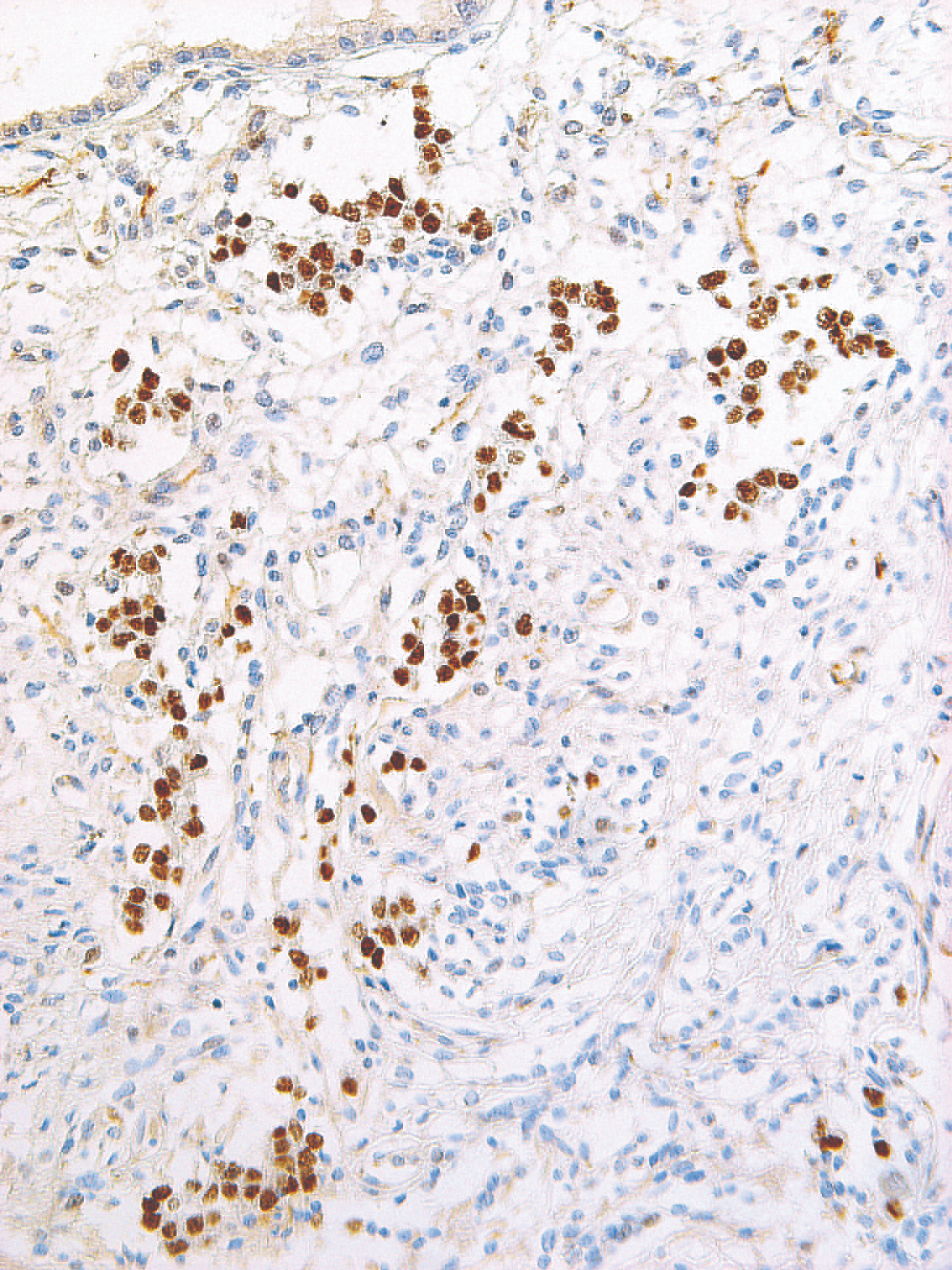
| Clone | IHC634 |
| Source | Mouse Monoclonal |
| Positive Control | Seminoma |
| Dilution Range | 1:200 |

Norgen’s Cells and Tissue DNA Isolation Kits are designed for the rapid preparation of genomic DNA from cultured cells as well as various tissue samples and urine. The purified genomic DNA is fully digestible with all restriction enzymes tested, and is completely compatible with PCR and Southern Blot analysis.
Cells and Tissue DNA Isolation Kit (Spin Column)
Purification is based on spin column chromatography as the separation matrix. Norgen’s columns bind DNA under optimized salt concentrations and release the bound DNA under low salt and slightly alkali conditions. The protocol can be completed in approximately 30 minutes for cells and within 90 minutes for tissues. Each kit contains sufficient materials for 50 preparations.
Cells and Tissue DNA Isolation Micro Kit (Micro)
Optimized for small inputs of cells and tissues, such as Laser-Captured Microdissection (LCM). Purification is based on spin column chromatography as the separation matrix. Norgen’s columns bind DNA under optimized salt concentrations and release the bound DNA under low salt and slightly alkali conditions. Preparation time for a single sample is approximately 60 minutes, and each kit contains sufficient materials for 50 preparations.
Cells and Tissue DNA Isolation Kit (Magnetic Bead System)
Purification is based on the use of magnetic beads that bind DNA under optimized binding conditions. Norgen’s Cells and Tissue DNA Isolation Kit (Magnetic Bead System) allows for the isolation of genomic DNA from various types of animal tissues or cell samples. Preparation for 10 purifications is approximately 40 minutes of hands-on time.
Cells and Tissue DNA Isolation 96-Well Kit (High Throughput Magnetic Bead System)
Purification is based on the use of magnetic beads that bind DNA under optimized binding conditions. Norgen’s Cells and Tissue DNA Isolation 96-Well Kit (Magnetic Bead System) allows for the isolation of genomic DNA from various types of animal tissues or cell samples. The Cells and Tissue DNA Isolation 96-Well Kit (Magnetic Bead System) also can be integrated with a robotic automation system.
Figure 1 / 9

Click for expanded view
| Kit Specifications | |
| Maximum Input | 20 mg of animal tissue Up to 150 μL of viral suspension 3 x 10⁶ cells |
| Column Binding Capacity | > 50 μg |
| Average Yield | 8 μg (from 1 x 10⁶ HeLa Cells) 10 μg (from 10 mg kidney) |
| Elution Volume | 50 – 200 μL |
| Analyte Purified | Genomic DNA, mitochondrial DNA, viral DNA |
| Format | Spin Column |
| Time to Complete 10 Purifications | 30 min (cells) and 90 min (tissue) |
Storage Conditions and Product Stability
All solutions should be kept tightly sealed and stored at room temperature. This kit is stable for 1 year after the date of shipment. The kit contains a ready-to-use Proteinase K, which is dissolved in a specially prepared storage buffer. The buffered Proteinase K is stable for up to 1 year after the date of shipment when stored at room temperature.
| Component | Cat. 53100 (50 preps) | Cat. 57300 (50 preps) | Cat. 59100 (50 preps) | Cat. 62500 (192 preps) |
|---|---|---|---|---|
| Lysis Buffer B | 20 mL | 20 mL | 20 mL | 1 x 40 mL 1 x 20 mL |
| Solution WN | 18 mL | 18 mL | 18 mL | 55 mL |
| Wash Solution A | 18 mL | 18 mL | – | – |
| Elution Buffer B | 30 mL | 8 mL | 15 mL | 1 x 30 mL 1 x 15 mL |
| Proteinase K | 1.2 mL | 1.2 mL | 1.2 mL | – |
| Proteinase K in Sotrage Buffer | – | – | – | 4 mL |
| Magnetic Bead Suspension | – | – | 2 x 1.1 mL | 8.5 mL |
| 96-Well Plate | – | – | – | 2 |
| Spin Columns | 50 | – | – | – |
| Micro Spin Columns | – | 50 | – | – |
| Collection Tubes | 50 | 50 | – | – |
| Elution Tubes (1.7 mL) | 50 | 50 | 50 | – |
| 96-Well Elution Plate | – | – | – | 2 |
| Adhesive Tape | – | – | – | 2 |
| Product Insert | 1 | 1 | 1 | 1 |

The NGS DNA Fragmentation & Library Prep Kit (illumina and MGI Platforms) was developed for construction of high quality libraries for next generation sequencing. The kit uses intact genomic DNA (EDTA-free DNA or DNA resuspended in TE buffer) as input DNA without an additional DNA fragmentation step. Our technology provides a fast and simple workflow. DNA libraries can be generated around 2 hours with only 10 min hands-on time. Library multiplexing is possible.
NGS DNA Fragmentation & Library Prep Kit Workflow
The incorporation of DNA fragmentation in the kit makes it possible to directly use intact genomic DNA as input DNA without the need of mechanical DNA shearing or enzymatic DNA fragmentation. The NGS DNA Fragmentation & Library Prep Kit does not generate sequencing bias as compared to library using mechanical sheared DNA as input. Sequence coverage is also consistent between enzymatic shearing and mechanical shearing. The library size is inversely correlated with the incubation time of step 1 at 20°C.
Three index types are available for the kit of the illumina platform:
Non-index (Cat.# 30026): Libraries do not have index.
Index (Cat.# 30028): Each of the index primers contains a unique index sequence of 6 bases. Library multiplexing for 48 samples is possible. Index information can be downloaded here.
Unique dual index (Cat.# 30030): Library multiplexing for 96 samples is possible. With the unique features of our 4-Base Difference Index System, the index sequence is 8-base long and each index has 4 bases different from others. Our unique dual index primers effectively identify sequencing errors such as index hopping, mis-assignment of reads, and de-multiplexing errors etc. The unique dual index primers set consists of 96 pre-mixed unique pairs of index primers. Index information can be downloaded here.
Indexes are available for the MGI platform kits (Cat.# 34028).
Kit features:

Library conversion efficiency: 100 ng, 300 ng and 500 ng of intact genomic DNA were used as input.

The library size is inversely correlated with the incubation time of step 1 at 20°C.

NGS data comparison: enzymatic shearing versus mechanical shearing
Enzymatic shearing
• DNA shearing and library prep: BioDynami NGS DNA Fragmentation & Library Prep Kit
Mechanical shearing
• DNA shearing: Covaris sonication
• Library prep: BioDynami NGS DNA Library Prep Kit.
The NGS DNA Fragmentation & Library Prep Kit (illumina and MGI Platforms) was developed for construction of high quality libraries for next generation sequencing. The kit uses intact genomic DNA (EDTA-free DNA or DNA resuspended in TE buffer) as input DNA without an additional DNA fragmentation step. Our technology provides a fast and simple workflow. DNA libraries can be generated around 2 hours with only 10 min hands-on time. Library multiplexing is possible.

029120 Lugol Iodine
Usage:For starch hydrolysis test.
Specification:10ml.
10ml