
Description
Specifications
| Clone | IHC697 |
| Source | Mouse Monoclonal |
| Positive Control | Colon Cancer |
| Dilution Range | 1:200 |
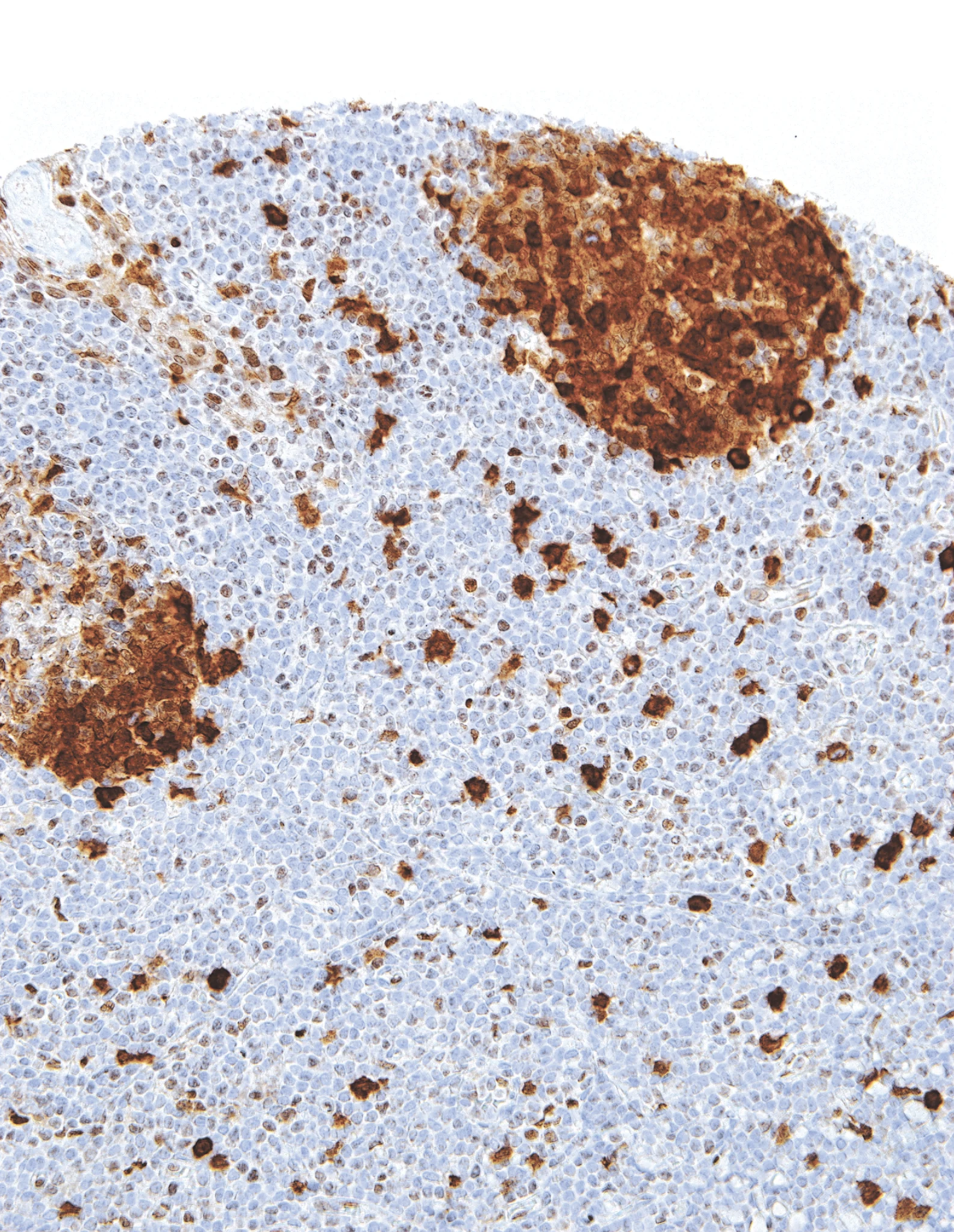
Thymidylate Synthase (TS) is a crucial enzyme responsible for the synthesis of 2′-deoxythymidine-5′-monophosphate (dTMP) a precursor for thymidylate which is necessary for DNA replication and repair from 2′-deoxyuridine-5′-monophosphate (dUMP). In terms of cancer, TS is an important target for cancer treatment as the inhibition of TS and therefore nucleotide synthesis necessary for cell growth has shown to be a vital part for successful treatment against colorectal, pancreatic and breast cancers.

| Clone | IHC697 |
| Source | Mouse Monoclonal |
| Positive Control | Colon Cancer |
| Dilution Range | 1:200 |
Attogene’s Organophosphate detection kit is in designed specifically to detect Organophosphate in liquid samples.
Organophosphate compounds (OP) account for the largest class of rural and urban poisons in the world that are used to kill pests but can also be toxic to humans. OPs cause toxicity by means of blocking the acetylcholinesterase enzyme (AchE). The AChE-directed OPs react with a serine residue that is located at the catalytic site found within the AChE gorge. The OP targeted enzyme is no longer able to hydrolyze ACh, resulting in the buildup of ACh in the nerve synapse. This effect causes excessive excitation of the nerves, producing uncoordinated movements, tremors, paralysis and death. Both synthetic and natural(Guanitoxin) organophosphates are dangerous to humans — exposure can lead to visual, coordination, muscular, and neurological deficiencies, and in some cases even to death. In turn, exposure to OP is a significant public health concern which would significantly benefit from an improved detection platform.
Attogene’s Organophosphate detection kit is in designed specifically to detect Organophosphate in liquid samples. For solid samples a simple sample preparation method is performed. The ability to detect Organophosphate is performed is simple and sensitive. The reaction uses a chromophore that can be detected by eye. In the presence of Organophosphate, the rate of chromophore production is reduced in a concentration dependent fashion. The higher the concentration of Organophosphate the less color is produced.
Attogene’s Organophosphate detection kit is in designed specifically to detect Organophosphate in liquid samples.
The HiPure Minipreps system provides a fast, simple, and cost-effective plasmid DNA miniprep method for routine molecular biology laboratory applications. HiPure Miniprep Kits use silica membrane technology to eliminate the cumbersome steps associated with loose resins or slurries. Plasmid DNA purified with Mini Kits is immediately ready for use. Phenol extraction and ethanol precipitation are not required, and high quality plasmid DNA is eluted in a small volume of Tris buffer or water.
Specifications
| Features | Specifications |
| Main Functions | Isolation up to 30μg endotoxin-free plasmid DNA from 1-5ml bacterial culture using 96-well bind plate |
| Applications | Cell transfection, animal injection, etc. |
| Purification method | 96 well plate |
| Purification technology | Silica technology |
| Process method | Manual (centrifugation or vacuum) |
| Sample type | Low copy plasmid vector |
| Sample amount | 1-5ml LB(x96) |
| Yield | 30μg |
| Elution volume | ≥75μl |
| Time per run | ≤60 minutes |
| Liquid carrying volume per column | 800μl |
| Binding yield of column | 70μg |
The HiPure Plasmid procedure is based on alkaline lysis of bacterial cells followed by adsorption of DNA onto silica in the presence of high salt. The unique silica membrane used in the kit completely replaces glass or silica slurries for plasmid DNA minipreps. The procedure consists of 3 basic steps: Preparation and clearing of a bacterial lysate by alkaline method,then transfer the supernatant to column to bind DNA. After washing proteins and other impurities, nucleic acid was finally eluted with low-salt buffer (10mm Tris, pH9.0, 0.5mm EDTA).
Advantages
1. High throughput: processing 96 samples at once;
2. High yield: The purified plasmid yield can reach up to 30μg, which is greater than the yield of the magnetic bead method kit;
3. Detoxification: endotoxin content <0.1EU/μg;
4. Fast: The entire extraction can be completed in 60 minutes without the need for time-consuming alcohol precipitation;
Kit Contents
| Contents | P115701 | P115702 | P115703 |
| Purification Times | 1 x 96 Preps | 4 x 96 Preps | 20 x 96 Preps |
| RNase A | 10 mg | 20 mg | 100 mg |
| Buffer P1 | 30 ml | 120 ml | 550 ml |
| Buffer P2 | 30 ml | 120 ml | 550 ml |
| Buffer LEN3 | 15 ml | 60 ml | 300 ml |
| Buffer LN4 | 80 ml | 270 ml | 2 x 700 ml |
| Buffer LN5 | 40 ml | 220 ml | 1100 ml |
| Buffer PW1 | 40 ml | 220 ml | 1100 ml |
| Buffer PW2 | 25 ml | 100 ml | 2 x 200 ml |
| Elution Buffer | 30 ml | 60 ml | 250 ml |
| Lysate Clear Plate | 1 | 4 | 20 |
| HiPure DNA Plate | 1 | 4 | 20 |
| 1.6ml Collection Plate | 2 | 8 | 40 |
| 0.5ml Collection Plate | 1 | 4 | 20 |
Storage and Stability
The kit components can be stored dry at room temperature (15-25°C) and are stable for at least 18 months under these conditions. If any precipitates form in the buffers, warm at 37℃ to dissolve. After addition of RNase A,Buffer P1 is stable for 6 months when stored at 2-8°C.
For any technical problems or customized products, please contact us.
F&Q about Endotoxin-free Plasmid Extraction Kit — P1156 ←click here
The HiPure Minipreps system provides a fast, simple, and cost-effective plasmid DNA miniprep method for routine molecular biology laboratory applications. HiPure Miniprep Kits use silica membrane technology to eliminate the cumbersome steps associated with loose resins or slurries. Plasmid DNA purified with Mini Kits is immediately ready for use. Phenol extraction and ethanol precipitation are not required, and high quality plasmid DNA is eluted in a small volume of Tris buffer or water.
A custom designed PACE® Genotyping Assay, designed to your target sequence. Compatible with all PACE genotyping master mixes.
PACE (PCR Allelic Competitive Extension) genotyping chemistry is a homogeneous, PCR-based allele-specific technology for the analysis of DNA sequence variants, most commonly SNPs (Single Nucleotide Polymorphisms) and Indels (insertion / deletions).
PACE genotyping chemistry is comprised of two parts:
When combined with sample DNA, these components create a PACE Genotyping Reaction, as illustrated in the figure below.
We have extensive knowledge and experience in assay design, especially when it comes to allele-specific PCR. PACE Genotyping Assays are available to purchase either Validated and Unvalidated. Validated assays require customer DNA to validate and optimise, for guaranteed performance. Unvalidated assays are designed in silico and supplied untested.
qPCR machine or Thermocycler + Fluorescent plate reader
PCR plate or equivalent and appropriate optically clear seal
Template DNA
PCR-grade water
PACE Genotyping Master Mix or PACE 2.0 Genotyping Master Mix