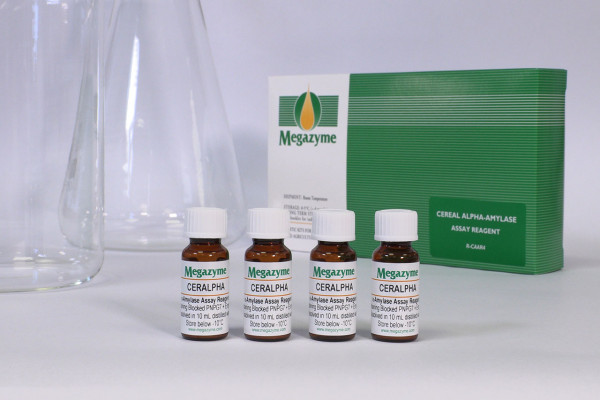
Purchase high purity Ceralpha: α-Amylase Reagent – 4 vials for the measurement of α-amylase for research, biochemical enzyme assays and in vitro diagnostic analysis.
p-Nitrophenyl α-D-maltoheptaoside (blocked), plus excess α-glucosidase and glucoamylase. For the measurement of cereal, fungal and bacterial α-amylase.
View our full range of reagent mixtures.
Detail
R-CAAR4
SKU: 700005034
200 assays per kit (4 vials)
Content:
200 assays per kit (4 vials)
Shipping Temperature:
Ambient
Storage Temperature:
Short term stability: 2-8oC, Long term stability: See individual component labels
Stability:
> 2 years under recommended storage conditions
Analyte:
α-Amylase
Assay Format:
Spectrophotometer, Auto-analyser
Detection Method:
Absorbance
Wavelength (nm):
400
Limit of Detection:
0.05 U/mL
Reproducibility (%):
~ 3%
Reaction Time (min):
~ 30 min
Purchase high purity Ceralpha: α-Amylase Reagent – 4 vials for the measurement of α-amylase for research, biochemical enzyme assays and in vitro diagnostic analysis.
p-Nitrophenyl α-D-maltoheptaoside (blocked), plus excess α-glucosidase and glucoamylase. For the measurement of cereal, fungal and bacterial α-amylase.
Propargyl-PEG2-acid is a linker consisting of propargyl and carboxylic acid functional groups. In the presence of activators (e.g. EDC, or HATU), the carboxylic acid reacts with primary amine to form a stable amide bond. The propargyl group reacts with azide group in biomolecules to yield a stable triazole linkage. Reagent grade, for research purpose. Please contact us for GMP-grade inquiries.
Document
Propargyl-PEG2-acid is a linker consisting of propargyl and carboxylic acid functional groups. In the presence of activators (e.g. EDC, or HATU), the carboxylic acid reacts with primary amine to form a stable amide bond. The propargyl group reacts with azide group in biomolecules to yield a stable triazole linkage. Reagent grade, for research purpose. Please contact us for GMP-grade inquiries.
Propargyl-PEG7-NHS ester contains a propargyl group and an NHS ester. As an amine reactive reagent, this product can be used for derivatizing peptides, antibodies, amine coated surfaces etc. In the presence of copper catalyst, propargyl group reacts with azide to yield a stable triazole linkage. The PEG units help increase the hydrophilicity of the reagent. Reagent grade, for research purpose. Please contact us for GMP-grade inquiries.
Document
Propargyl-PEG7-NHS ester contains a propargyl group and an NHS ester. As an amine reactive reagent, this product can be used for derivatizing peptides, antibodies, amine coated surfaces etc. In the presence of copper catalyst, propargyl group reacts with azide to yield a stable triazole linkage. The PEG units help increase the hydrophilicity of the reagent. Reagent grade, for research purpose. Please contact us for GMP-grade inquiries.
The 16S V3-V4 Library Preparation Kit for Illumina consists of the reagents and components required for library preparation of the 16S V3-V4 amplicon libraries to be used for next-generation sequencing on Illumina platforms. All molecular reagents including primers, enzyme mixes, indexes, and buffers are provided. Instructions for PCR clean up with the AMPure XP Magnetic Beads (supplied by customer) are also included for rapid purification of nucleic acid products generated at two steps of the workflow. The library prep workflow could be used for purified DNA inputs from different sources including stool, soil, water, saliva, plant, urine, skin swab, vaginal swab, cheek swab, nasal swab, plasma/serum, tongue swab, gum swab, and others.
The 16S V3-V4 Library Preparation Kit for Illumina has a streamlined procedure that reduces the handling time such that the library prep procedure can be completed in approximately 4 hours (see diagram below). Input DNA is first subjected to targeted PCR to amplify the V3-V4 region of the DNA encoding 16S rRNA. The post-PCR reaction is then cleaned up using AMPure XP beads. Dual index primers are then added using a limited-cycle PCR. The indexed amplicons flanked by 5′ and 3′ barcoded adaptors are then cleaned using AMPure XP beads. The libraries are then ready for quantification, pooling and sequencing.
Details
Minimum amount of starting material:
2.5 µL of DNA (5 ng/µL)
Time to complete library preparation:
4 hours
Storage Conditions and Product Stability Norgen’s 16S V3-V4 Library Prep Kit for Illumina is shipped as one kit box (for the 24 prep kit) or two sub-component kits (for the 96 prep kit). All kits should be stored at -20°C upon arrival.
All kit components should remain stable for at least 1 year when stored at the specified storage conditions.