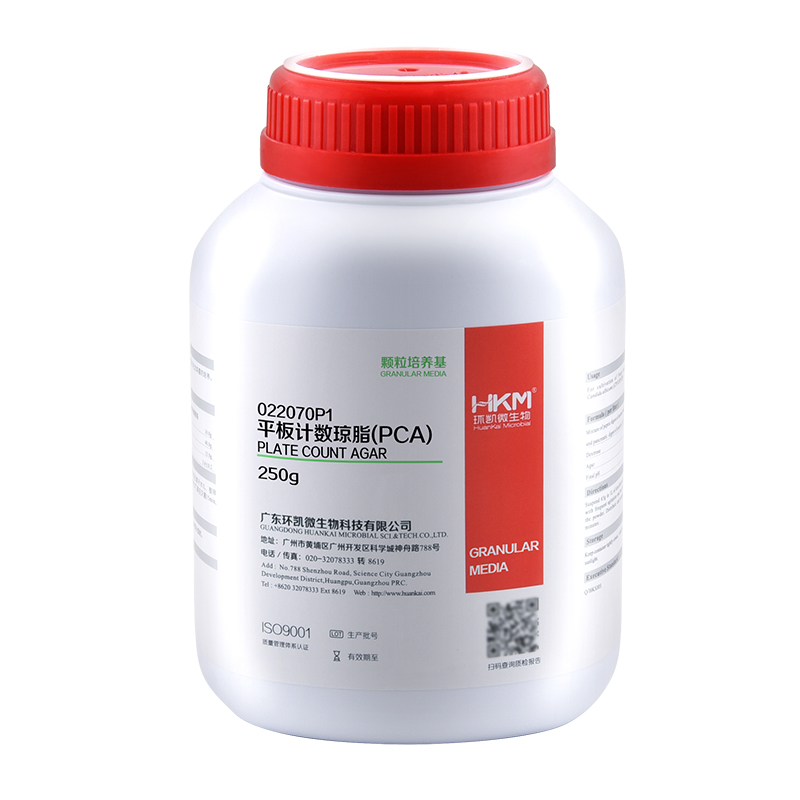
Usages: For determination of total bacterial count.
Principle: Tryptone provide carbon and nitrogen; yeast extract powder provides B vitamins; glucose to provide energy, agar is the solidifying agent.
Formulation(per liter): Tryptone 5.0g Yeast extract powder 2.5g Glucose 1.0g Agar 15.0g Final pH 7.0 ± 0.2
How to use: 1.Suspend 23.5g in 1 L of distilled water , stirring heated to boiling until completely dissolved, dispensing flask, 121 ℃ autoclave for 15min. 2.Diluted and treated samples.
Quality control:
Item
The name and number of strain
Growth
Colony
1
E.Coli ATCC8739
Good
white
2
Staphylococcus aureus ATCC6538
Good
yellow
Storage: Keep container tightly closed, store in a cool, dry place, away from bright light. Storage period of 3 years.
Mycoplasma is a common and serious contaminant of cell cultures. Mycoplasma is often not visible and does not respond to antibiotics, and therefore it is a major issue that requires monitoring and early detection. Up to 30% of cell cultures may be contaminated with Mycoplasmas, the main contaminants being the species M. orale, M. laidlawii, M. arginini and M. hyorhinis. These organisms produce a variety of effects on the infected cells in culture, including changes in metabolism growth, viability and morphology, thereby altering the phenotypic characteristics of the host cells. Therefore there is an absolute requirement for routine, periodic assays to diagnose possible Mycoplasma contamination of all cell cultures, particularly continuous or established cell lines.
Mycoplasma TaqMan PCR Kit, 100 reactions
Ready to use format, including Master Mix for the target and PCR control to monitor for PCR inhibition and validate the quality
Specific Primer and Probe mix for the pathogen/virus/viroid of interest
Primer and Probe mix
Positive and negative control to confirm the integrity of the kit reagents
Mycoplasma TaqMan PCR Probe/Primer Set and Controls, 100 reactions
Specific Primer/Probe mix and Positive Control for the pathogen/virus/viroid of interest
Nuclease-free water
Can be used together with Norgen’s PCR Master Mix (#28007) or customer supplied master mix
For research use only and NOT intended for in vitro diagnostics.
Storage Conditions and Product Stability All kit components can be stored for 2 years after the date of production without showing any reduction in performance.
All kit components should be stored at -20°C upon arrival. Repeated thawing and freezing (> 2 x) of the Master Mix and Positive Control should be avoided, as this may affect the performance of the assay. If the reagents are to be used only intermittently, they should be frozen in aliquots.