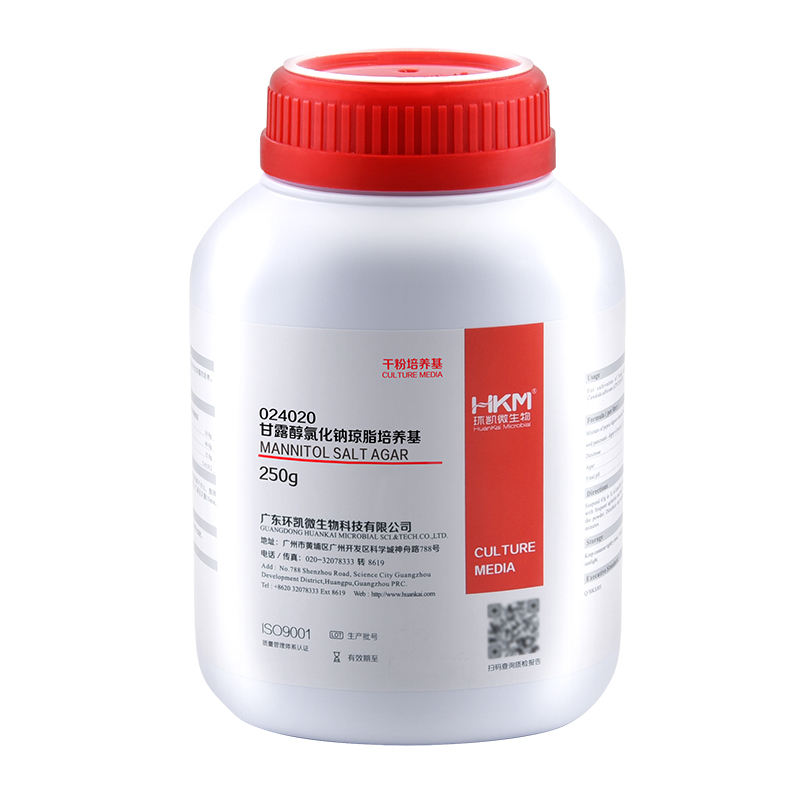
For selective isolation and culture of Staphylococcus aureus.
Principle:
Peptone and beef extract powder provides carbon, nitrogen, vitamins and minerals; D- mannitol to fermentable sugars; higher levels of sodium chloride to provide a higher osmotic pressure, suppress most non-staphylococcal microorganisms ; phenolsulfonphthalein as pH indicator; agar is medium coagulant. Typical pathogenic staphylococci (coagulase positive) D- mannitol produce acid fermentation and produce yellow colonies with a yellow halo, typically non-pathogenic Staphylococcus unfermented D- mannitol to form red colonies.
Formulation(per liter): Pancreatic digest of casein 5.0g Pancreatic digest of animal tissue 5.0g Beef Extract 1.0g Sodium Chloride 75.0g Mannitol 10.0g Phenol Red 0.025g Agar 15.0g Final PH 7.4±0.2
How to use: 1.Suspend 111g in 1L of distilled water , stirring heated to boiling to completely dissolve ,autoclave at 121℃ for 15 minutes. 2.Diluted and treated samples.
Quality control:
Item
The name and number of strain
Growth
Colony Color
1
Staphylococcus aureus CMCC (B) 26003
Good
Golden yellow
2
Staphylococcus epidermidis CMCC (B) 26069
Good
Red
3
Escherichia coli CMCC (B) 44102
Inhibition
—
Storage: Keep container tightly closed, store in a cool, dry place, away from bright light. Storage period of 3 years.
Specifications: 250g/bottle
Other Products
NGS Cell Free DNA Library Prep Kit (illumina and MGI Platforms)
Product Info
Document
Product Info
The NGS Cell Free DNA Library Prep Kit (illumina and MGI Platforms) was developed for the construction of high quality cell-free DNA (cfDNA) libraries using 1 ng to 50 ng of cell-free DNA as input. The kit has a simple work flow and a fast procedure. Multiplexing of the cell free DNA library is possible based on the index type.
NGS Cell Free DNA Library Prep Kit Workflow
The main source of cell-free DNA (cfDNA) is derived from apoptotic hematopoietic cells in blood and found in the plasma. The length of the cfDNA is about 150-200 bp in length. Circulating tumor DNA (ctDNA) derived from malignant tumors is a part of cfDNA. Both cfDNA and ctDNA can be used as a noninvasive biomarker since it offers a better approach in comparison to invasive tissue biopsies.
NGS has been used for cfDNA and ctDNA sequencing in the field of liquid biopsy as it provides a whole genome level of molecular profiling. One of the hurdles for cfDNA sequencing is the difficulty of library preparation from the limited amount of cfDNA obtained from plasma. Our cell-free NGS kit makes it easy to get enough libraries from limited input in just 1.5 hours.
Three index types are available for the NGS Cell Free DNA Library Prep Kit of the illumina platform:
Non-index (Cat.# 30029): Libraries do not have index.
Index(Cat.# 30031): Each of our index primers contains a unique 6-base index sequence that can be used for sample identification. Total 48 library multiplexing is possible. Index information can be downloaded here.
Unique dual index (Cat.# 30033): Cell-free DNA library multiplexing up to 96 samples is possible with the unique dual indexes. We have developed a Four-Base Difference Index System. The system have at least 4 bases different from each other in the 8 bases index length. The primers effectively minimize sequencing errors such as mis-assignment, index hopping, index contamination etc. Index information can be downloaded here.
Indexes are available for the MGI platform kits (Cat.# 34031).
Kit advantages:
Fast and simple protocol
Hands-on time is around 10 minutes
The total protocol time is only 1.5 hours
Easy procedure based on:
Ready-to-use master mix for easy setup of reactions
Less reaction components to simplify bench work
Less magnetic beads used for cleanup procedures: This can reduce more than 50% of the beads consumption
Guaranteed high library conversion efficiency
Low input cell-free DNA: From 1 ng to 50 ng
Comparison of library conversion efficiency with different samples under the same condition.
Comparison of library yield with different samples under the same condition.
Document
The NGS Cell Free DNA Library Prep Kit (illumina and MGI Platforms) was developed for the construction of high quality cell-free DNA (cfDNA) libraries using 1 ng to 50 ng of cell-free DNA as input. The kit has a simple work flow and a fast procedure. Multiplexing of the cell free DNA library is possible based on the index type.
1.System optimization and adaptation:MIRA reagents have undergone a series of screenings of the entire system, types and concentrations of cofactors, and multiple optimizations of the production freeze-drying process. Based on the mastery of the components and processes, we can make adjustments according to customer needs to suit them methodology or project. 2.Diversified product forms:For example, we can provide reagents in different systems and forms (dry powder/microsphere/liquid), etc., to achieve personalized customized services according to customer needs. 3.Industrial application support: It has a 4,000-square-meter factory building to support customer projects in entrusting freeze-drying production and industrial application of the project.
Document
MIRA VS RPA,MIRA Advantages:
1.System optimization and adaptation:MIRA reagents have undergone a series of screenings of the entire system, types and concentrations of cofactors, and multiple optimizations of the production freeze-drying process. Based on the mastery of the components and processes, we can make adjustments according to customer needs to suit them methodology or project. 2.Diversified product forms:For example, we can provide reagents in different systems and forms (dry powder/microsphere/liquid), etc., to achieve personalized customized services according to customer needs. 3.Industrial application support: It has a 4,000-square-meter factory building to support customer projects in entrusting freeze-drying production and industrial application of the project.