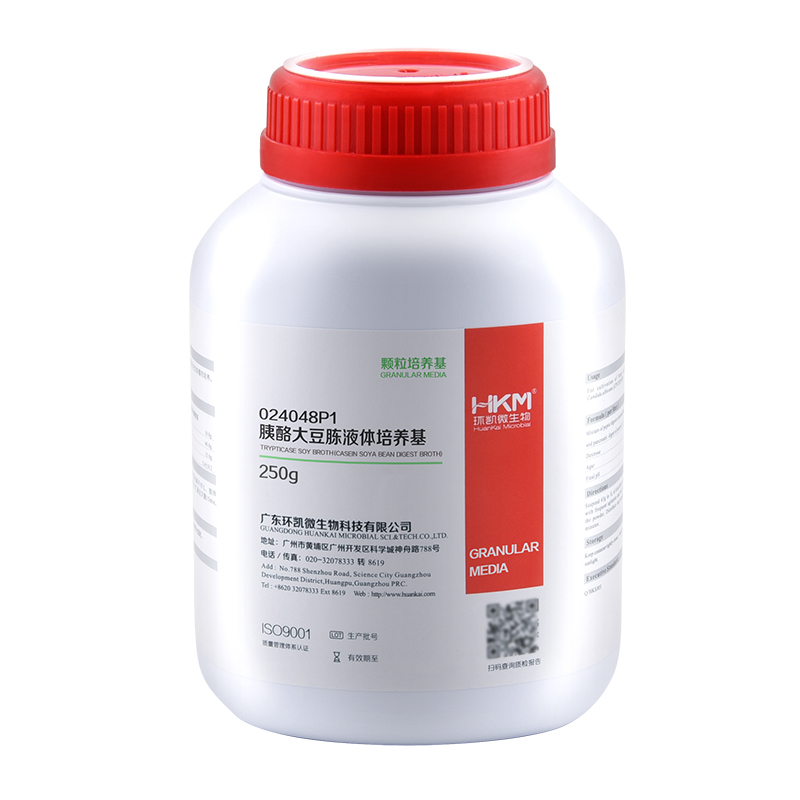
Usages: For cultivating of bacteria.And sterility test of drugs and biological products.
Principle: Tryptone, peptone and yeast extract multivalent powder provides a nitrogen source, vitamins, and growth factors; sodium chloride to maintain osmotic balance; glucose carbon source; dipotassium hydrogen phosphate as a buffering agent.
Formulation(per liter): Pancreatic Digest of Casein 17g Papaic Digest of Soybean 3g Sodium chloride 5g Dipotassium hydrogen phosphate 2.5g Glucose Monohydrate 2.5g Final pH 7.3±0.2
How to use: 1.Suspend 30g in 1L of distilled water , stirring heated to boiling to completely dissolve ,autoclave at 121℃ for 15 minutes. 2.Diluted and treated samples.
Storage: Keep container tightly closed, store in a cool, dry place, away from bright light. Storage period of 3 years.
Specifications: 250g/bottle
Other Products
Livestock Porcine Detection Kit With African Swine Fever Virus Test Kit For Nucleic Acid Detection
Livestock Disease Kit with African swine fever virus Test Kit for Nucleic Acid Detection
Product parameters:
Kit composition(WLRE8208KIT 48T/Pack)
Composition
Content
E buffer
1 mL×2 Tubes
B buffer
150 μL×1Tube
Positive control template
100 μL×1Tube
Reagents
48T
Product features and advantages:
Product features and advantages
Features
Advantages
High sensitivity
1 copies/ml
Strong specificity
Specificity is superior to PCR
Short reaction time
20min
Polymorphic reagent
Liquid, freeze-dried powder, freeze-dried ball
Easy to operate
Few steps of liquid dispensing; It is even possible to add only samples and amplify to get the resultsDesign of primers and probe is simple
Easy to store and transport
It is best preserved at -20℃, and can be stored at room temperature for up to 30 days in a cool place away from light.The freeze-dried form has a long storage time and is convenient for transportation
Low requirements on equipment
Applicable to Applied Biosystems 7500, QuantStudio 3/5, QuantStudio 6/7 Flex fluorescence quantitative PCR instrument;Applicable to our WL-16-III and other isothermal fluorescence detector
Product application:
Application
Ultra-clean laboratory
African Swine Fever Virus Isothermal Detection
Indoor
Operation procedure and process:
Take out the liquid components of the kit in advance, thaw at room temperature, and shake to mix.
Prepare freeze-dried reagents according to the number of samples to be tested, negative and positive controls, and add 37.5 μL E buffer to each freeze-dried reagent.
Select the appropriate nucleic acid extraction method and reagent to extract the sample nucleic acid
Add 10 μL nucleic acid template to the reaction tube (the amount of template can be adjusted to be filled with sterile water; That is, 10 μL nucleic acid template plus sterile water), 10 μL positive control template was added to positive control, and 10 μL sterile water was added to negative control
Add 2.5μL B buffer to each reaction tube and close the tube cap (for multiple reactions, it is recommended to add B buffer to the inside of the tube cap)
Thoroughly mix the reaction tube upside and down for 8-10 times. After mixing, shake (or rapidly centrifuge) the reaction liquid to the bottom of the tube and transfer it to the amplification zone.
Performence Comparison Data:
No.
TT value
Template concentration
Result determination
1
4.2
10-1
Positive
2
5.5
10-2
Positive
3
10.2
10-3
Positive
4
17.0
10-4
Positive
5
12.0
10-5
Positive
6
–
10-6
Negative
7
–
10-7
Negative
8
Negative control
Negative
Support and Services:
Livestock Disease Kit Technical Support and Services
We provide technical support and services for our Livestock Disease Kit. We are committed to helping you get the most out of your product and ensuring your satisfaction with our products and services.
Our technical support staff is available to answer any questions you may have about the product.
We offer online tutorials and user guides to help you understand the product better.
We provide technical assistance to help troubleshoot any issues you may be having with the product.
We offer a warranty on our products.
If you have any questions or need technical support, please do not hesitate to contact us. We are here to help you make the most of your Livestock Disease Kit.
FAQ:
Q: What diseases can Livestock Disease Kit detect? A: Livestock Disease Kit can detect different infectious diseases, such as Foot and Mouth Disease, Bluetongue Disease, Bovine Viral Diarrhea.
Q: How does Livestock Disease Kit work? A: Livestock Disease Kit uses advanced MIRA technology to amplify the target DNA/RNA targent sequences , and detect the disease by analyzing the amplified sequences.
Q: How long does it take to get results from Livestock Disease Kit? A: Livestock Disease Kit can give a result within 5-20 mins.
Q: What type of sample is suitable for Livestock Disease Kit? A: Livestock Disease Kit is suitable for blood, serum, and tissue samples.
Q: Does Livestock Disease Kit require professional equipment? A: No, Livestock Disease Kit does not require any professional equipment,can use with our isothermal equipment or pcr machine
Document
Livestock Disease Kit with African swine fever virus Test Kit for Nucleic Acid Detection
DBCO-PEG13-DBCO is a long chain click chemistry reagent DBCO will react with azide-bearing compounds or biomolecules without copper catalyst. The hydrophilic PEG spacer arm can increase water solubility and membrane permability. Reagent grade, for research purpose. Please contact us for GMP-grade inquiries.
Document
DBCO-PEG13-DBCO is a long chain click chemistry reagent DBCO will react with azide-bearing compounds or biomolecules without copper catalyst. The hydrophilic PEG spacer arm can increase water solubility and membrane permability. Reagent grade, for research purpose. Please contact us for GMP-grade inquiries.
Isolate all sizes of circulating and exosomal RNA, including microRNA
Versatile plasma/serum input ranges
No phenol extractions
No carrier RNA
Bind and elute all RNA irrespective of size or GC content, without bias
Concentrate circulating RNA and exosomal RNA into a flexible elution volume
High quality, purified RNA is suitable for a variety of downstream applications, including Small RNA Sequencing. Find out more information on Norgen’s NGS services
Compatible with Streck Cell-Free RNA BCT® Tubes
Purification is based on spin column chromatography that uses Norgen’s proprietary resin separation matrix
These kits provide a fast, reliable and convenient method to purify and concentrate high quality, high purity and inhibitor-free cell-free circulating and exosomal RNA using a convenient spin column method. These kits can purify RNA from fresh or frozen serum or plasma samples prepared from blood collected on either EDTA or Citrate. Plasma samples prepared from blood collected on heparin should not be used, as heparin can significantly interfere with many downstream applications such as RT-PCR. The purified plasma/serum RNA is fully compatible with all downstream applications including PCR, qPCR, methylation-sensitive reverse transcription qPCR, reverse transcription PCR, Northern blotting, RNase protection and primer extension, expression array assays, and NGS.
Background
Plasma/Serum cell-free circulating RNA or exosomal RNA has the potential to provide biomarkers for certain cancers and disease states. Exosomes are 40 – 150 nm membrane vesicles, which are secreted by most cell types. Exosomes can be found in saliva, blood, urine, amniotic fluid and malignant ascitic fluids, among other biological fluids. Evidence has been accumulating recently that these vesicles act as cellular messengers, conveying information to distant cells and tissues within the body. These exosomes may play a functional role in mediating adaptive immune responses to infectious agents and tumours, tissue repair, neural communication and transfer of pathogenic proteins. For this reason exosomal RNAs may serve as biomarkers for various diseases including cancer. As the RNA molecules encapsulated within exosomes are protected from degradation by RNAses they can be efficiently recovered from biological fluids, such as plasma or serum.
Plasma/Serum RNA Purification Mini Kit
This kit can purify RNA from fresh or frozen serum or plasma samples prepared from blood collected on either EDTA or Citrate, from volumes ranging from 50 µL to 200 µL. The purified plasma/serum RNA is eluted in a flexible final volume of 10 µL to 25 µL.
Plasma/Serum RNA Purification Midi Kit
This utilizes a two column method, and can purify RNA from fresh or frozen serum or plasma samples prepared from blood collected on either EDTA or Citrate, from volumes ranging from 250 µL to 1.5 mL. The first column will handle the large volume input of bodily fluids that is followed by a concentration on a mini column for a final elution of 50 µL to 100 µL.
Plasma/Serum RNA Purification Maxi Kit
This kit can purify RNA from fresh or frozen serum or plasma samples prepared from blood collected on either EDTA or Citrate, from volumes ranging from 2 mL to 5 mL. The first column will handle the large volume input of bodily fluids that is followed by a concentration on a mini column for a final elution of 50 µL to 100 µL.
*This kit is suitable for the isolation of RNA from fresh or frozen serum or plasma prepared from blood collected on either EDTA or Citrate. Plasma samples prepared from blood collected on heparin should not be used as heparin can significantly interfere with many downstream applications such as RT-PCR.
**Please check page 7 for Average Plasma/Serum Yields and Common RNA Quantification Methods.
Storage Conditions and Product Stability
All solutions should be kept tightly sealed and stored at room temperature. This kit is stable for 2 years after the date of shipment. It is recommended to warm Lysis Buffer A for 20 minutes at 60°C if any salt precipitation is observed.