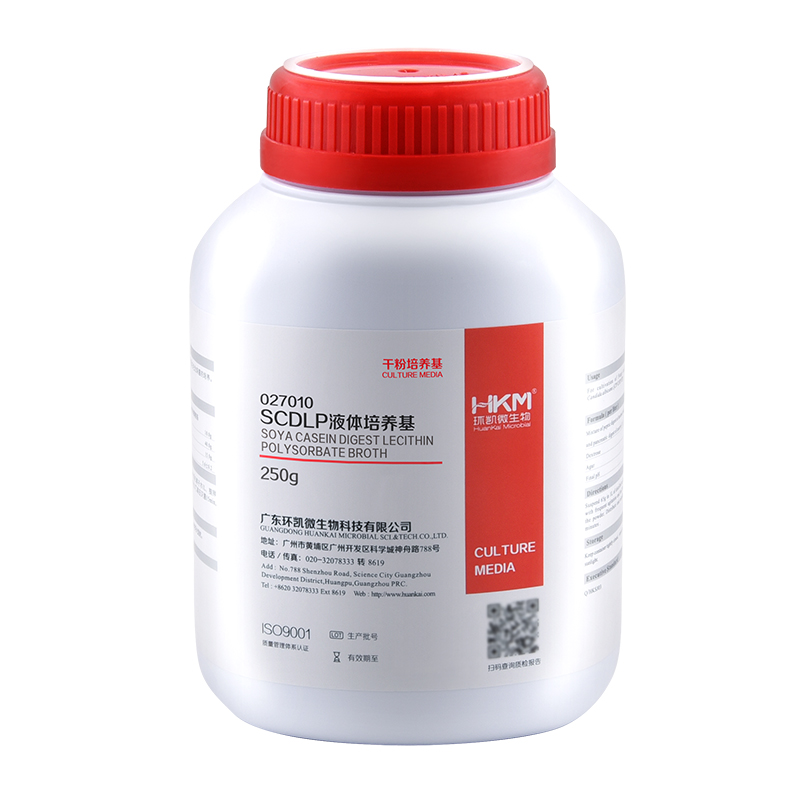
For enrichment of bacteria of cosmetics and disposable hygiene products.
Principle:
Casein peptone and soybean peptone provide the nitrogen source, vitamins, and growth factors; sodium chloride to maintain osmotic balance; dipotassium hydrogenphosphate as a buffer; lecithin and Tween 80 can neutralize preservatives and can play a dispersed material in the emulsion features, lecithin can neutralize quaternary ammonium salt, Tween 80 neutralizes phenols, hexachlorophene, formalin, a combination that can neutralize and ethanol.
Formulation(per liter):
Casein peptone 17g
Soy peptone 3g
Sodium chloride 5g
Dipotassium hydrogen phosphate 2.5g
Glucose 2.5g
Lecithin 1g
Tween 80 7g
Final pH7.2 ± 0.2
How to use:
1.Suspend 38g in 1 L of distilled water , stirring heated to boiling until completely dissolved, distribute into flask,autoclave at 121 for 15 minutes.
2.Diluted and treated samples.
Storage: Keep container tightly closed, store in a cool, dry place, away from bright light. Storage period of 3 years.
Other Products
C13123 HiPure DNA Maxi Column III
Product Info
Document
Product Info
Introduction
Magen’s HiPure columns are prepared by high quality glass fiber filter membrane as raw materials through membrane cutting, membrane release, ring release, ring pressing, gland, weighing and other processes. HiPure nucleic acid adsorption columns have the characteristics of long-term stability and high binding capacity. Experiments show that the highest binding capacity and binding efficiency of HiPure nucleic acid adsorption columns are basically unchanged when stored at room temperature for 4 years.
The series of nucleic acid columns produced by Magen Biotech are based on carefully selected imported glass fiber membranes (GF/B, GF/D, GF/F). Columns production processes such as polypropylene injection molding materials, injection molding process, and downstream membrane packing and compression rings are strictly controlled. This is to ensure that the column has extremely high adsorption capacity and long-term stability. Compared with conventional products on the market, Magen’s columns are with varieties, and binding rate will not change when stored at room temperature for 4 years.
Details
Specifications
Features
Specifications
Recommended application
Plasmid Maxi preparation
Preservation conditions
Room temperature
Stability
Up to 4 years
Filter membrane
High quality glass fiber filter GF/B, 8 layers
Membrane aperture
1.0 μm
Maximum binding yield of plasmid
1 mg
Maximum yield of alcohol mediated binding
5 mg
Plasmid yield
Up to 1mg
Single liquid carrying capacity of column
20 ml
Minimum elution volume
800 μl
Withstand centrifugal force
3,000-5,000 x g
Centrifuge
Low speed centrifuge for 50ml centrifuge tubes, >3000 x g, swing-out Rotor
Adsorption Mechanism
Based on the negatively charged DNA skeleton, it has a high affinity for positively charged glass fibers. In high salt and ethanol solutions, DNA/RNA binds to glass fiber and interacts with hydrophilic matrix on silica through hydrogen bond. DNA/RNA is tightly bound. All pollutants can be removed by washing solution. At high salt concentration, nucleic acids selectively bind to silicagel membrane, while other pollutants, mainly proteins, are removed by membrane washing.
Ordering information
CAT.No.
Product Name
Package
C13123
HiPure DNA Maxi Column III (8 x GF/B)with 50ml Collection Tubes
100/Bag
Purchase Guide
Item No.
Product Name
Membrane type/number of layers
Collection tubes
Plasmid DNA binding capacity (Physical adsorption)
Note: GF/B pore size is for 1.0μM glass fiber membrane; GF/F pore size is for 0.7μm glass fiber membrane.
Document
Magen’s HiPure columns are prepared by high quality glass fiber filter membrane as raw materials through membrane cutting, membrane release, ring release, ring pressing, gland, weighing and other processes. HiPure nucleic acid adsorption columns have the characteristics of long-term stability and high binding capacity. Experiments show that the highest binding capacity and binding efficiency of HiPure nucleic acid adsorption columns are basically unchanged when stored at room temperature for 4 years.
High Sensitivity Isothermal NFO RNA Amplification Kit For Easy To Use Detection
Product Info
Document
Product Info
Product Description
Product Detail
Kit Storage and Term of Validity
Storage term: stored at ≤-20℃,keep away from light, avoid heavy weight and repeated freezing and thawing.
Term of Validity: 14 months
Isothermal Nucleic Acid Principle Summary
This kit is based on a rapid nucleic acid amplification technology at room temperature and constant temperature: at room temperature and constant temperature (generally 39 ºC~42 ºC), reverse transcriptase uses specific primers and template RNA to synthesize cDNA strands, and binds the auxiliary protein and single strand With the help of the protein, the recombinase and the primer form a complex; perform a homology search and bind the target homology domain, at this time a D-loop region is formed at the homology position and strand exchange begins; accompanied by the recombinase from the complex Upon dissociation, the polymerase also binds to the 3′ end of the primer, initiating chain extension. Relying on the action of nfo enzyme, adding specific molecular probes designed according to the template, and using colloidal gold technology (sandwich method) can detect the final result.
Isothermal Nucleic Acid Product Features
1/ High sensitivity and specificity, short reaction time.
2/ The reagent form is freeze-dried, stable and easy to operate.
3/ The reaction can be operated by metal bath and water bath pot without purchasing expensive PCR apparatus.
Technical Parameters:
Parameters
Details
Product Name
RNA Isothermal Amplification Kit NFO
Manufacturer
Amp-future
Storage Temperature
-20°C
Kit Components
Enzymes, Buffers ,Reagents
Packaging
48 Tests/box
Detection Limit
500-1000copies/µL
Shipping
ICE
Test Time
5-20mins
Isothermal Nucleic Acid Applications
Suitable for RNA isothermal rapid amplification kit(NFO type)
Primer: Require pair of nucleotide primers with the length of 25-35 bp.
RNA NFO kit reaction temperature is 39 to 42℃ and time is 5-20 minutes.
Notes
1/ Please avoid nucleic acid contamination and set blank control during reaction due to the high sensitivity of the kit.
2/ Please take out the required quantity of MIRA reaction units for the experiment, and put the rest under storage conditions when performing the experiment.
Usages: For determination of coliform confirmatory test for multi-tube fermentation.
Principle: Peptone provide carbon and nitrogen sources; lactose as fermentable sugars; ox bile powder and brilliant green inhibit the non-Enterobacteriaceae.
Formulation (per liter): Peptone: 10g Lactose: 10g Ox bile powder: 20g Brilliant green: 0.0133g Final pH7.2 ± 0.2
How to use: 1.Suspend 40g of the product, add 1 L of distilled water, stirring heated to boiling until completely dissolved, packed in a test tube with a small inverted tube, autoclave at 121 ℃ for 15min, cool to room temperature and set aside. 2.Sample handling and dilution. Slightly. 3.Transplanted LST broth tube to brilliant green lactose bile broth tube by using a inoculating loop. 4.the tube was placed in an incubator culture at 36 ± 1 ℃ for 24h. 5.Observe the results. Press production trachea number, check table report MPN MPN value per gram (mL) sample of coliform bacteria.
Quality control: Quality control strains were inoculated and culuture at 36 ± 1 ℃ for 24h ,results are as follows: Bacterial Name Bacterial No. Growth Status Gassing Escherichia coli ATCC25922 good +
Salmonella typhimurium CMCC (B) 50115 good —
Staphylococcus aureus ATCC6538 inhibited —
Storage: Store in a dark, cool and dry place, tighten the cap immediately after use. Storage period of three years.