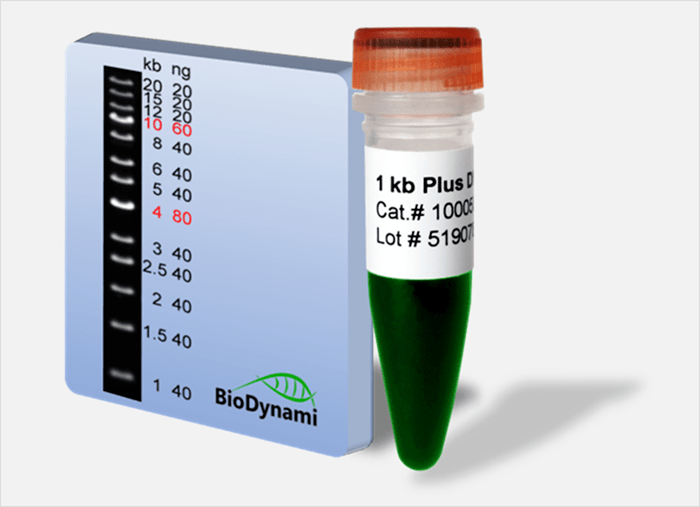
• For sizing and quantification of double strand DNA fragments. • Composed of 13 bands as shown on right. • The 10 kb and 4 kb bands with higher concentration are easily distinguishable from the others. • Premixed with 6X DNA loading buffer for direct gel loading.
Detail
1 kb Plus DNA Ladder in 1% agarose gel.
• For sizing and quantification of double strand DNA fragments. • Composed of 13 bands as shown on right. • The 10 kb and 4 kb bands with higher concentration are easily distinguishable from the others. • Premixed with 6X DNA loading buffer for direct gel loading.
Other Products
Propargyl-PEG10-t-butyl ester
Product Info
Document
Product Info
Propargyl-PEG10-t-butyl ester is a crosslinking reagent that can react with azide-bearing compounds or biomolecules via copper catalyzed Click Chemistry reactions. The carboxyl group can be deprotected under acidic conditions. Reagent grade, for research purpose. Please contact us for GMP-grade inquiries.
Document
Propargyl-PEG10-t-butyl ester is a crosslinking reagent that can react with azide-bearing compounds or biomolecules via copper catalyzed Click Chemistry reactions. The carboxyl group can be deprotected under acidic conditions. Reagent grade, for research purpose. Please contact us for GMP-grade inquiries.
We will help to establish your experiments using our broad knowledge:
With myPOLS Biotec’s access to large libraries of different mutant polymerases and experience in high throughput screening we can find the best enzyme for your needs.
We also optimize your polymerases for your defined requirements or enhance our DNA polymerase-based products accordingly.
Finally, we can develop freeze-dried enzyme formulations and production.
We at myPOLS Biotec are scientists and have vast experience in polymerase-based product development. You can benefit from this. Get in touch.
Document
We will help to establish your experiments using our broad knowledge:
With myPOLS Biotec’s access to large libraries of different mutant polymerases and experience in high throughput screening we can find the best enzyme for your needs. We also optimize your polymerases for your defined requirements or enhance our DNA polymerase-based products accordingly. Finally, we can develop freeze-dried enzyme formulations and production.
Interested in the analysis of DNA or RNA modifications? Then this DNA polymerase could help to analyze such modifications. The m6A sensitive DNA polymerase exhibits increased misincorporation rates opposite m6A, while unmodified adenine is not affected. This prevents the loss of methylation information during reverse transcription and thus allows direct m6A sequencing. For further information refer to the original publication.
Available upon request and for R&D use only – Contact Us
The m6A sensitive DNA polymerase is supplied as a 5 µM solution containing glycerol and is supplied together with 10x reaction buffer.
The enzyme can also be used for real-time cycling, when adding a suitable dye.
Document
Interested in the analysis of DNA or RNA modifications? Then this DNA polymerase could help to analyze such modifications. The m6A sensitive DNA polymerase exhibits increased misincorporation rates opposite m6A, while unmodified adenine is not affected. This prevents the loss of methylation information during reverse transcription and thus allows direct m6A sequencing. For further information refer to the original publication.