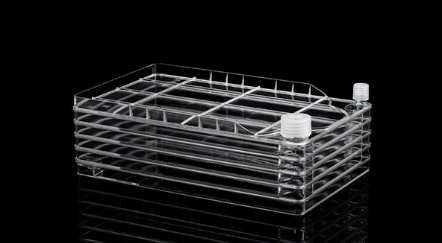
5 Layer Cell Factory One Wide Mouth And One Narrow Mouth
Facebook
X
Pinterest
Email
Huayi Cell Factory is a robust and easy-to-use cell culture platform for applications in the production of human and animal vaccines, therapeutic proteins, cell therapy, and gene therapy.
To address the needs of your workflow, We have three kinds of mouth, which is available on most cell culture products to ensure consistent performance from lot to lot and from format to format.
5 Layer Cell Factory One Wide Mouth And One Narrow Mouth
Huayi Cell Factory is a robust and easy-to-use cell culture platform for applications in the production of human and animal vaccines, therapeutic proteins, cell therapy, and gene therapy.
To address the needs of your workflow, We have three kinds of mouth, which is available on most cell culture products to ensure consistent performance from lot to lot and from format to format.
The product assembled with ultrasonic welded technology
Versatile port design facilitates both pouring and aseptic filling techniques
Gamma radiation sterilization
the cell culture surface area
of one 10-layer Cell Factory unit is equivalent to the area
of 36 T-175 flasks
Other Products
D3113 HiPure Tissue&Blood DNA Midi Kit
Product Info
Document
Product Info
Introduction
This product provides fast and easy methods for purification of total DNA for reliable PCR and Southern Blotting. Total DNA (e.g., genomic, viral, mitochondrial) can be purified from tissue and culture cells.
Details
Specifications
Features
Specifications
Main Functions
Isolation total DNA from 2ml blood and 200mg tissue using Midi column
Applications
PCR, southern bolt and virus detection, etc
Purification method
Midi spin column
Purification technology
Silica technology
Process method
Manual (centrifugation or vacuum)
Sample type
Tissue, cell, blood, saliva, swab, blood spot, semen and other clinical samples
Sample amount
0.2-2 ml
Elution volume
≥300μl
Time per run
≤80 minutes
Liquid carrying volume per column
4ml
Binding yield of column
1mg
Principles
This product is based on silica column purification. The sample is lysed and digested with lysate and protease, DNA is released into the lysate. Transfer to an adsorption column. Nucleic acid is adsorbed on the membrane, while protein is not adsorbed and is removed with filtration. After washing proteins and other impurities, Nucleic acid was finally eluted with low-salt buffer (10mm Tris, pH9.0, 0.5mm EDTA).
Advantages
High quality DNA – meet a variety of downstream applications, including PCR, qPCR, enzyme digestion, hybridization, etc.
Fast – without separation of leukocytes, organic extraction or ethanol precipitation
Simple – all nucleic acids can be obtained by direct digestion
Wide applicability – handle a variety of liquid samples
Kit Contents
Contents
D311302
D311303
Purification Times
20
100
HiPure gDNA Midi Columns
20
100
15ml Collection Tubes
40
200
Buffer ATL
50 ml
250 ml
Buffer AL
50 ml
250 ml
Buffer GW1*
22 ml
110 ml
Buffer GW2*
12 ml
50 ml
RNase A
20 mg
90 mg
Proteinase K
100 mg
440 mg
Protease Dissolve Buffer
10 ml
30 ml
Buffer AE
20 ml
120 ml
Storage and Stability
Proteinase K, RNase A should be stored at 2-8°C upon arrival. However, short-term storage (up to 12 weeks) at room temperature (15-25°C) does not affect their performance. The remaining kit components can be stored at room temperature (15-25°C) and are stable for at least 18 months under these conditions.
*Note:Leukocyte protocol can be used when large volume whole blood samples need to be processed. Whole blood was treated with red blood cell lysate, and white blood cells were obtained by centrifugation before extraction
Select the right purification kit to get impactful results:
This product provides fast and easy methods for purification of total DNA for reliable PCR and Southern Blotting. Total DNA (e.g., genomic, viral, mitochondrial) can be purified from tissue and culture cells.
The Plant RNA Kit (NA2014-01) is optimized for purification of total RNA from a wide variety of plant samples which rich in polysaccharides and phenol. It comes with proprietary magnetic beads and a specially optimized buffer. Toxic solvents such as phenol, chloroform are not needed in the process. The eluted RNA is high-quality and is ready for all downstream applications, such as RT-PCR, Northern blotting, differential display. The procedures can be fully automated on the magnetic particle processor instrument and ease of use.
DBCO-C6-NHS ester is an amine-reactive compound, which can be used to modify an amine-containing molecule in organic media. This reagent isn’t soluble in aqueous media. The extended 6-carbon atom spacer arm improves solubility in commonly used organic solvents including dichloromethane, chloroform, THF, and ethyl acetate and it also improves derivatization efficiency and stability of conjugates. DBCO is commonly used for copper-free Click Chemistry reactions. Reagent grade, for research purpose. Please contact us for GMP-grade inquiries.
Document
DBCO-C6-NHS ester is an amine-reactive compound, which can be used to modify an amine-containing molecule in organic media. This reagent isn’t soluble in aqueous media. The extended 6-carbon atom spacer arm improves solubility in commonly used organic solvents including dichloromethane, chloroform, THF, and ethyl acetate and it also improves derivatization efficiency and stability of conjugates. DBCO is commonly used for copper-free Click Chemistry reactions. Reagent grade, for research purpose. Please contact us for GMP-grade inquiries.