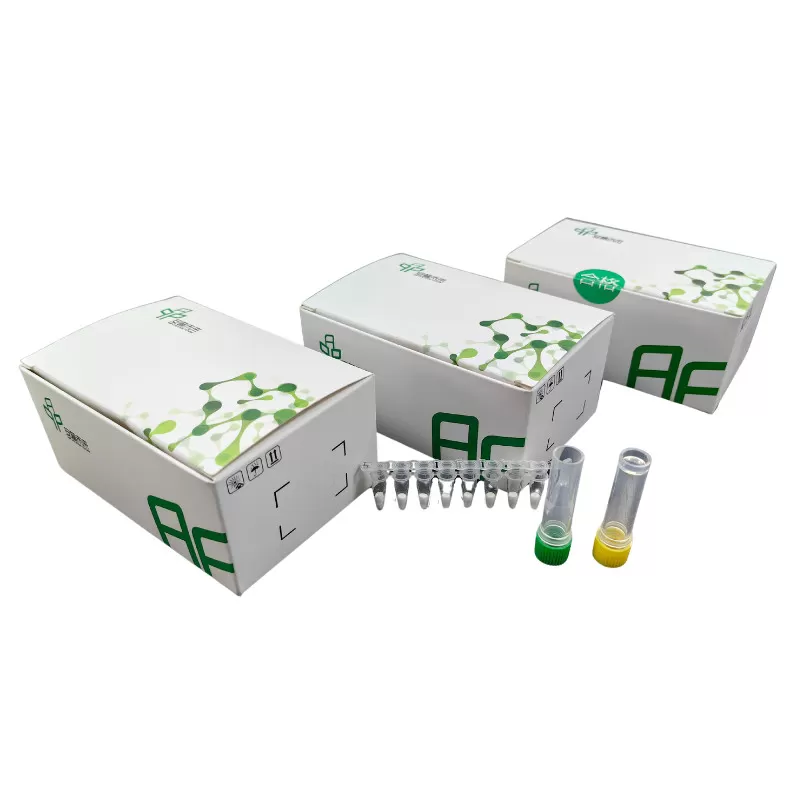
Basic Nucleic Acid DNA Amplification Kit 48 Reactions 20mins
Facebook
X
Pinterest
Email
Detail
Product Description
Unlocking The Potential Of Nucleic Acid Amplification With DNA Amplification Kit (Basic)
Product Detail
Kit Storage and term of Validity
Storage term: stored at ≤-20℃,keep away from light, avoid heavy weight and repeated freezing and thawing.
Term of Validity: 14 months
Isothermal nucleic acid Principle Summary
The kit is based on rapid nucleic acid amplification technology at room temperature and constant temperature, its principle is that at room and constant temperature, the recombinase and primer form a protein/single-stranded nucleotide complex Rec/ssDNA, and invade the double-stranded DNA template with the help of auxiliary proteins and single-stranded binding protein SSB; then form a D-loop region at the invasion point and start to scan the DNA duplex, after finding the target region complementary to the primer and disintegration of the complex Rec/ssDNA, the polymerase also binds to the 3′ end of the primer to start the chain extension.
Isothermal nucleic acid Product Features
1/ High sensitivity and specificity, short reaction time.
2/ The reagent form is freeze-dried, stable and easy to operate.
3/ The reaction can be operated by metal bath and water bath pot without purchasing expensive PCR apparatus.
Technical Parameters:
Parameters
Details
Product Name
DNA Isothermal Amplification Kit Basic
Manufacturer
Amp-future
Storage Temperature
-20°C
Kit Components
Enzymes, Buffers ,Reagents
Packaging
48 Tests/box
Detection Limit
500-1000copies/µL
Shipping
ICE
Test Time
5-20mins
Isothermal nucleic acid Applications
Suitable for DNA isothermal rapid amplification kit(Basic type)
Primer: Require pair of nucleotide primers with the length of 25-35 bp.
DNA basic kit reaction temperature is 39 to 42℃ and time is 5-20 minutes.
Notes
1/ Please avoid nucleic acid contamination and set blank control during reaction due to the high sensitivity of the kit.
2/ Please take out the required quantity of MIRA reaction units for the experiment, and put the rest under storage conditions when performing the experiment.
Other Products
C1412 MagPure Particles G
Product Info
Document
Product Info
Introduction
Magnetic bead nucleic acid purification technology uses nano or micron superparamagnetic material as the matrix, generally black ferric oxide or yellowish brown ferricoxide as the magnetic material. The surface of bead is coated with appropriate functional groups, which can adsorb nucleic acid. Magnetic beads commonly used for nucleic acids, containing carboxyl groups, hydroxyl groups, or silicon groups. Silicon-based magnetic beads are the most common, and its principle of adsorbing nucleic acid is consistent with the classical glass milk purification technology or glass fiber filter membrane purification method. Magpure particle is a kind of polydisperse fast speed silica magnetic beads. The core is ferricoxide, accounting for 50%, and the surface coating is silica, accounting for 50%. The product can be used for plasmid extraction, gel DNA recovery, product purification, genomic DNA and RNA extraction, and viral nucleic acid extraction.
Details
Specifications
Features
Specifications
Concentration
40 mg/ml
Appearance
Suspension of dark brown particles
Surface functional group
Si-OH, Silanol
Dispersibility
Monodisperse,spherical
Particle size
1.0-1.5 μm
Preservation conditions
Room Temperature, valid for up to 2 years.It is recommended to store in 2-8°C to prevent microbial growth.
Magnetic response speed
~30 seconds
Settling velocity
>3 minutes
High salt mediated binding
>2M guanidine isothiocyanate, DNA recovery up to 80%
Alcohol mediated binding
2M guanidine hydrochloride / isopropanol (30%), and the recovery of DNA / RNA was as high as 85%
PEG8000 mediated binding
The recovery of DNA/RNA was up to 85%
DNase/RNase
Not detected
DNA residue
Not detected
Recommended application
Genomic DNA extraction, RNA extraction, viral nucleic acid extraction, circulating DNA isolation
Principle
Highsalt mediated binding: in the solution containing 2-4M guanidine isothiocyanate, Magpure particles can selectively recover DNA molecules, and impurities such as protein polysaccharides are not adsorbed.
Alcohol mediated binding: in the solution containing guanidine salt and alcohol (>25%), Magpure particles can selectively recover DNA/RNA molecules, and proteins and other impurities are not adsorbed.
After biological samples are treated with digestive solution or lysis Buffer, DNA/RNA is released from cells, organelles and protein complexes (ribosomes and nucleosomes) into reagents. After Magpure particles and binding solution are added, DNA/RNA is adsorbed to the surface of Magpure particles to form DNA/RNA bead complex. Under the action of the magnetic field, the magnetic beads are separated and collected, and the impurities such as protein are removed with the waste liquid. After two or three steps of further cleaning, the DNA/RNA magnetic bead complex is resuspended in sterilized water or TE buffer, and the DNA/RNA falls off from the surface of the magnetic beads, so as to achieve the purpose of purification.
gDNA/RNA Isolation from Blood, Tissue, Plant, Swab, Spots, Stool, Soil and etc.Viral DNA/RNA IsolationAgarose Gel DNA Purification
DNA/RNA Isolation from low nucleic acid content samplesPlasmid IsolationDNA/RNA Clean Up
Circulating DNA IsolationViral Nucleic acid IsolationgDNA Isolation FFPE DNA/RNA Isolation
Plasmid extractiongel DNA recoverygenomicDNA/RNA extraction viral nucleic acid extractionCirculating DNA extraction
DNA/RNA Clean Up and concentrationDNA/RNA Isolation from low nucleic acid content samplesResearch immuno assays
The MagPure magnetic-particle technology combines the speed and efficiency of silica-based DNA purification with the convenient handling of magnetic particles. DNA binds to the silica surface of the magnetic particles in the presence of a chaotropic salt. DNA bound to the particles is then efficiently washed, considerably improving the purity of DNA. High-quality DNA is eluted. The automated purification procedure completely removes enzymes, nucleotides, and other contaminants and inhibitors. Purified DNA is suitable for direct use in downstream applications, such as sequencing and microarray analysis.
Document
Magnetic bead nucleic acid purification technology uses nano or micron superparamagnetic material as the matrix, generally black ferric oxide or yellowish brown ferricoxide as the magnetic material. The surface of bead is coated with appropriate functional groups, which can adsorb nucleic acid. Magnetic beads commonly used for nucleic acids, containing carboxyl groups, hydroxyl groups, or silicon groups. Silicon-based magnetic beads are the most common, and its principle of adsorbing nucleic acid is consistent with the classical glass milk purification technology or glass fiber filter membrane purification method. Magpure particle is a kind of polydisperse fast speed silica magnetic beads. The core is ferricoxide, accounting for 50%, and the surface coating is silica, accounting for 50%. The product can be used for plasmid extraction, gel DNA recovery, product purification, genomic DNA and RNA extraction, and viral nucleic acid extraction.
HiDi® stands for High Discrimination of mismatches at the 3’-terminus of primers in PCR. This myPOLS Biotec enzyme family is optimized for this feature and is the first choice for applications that rely on this property such as allele-specific PCR (asPCR) or allele-specific amplification (ASA).Please note: This DNA polymerase is also available as a nuclease deficient variant, featuring higher robustness towards potential PCR inhibitors and compatibility with real-time dyes such as our GreenDye.Benchmarking with products of competitors conducted by us and others show that the HiDi® DNA polymerase family is the first choice for highly selective PCRs, such as genotyping by allele-specific PCR, HLA genotyping, analysis of single CpG methylation sites or the detection of mutations in a high background of wild-type sequences. By using HiDi® Taq DNA polymerase, less than 10 copies of a mutation can be detected in a background of >10.000 wild-type copies straight away without any other tedious assay optimization.HiDi® Taq DNA polymerase harbours a nuclease function and therefor is also suitable for use with hydrolysis probes (TaqMan® probes etc.). It has also been shown that HiDi® DNA polymerase family is highly suitable for quality control and mutation identification in CRISPR-Cas or TALEN-based applications.Several independently conducted studies show that HiDi® Taq DNA polymerase is ideally suited for use in asPCR in numerous research areas ranging from mutation detection to genome editing. (read more) For research use and further manufacturing.In case you are aiming to use our RUO products as components or for your development of e.g. an IVD medical device, please contact us.
Casestudies: HiDi® DNA Polymerase: Applications from mutation detection to genome editing (read more)
Example Primer Design
Matching vs. mismatching nucleotide is placed at the 3′-end of the primer for best discrimination results.
Example Results – There´s no accounting for taste
Cilantro: some people love it in their food, some hate it. Here we are detecting a genomic SNP (rs72921001) in HeLa genomic DNA. This SNP is reported to be close to a number of genes coding for olfactory receptors. (Reference: Eriksson N. et al. (2012), “A genetic variant near olfactory receptor genes influences cilantro preference.”)
Considering, that only the C-allele specific primer is extended and yielding in a specific amplicon, we can conclude a genetic predisposition in disliking cilantro, as this SNP is significantly associated with detecting a soapy taste to cilantro.
Allele-specific PCRs were performed from 1 ng/µl of HeLa gDNA in the presence of a realtime dye, indicating the amplification of the C-allele specific primer only. The A-allele specific primer is discriminated, thus not amplified up to 50 cycles.
PCR products were subsequently analysed on a 2.5% agarose gel. Specific product is visualized by ethidium bromide staining at the amplicon length of 109 bp.
Document
HiDi® stands for High Discrimination of mismatches at the 3’-terminus of primers in PCR. This myPOLS Biotec enzyme family is optimized for this feature and is the first choice for applications that rely on this property such as allele-specific PCR (asPCR) or allele-specific amplification (ASA).
Please note: This DNA polymerase is also available as a nuclease deficient variant, featuring higher robustness towards potential PCR inhibitors and compatibility with real-time dyes such as our GreenDye.
CE-IVD marked version available for in vitro diagnostic use
Available in TaqMan format for analysis
Cryptosporidium is a parasite found in water that causes an infection in mammals termed cryptosporidiosis. It is one of the most common water-borne diseases and is found world-wide. It affects the intestines of mammals and typically causes an acute short-term infection. The most common symptom is self-limiting diarrhea in healthy individuals, however in immunocompromised individuals the symptoms are particularly severe and often fatal. There is no specific treatment for cryptosporidiosis other than fluid rehydration and management of any pain. Therefore early detection of Cryptosporidium in water is the foremost action to prevent the infection.
Cryptosporidium TaqMan RT-PCR Kit, 100 reactions
Ready to use format, including Master Mix for the target and PCR control to monitor for PCR inhibition and validate the quality
Specific Primer and Probe mix for the pathogen/virus/viroid of interest
Primer and Probe mix
Positive and negative control to confirm the integrity of the kit reagents
Cryptosporidium TaqMan RT-PCR Probe/Primer Set and Controls, 100 reactions
Specific Primer/Probe mix and Positive Control for the pathogen/virus/viroid of interest
Nuclease-free water
Can be used together with Norgen’s RT-PCR Master Mix (#28113) or customer supplied master mix
Storage Conditions and Product Stability All kit components can be stored for 1 year after the date of production without showing any reduction in performance.
All kit components should be stored at -20°C upon arrival. Repeated thawing and freezing (> 2 x) of the Master Mix and Positive Control should be avoided, as this may affect the performance of the assay. If the reagents are to be used only intermittently, they should be frozen in aliquots.