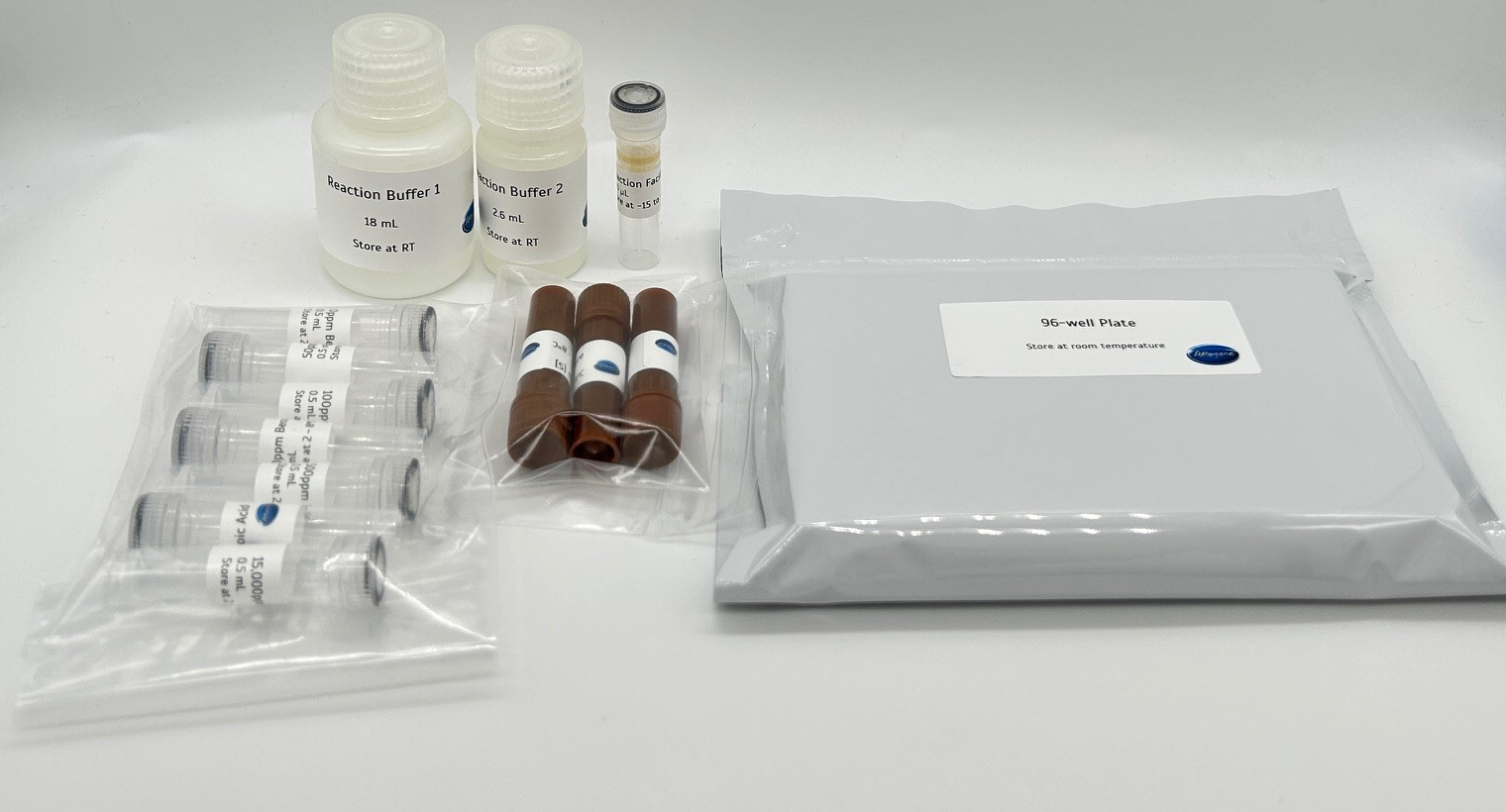
Highly Sensitive Assay to Screen for Benzoic Acid Visual Readout (sample dependent: milk, red/pink) Detection range of 1ppm to 1500ppm Tube or Plate based options available Compatible with the Nix Sensor or plate readers to obtain quantitative results.
The Benzoic Acid Detection Kit provides a rapid, simple, sensitive, and reliable test suitable for screening of Benzoic Acid concentration.
Benzoic Acid is a white solid that is an extensively used preservative. Although this preservative prevents or delays nutritional losses due to microbiological, enzymatic or chemical changes of foods during its shelf life there is a suspicion that small amounts of benzene may be formed from benzoic acid in nonalcoholic beverages in the presence of ascorbic acid. Benzoic acid and ascorbic acid are food additives which must be declared on the food. Benzoic acid or E 210 is a preservative which also occurs naturally, for instance, in cranberries. A maximum amount of 150 mg/l benzoic acid may be added to non-alcoholic flavored beverages.
Other Products
cfDNA Purification Kit (Magnetic Beads)
Product Info
Document
Product Info
cfDNA Purification Kit (Magnetic Beads)
The cfDNA Purification Kit (Magnetic Beads) was developed for cell free DNA (cfDNA) enrichment by separating genomic DNA contamination from isolated cfDNA samples.
Many diagnostic technologies for detection of disease signals in cfDNA begin with isolation and purification of DNA from liquid biopsy that include urine, plasma, cerebrospinal fluid. The most widely explored biotechnology is assays used to detect cancer-derived plasma cfDNA. Silica-based magnetic bead cfDNA isolation kits can reliably extract total DNA from plasma, but typically yield a large variation in cfDNA that includes the presence of genomic DNA that often depends on tumor stage, tumor size, or healthy status individuals. Most of the commercial cfDNA isolation kits can’t specifically recover the cfDNA while leaving the high molecular weight genomic DNA behind. The presence of genomic DNA can lead to decreased sensitivity or inconsistent results in downstream applications such as next-generation sequencing (NGS), PCR, QPCR, and digital PCR etc.
Therefore, an additional purification step to enrich cfDNA before downstream methods helps to improve signal from fragments that originate from cancer cells. A proportion of cancer-derived cfDNA fragment signals are below 100 bp and are often not detectable except by qPCR or single-stranded DNA based library preparation for NGS (1, 2, 3). Furthermore only 1% of cancer-derived fragments are found above 400 bp (1, 2). Capture of size-selected fragments between 90-150 bp improved detection of cancer by 2-4 fold (4). Furthermore, TF-bound and protected cfDNA fragments are also being investigated for active cancer-specific signals down to 35-80 bp (5, 6).
This kit uses Dual Solid Phase Reversible Immobilization (SPRI) technology for cfDNA purification. Most Dual SPRI procedures do NOT recover fragments below 100 bp. The kit can be used for the enrichment of cfDNA isolated from liquid biopsies, plasma, serum, and urine. The kit separates cfDNA (50-500 bp) and genomic DNA, and recovers of 90% of the cfDNA without the high molecular weight genomic DNA with high efficiency. Fragments at 500 bp and above may also be retained. Both the 50-500 bp and >500 bp DNA fractions can be used for downstream applications such as single-stranded or double stranded NGS library prep, qPCR, ddPCR, and other methods.
Features
Separation of cfDNA and genomic DNA; Recovery of both types of DNA
Recovery of cfDNA (50-500 bp)
As short as 50 bp can be recovered
Recovery of high molecular weight genomic DNA
Removal of unwanted components and other impurities
Automation friendly
Examples of cfDNA purification. Both cfDNA and genomic DNA can be recovered separately.
The range of recovered small DNA fragments is from 50 to 500 bp. The input DNA are mixtures of sheared small DNA fragments and intact genomic DNA. The ratios of sheared DNA fragments versus genomic DNA are indicated.
Recovery rates of cfDNA and genomic DNA.
Document
Many diagnostic technologies for detection of disease signals in cfDNA begin with isolation and purification of DNA from liquid biopsy that include urine, plasma, cerebrospinal fluid. The most widely explored biotechnology is assays used to detect cancer-derived plasma cfDNA. Silica-based magnetic bead cfDNA isolation kits can reliably extract total DNA from plasma, but typically yield a large variation in cfDNA that includes the presence of genomic DNA that often depends on tumor stage, tumor size, or healthy status individuals. Most of the commercial cfDNA isolation kits can’t specifically recover the cfDNA while leaving the high molecular weight genomic DNA behind. The presence of genomic DNA can lead to decreased sensitivity or inconsistent results in downstream applications such as next-generation sequencing (NGS), PCR, QPCR, and digital PCR etc.
The Opentrons® 3-piece Aluminum Block Set is used with our Temperature Deck. The set comes with a 24-well, 96-well and flat bottom plate format block. These are used to keep your 2mL tubes, 1.5mL tubes, 96-well PCR plates, PCR strips and flat bottom plates at a constant temperature. These blocks holds temperatures between 4°C and 95°C when used with the Opentrons Temperature Module (GEN2).
Document
The Opentrons® 3-piece Aluminum Block Set is used with our Temperature Deck. The set comes with a 24-well, 96-well and flat bottom plate format block. These are used to keep your 2mL tubes, 1.5mL tubes, 96-well PCR plates, PCR strips and flat bottom plates at a constant temperature. These blocks holds temperatures between 4°C and 95°C when used with the Opentrons Temperature Module (GEN2).