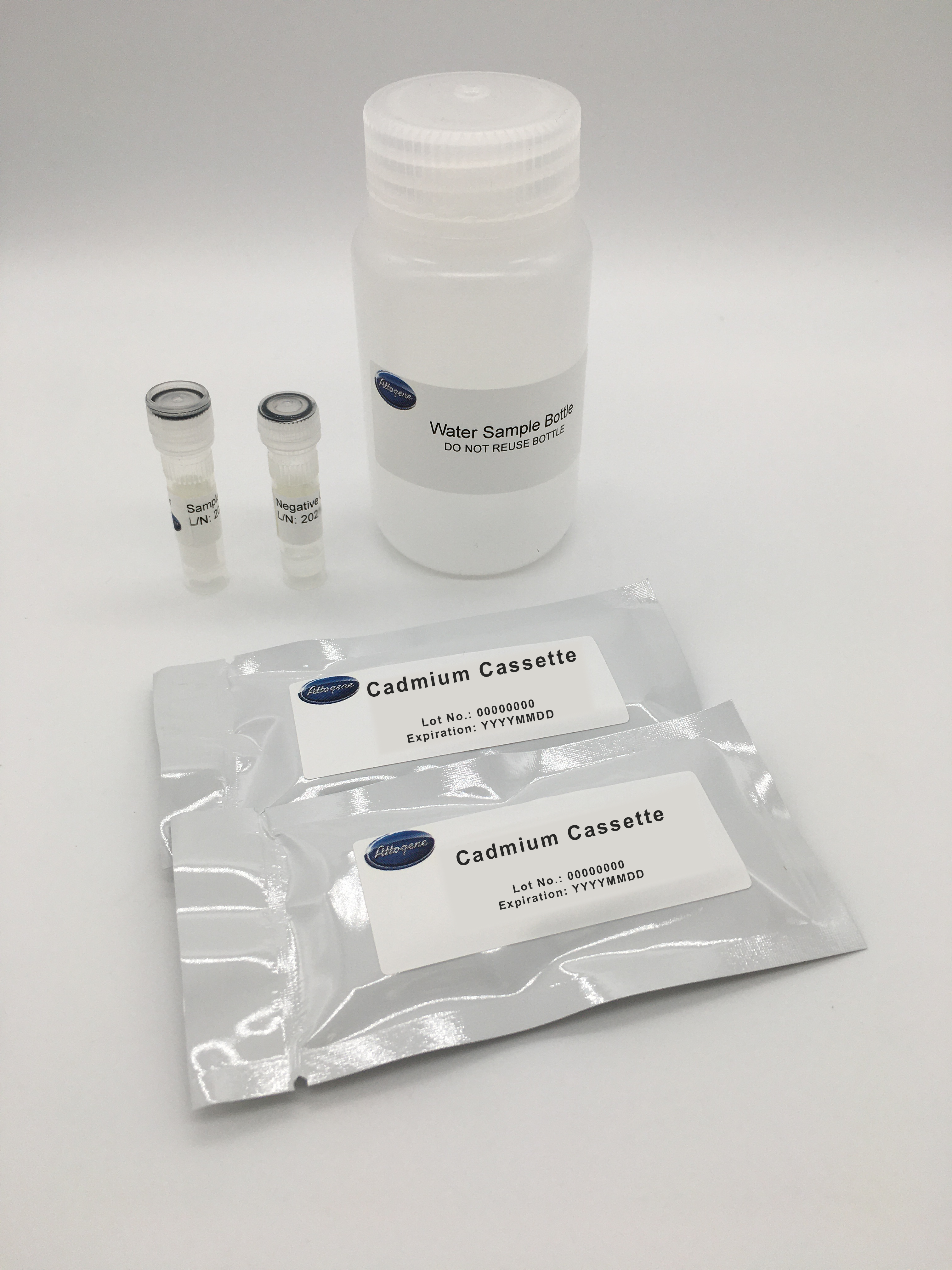
Attogene’s Cadmium Lateral Flow Kit can be used to detect Cadmium in water samples at 5 ppb in the field.
Format: 10 test cassettes
Run Time: 15-30 minutes
Cadmium contamination is a serious worldwide environmental problem. As it is difficult to detoxify by chemical or biological methods, gradual Cadmium accumulation in the nervous and cardiovascular systems of the human body can subsequently cause serious diseases. Long-term health consequences of drinking cadmium-contaminated food and water include numerous negative health effects. Attogene’s Cadmium Lateral Flow test gives results conforming of 5ppb or greater. Using the supplied pipette, simply fill the vial with your water sample, place the water into the sample port and wait 15-30 minutes.
Other Products
Propargyl-PEG7-t-butyl ester
Product Info
Document
Product Info
Propargyl-PEG7-t-butyl ester comprises a propargyl group and a t-butyl protected carboxyl group. The propargyl group reacts with azide compounds via copper catalyzed Click Chemistry to form a stable triazole linkage. Under acidic conditions, the carboxyl group can be deprotected. The hydrophilic PEG units enhance solubility of the molecule in aqueous media. Reagent grade, for research purpose. Please contact us for GMP-grade inquiries.
Document
Propargyl-PEG7-t-butyl ester comprises a propargyl group and a t-butyl protected carboxyl group. The propargyl group reacts with azide compounds via copper catalyzed Click Chemistry to form a stable triazole linkage. Under acidic conditions, the carboxyl group can be deprotected. The hydrophilic PEG units enhance solubility of the molecule in aqueous media. Reagent grade, for research purpose. Please contact us for GMP-grade inquiries.
Short term stability: 2-8oC, Long term stability: See individual component labels
Stability:
> 2 years under recommended storage conditions
Analyte:
Phosphate
Assay Format:
Spectrophotometer, Auto-analyser
Detection Method:
Absorbance
Wavelength (nm):
360
Signal Response:
Increase
Linear Range:
0.1 to 10 μg of phosphate per assay
Limit of Detection:
0.16 mg/L
Reaction Time (min):
~ 20 min
Application examples:
Processed foods and drinks, bakery products, dairy products, waste water samples, cosmetics, pharmaceuticals and other materials (e.g. biological cultures, etc.).
The Phosphate Assay Kit is a rapid, simple, reliable and accurate method for the specific measurement and analysis of phosphate in water, foodstuffs, beverages and other materials. The phosphate detection reaction employs the defined chemical substrate 2-amino-6-mercapto-7-methylpurine ribonucleoside (MESG). In the presence of phosphate, the substrate is converted enzymatically by purine nucleoside phosphorylase (PNPase) to the products ribose 1-phosphate and 2-amino-6-mercapto-7-methylpurine. An application note describes the dephosphorylation reaction of phytic acid using phytase and alkaline phosphatase (sold separately), and subsequent phosphate detection using the reagents provided in K-PHOS.
This method is suitable for analysis using spectrophotometer and auto-analyser.
Note for Content: The number of manual tests per kit can be doubled if all volumes are halved.
Need other products? See our complete list of assay kits.
Advantages
Chemically defined detection method
All reagents stable for > 2 years after preparation
Rapid reaction (~ 20 min)
Mega-Calc™ software tool is available from our website for hassle-free raw data processing
Standard included
Suitable for manual and auto-analyser formats
Document
The Phosphate Assay Kit is a rapid, simple, reliable and accurate method for the specific measurement and analysis of phosphate in water, foodstuffs, beverages and other materials. The phosphate detection reaction employs the defined chemical substrate 2-amino-6-mercapto-7-methylpurine ribonucleoside (MESG). In the presence of phosphate, the substrate is converted enzymatically by purine nucleoside phosphorylase (PNPase) to the products ribose 1-phosphate and 2-amino-6-mercapto-7-methylpurine. An application note describes the dephosphorylation reaction of phytic acid using phytase and alkaline phosphatase (sold separately), and subsequent phosphate detection using the reagents provided in K-PHOS.
AAV Purification from any input – cell fraction or media fraction
High AAV recovery, up to 90%
No specialized equipment needed
Purification from a variety of AAV serotypes (including AAV6 and AAV9)
Yields highly active AAV for in vivo and in vitro experiments
Purification is based on spin column chromatography that uses Norgen’s resin separation matrix
Recombinant adeno-associated virus (AAV) vectors are highly promising tools for both in vitro and in vivo gene transfer. Norgen’s AAV Purification Kits provide fast and simple procedures for concentrating and purifying AAV vectors from cell lysate and cell culture media. Purification is based on precipitation onto Norgen Biotek’s proprietary resin. Contaminating cellular debris is largely removed from the sample via a centrifugation step, while contaminating DNA and RNA is reduced using enzymatic digestion. AAV vector purified in this manner is highly active for use in in vitro and in vivo transduction experiments.
AAV Purification Kit
Norgen’s AAV Purification Kit contains sufficient materials for 15 preparations (33.5 mL per prep of supernatant (SN) or a total of 500 mL of supernatant input). Approximately 1 mL of cell pellet can be purified per prep, up to a maximum of 15 mL of cell pellet in total for the entire kit. Up to 33X sample concentration.
AAV Purification Mini Kit
Each spin column is able to concentrate and purify AAV from 0.5-8 mL of cell pellet, cell culture media, or cells and culture media mixed together. Up to 50X sample concentration. AAV vector purified in this manner is highly active for use in in vitro transduction experiments, and is eluted into a small volume (200 µL). Preparation time for 4 samples is 1.5 hours, with 45 minutes of hands-on time.
AAV Purification Midi Kit
Each spin column is able to concentrate and purify AAV from 8 mL up to 45 mL of input consisting of cell pellet, cell culture media, or cells and culture media mixed together. Up to 50X sample concentration. AAV vector purified in this manner is highly active for use in in vitro transduction experiments, and is eluted into a small volume (1 mL). The kit may be used to purify up to 8 x 25 mL or 4 x 45 mL of samples using the included columns. Preparation time for 4 samples is approximately 2 to 2.5 hours, with 1.5 hours of hands on time.
AAV Purification Maxi Kit (Slurry Format)
Each spin column is able to concentrate and purify AAV from 45 mL to 90 mL of input consisting of cell pellet, cell culture media, or cells and culture media mixed together. Up to 200X sample concentration. AAV vector purified in this manner is highly active for use in in vitro transduction experiments, and is eluted into a small volume (1-10 mL) using the optional concentration step. The kit may be used to purify up to 1 x 900 mL samples or 10 x 45-90 mL samples using the included columns. Preparation time for 1 x 900 mL sample is approximately 2.5 to 3.5 hours, with an optional concentration step requiring an additional 30 min.
At least 5 x 10¹⁰ AAV particles as determined by qPCR
AAV Vector Serotype
AAV6, AAV9 and others
Input Type
Cells, media
Input Volume (AAV supernatant)
1 – 33.5 mL SN per prep (500 mL SN in total)
Input Volume (AAV cell pellet)
1 mL cell pellet per prep (15 mL in total)
Time to Complete Purifications
2.5 to 4.5 hours with 1 hour hands on time
In vivo transduction
Yes
Storage Conditions and Product Stability
HL-SAN Nuclease should be stored at -20°C upon arrival. Elution Buffer O should be stored tightly capped at 4°C upon arrival. All other solutions should be kept tightly sealed and stored at room temperature. Once opened, the solutions should be stored at 4°C. This kit is stable for 2 years after the date of shipment.
Component
Cat. 66100 (15 preps)
Cat. 63200 (20 preps)
Cat. 63300 (4-8 preps)
Cat. 63250 (1-10 preps)
Lysis Buffer S
5.5 mL
5.5 mL
5.5 mL
20 mL
DNAse I
–
2 x 25 uL
2 x 25 uL
210 μL
RNAse A
–
60 μL
60 μL
240 μL
HL-SAN Nuclease
102 μL
–
–
–
Binding Buffer A
20 mL
4 mL
4 mL
2 x 8 mL
Purification Solution C
60 mL
–
–
–
Purification Solution D
130 mL
–
–
–
Wash Solution C
2 x 130 mL
60 mL
60 mL
3 x 60 mL
Slurry E
12.5 mL
–
–
2 x 14.5 mL
Elution Buffer O
66 mL
8.5 mL
8.5 mL
66 mL
Protein Neutralizer
4 mL
4 mL
4 mL
4 mL
Spin Columns
–
20
–
–
Mini Spin Columns
–
20
–
–
Midi Spin Columns (grey contents) with Collection Tubes
–
–
8
10
Midi Spin Columns (white contents) with Collection Tubes
–
–
8
–
Maxi Spin Columns (grey contents) with Collection Tubes
–
–
–
10
Maxi Spin Columns (white contents) with Collection Tubes