
Introduction
Place of Origin: Guangdong, China
Warranty: 2 years
Customized support: OEM
Brand Name: HKM
Model Number: CRM011
Reagent grade: Biochemical Reagent
Form: Powder
Color: Light yellow
Type: Shigella Agar

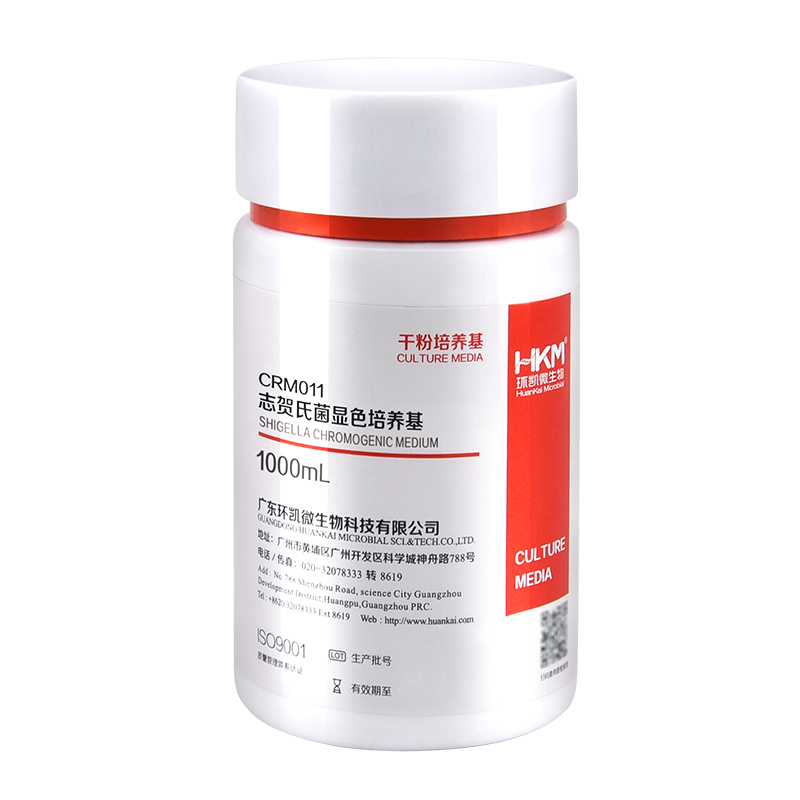
Place of Origin: Guangdong, China
Warranty: 2 years
Customized support: OEM
Brand Name: HKM
Model Number: CRM011
Reagent grade: Biochemical Reagent
Form: Powder
Color: Light yellow
Type: Shigella Agar

These kits provide fast and reliable procedures for the purification of genomic DNA from viable yeast cells, fungal spores or mycelium, and bacteria including Gram-positive. Genomic DNA is efficiently extracted from the cells by a combination of heat treatment, detergents and Bead Tubes (provided). An optional lyticase treatment allows for improved DNA yields with certain fungal and yeast species. Recovered genomic DNA is of excellent yield and purity for any downstream application including PCR, qPCR, Restriction Fragment Length Polymorphism (RFLP), Amplified Fragment Length Polymorphism (AFLP), sequencing, SNP analysis and more.
Fungi/Yeast Genomic DNA Isolation Kit (Spin Column)
This kit provides rapid spin column purification of genomic DNA from viable yeast cells, fungal spores or mycelium, and bacteria including Gram-positive. Preparation time for a single sample is less then 30 minutes, and each kit contains sufficient materials for 50 preparations.
Fungi/Yeast Genomic DNA Isolation 96-Well Kit (HT)
Norgen’s Fungi/Yeast Genomic DNA Isolation 96-Well Kit provides a fast, reliable and simple procedure for high throughput isolation of DNA from viable yeast cells, fungal spores or mycelium and Gram-positive bacteria. The purification could be performed on either a vacuum manifold or using centrifugation. Complete 96 purifications in 40 minutes.
Figure 1 / 6

Click for expanded view
| Kit Specifications | |
| Column Binding Capacity | 50 μg |
| Maximum Column Loading Volume | 650 μL |
| Maximum Amount of Starting Material: Fungi (wet weight) Yeast or Bacteria Culture | 50 mg 0.5mL – 1mL |
| Average Yield* Pichia sp. (yeast) Botrytis cinerea Fusarium sp. Aspergillis niger Mucor racemosus Cladosporium cladosporioides Penicillium sp. Rhizopus oryzae Alternaria tenuissima | 25 μg 32 μg 42 μg 26 μg 15 μg 12 μg 40 μg 7 μg 30 μg |
| Time to Complete 10 purifications | 30 minutes |
* Yield will vary depending on the type of sample processed
Storage Conditions and Product Stability
All solutions should be kept tightly sealed and stored at room temperature. This kit is stable for 1 year after the date of shipment.
| Component | Cat. 27300 (50 preps) | Cat. 27350 (192 preps) |
|---|---|---|
| Lysis Buffer L | 30 mL | 2 x 60 mL |
| Resuspension Solution A | 20 mL | 60 mL |
| Solution BX | 28 mL | 2 x 28 mL |
| Wash Solution A | 18 mL | 2 x 38 mL |
| Elution Buffer B | 15 mL | 30 mL |
| Bead Tubes | 50 | 200 |
| Spin Columns | 50 | – |
| Collection Tubes | 50 | – |
| 96-Well Plate | – | 2 |
| 96-Well Collection Plate | – | 2 |
| Adhesive Tape | – | 4 |
| Elution Tubes (1.7 mL) | 50 | – |
| 96-Well Elution Plate | – | 2 |
| Product Insert | 1 | 1 |

Description
The DM5100 ExcelBand™ Super Range DNA Ladder is a ready-to-use DNA ladder, which is pre-mixed with loading dye for direct gel loading. The DNA Ladder DM5100 is composed of 26 individual DNA fragments: 25k, 10k, 8k, 6k, 5k, 4k, 3k, 2.5k, 2k, 1.5k, 1.2k, 1k, 900, 800, 700, 600, 500, 450, 400, 350, 300, 250, 200, 150, 100 and 50 base pairs derived from a mixture of PCR products and specifically digested plasmid DNA. This product contains four enhanced bands (3k, 1.2k, 500 and 200 bp) for easier reference. In addition, three tracking dyes, Xylene cyanol FF, Bromophenol blue and Orange G which mimic the migration of 4,000 bp, 500 bp and 50 bp dsDNA during electrophoresis are added for real time monitoring.
Features
Source
Phenol extracted PCR products and dsDNA digested with specific restriction enzymes, equilibrated in 10 mM Tris-HCl (pH 8.0) and 10 mM EDTA.
Range
50 ~ 25,000 bp
Concentration
88.7 µg/ 500 µl
Recommended loading volume
5 µl/ well
Storage
Room temperature for 6 months
4°C for 12 months
-20°C for 36 months
These kits are designed for the rapid spin column removal of endotoxins from previously purified DNA. Norgen’s spin columns bind DNA while endotoxins, salts and other contaminants are washed away. These kits reduce endotoxins to 0.1 EU/μg DNA or less providing plasmid DNA that is immediately ready for transfections or other endotoxin-sensitive applications. Typical recovery of DNA is >90% of the starting sample.
Endotoxin Removal Kit (Mini)
This kit is designed for the rapid spin column removal of endotoxins from up to 25 µg of previously purified DNA. The convenient spin column procedure can be completed in approximately 20 minutes.
Endotoxin Removal Kit (Midi)
This kit is designed for the rapid spin column removal of endotoxins from up to 200 μg of previously purified DNA. The convenient spin column procedure can be completed in approximately 30 minutes.
Endotoxin Removal Kit (Maxi)
This kit is designed for the rapid spin column removal of endotoxins from up to 1 mg of previously purified DNA. The convenient spin column procedure can be completed in approximately 30 minutes.
About Endotoxins
Endotoxins (also called lipopolysaccharides), are cell-membrane components of Gram-negative bacteria such as E. coli. Endotoxins are released during the lysis step of plasmid purification and significantly reduce transfection efficiencies in endotoxin sensitive cell lines. Therefore, the removal of endotoxins from plasmid preparations is often necessary prior to the use of the DNA in such downstream applications.
Figure 1 / 2
Click for expanded view
| Kit Specifications | |
| Maximum DNA Input | 25 μg |
| Final Endotoxin Level | ≤ 0.1 EU/µg DNA |
| Size of DNA Purified | Up to 13,000 bp |
| Maximum DNA Volume Input | 100 μL |
| Average Recovery | > 90% |
| Time to Complete 10 Purifications | 20 minutes |
Storage Conditions and Product Stability
All solutions should be kept tightly sealed and stored at room temperature. This kit is stable for 2 years after the date of shipment.
| Component | Cat. 22700 (25 preps) | Cat. 52200 (10 preps) | Cat. 21900 (4 preps) |
|---|---|---|---|
| Buffer SK | 15 mL | 60 mL | 60 mL |
| Wash Solution H | 18 mL | 18 mL | 18 mL |
| Elution Buffer I | 6 mL | 12 mL | 12 mL |
| Endotoxin Removal Solution | 1.5 mL | 1.5 mL | 1.5 mL |
| Precipitation Solution | – | 1.5 mL | 1.5 mL |
| Spin Columns (assembled with Collection Tubes) | – | 10 | 4 |
| Spin Columns | 25 | – | – |
| Collection Tubes | 25 | – | – |
| Elution Tubes (1.7 mL) | 25 | – | – |
| Elution Tubes (15 mL) | – | 10 | – |
| Elution Tubes (50 mL) | – | – | 4 |
| Product Insert | 1 | 1 | 1 |