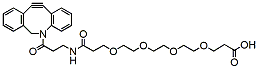
DBCO-NHCO-PEG4-acid is an analog of DBCO-Acid with a hydrophilic PEG spacer arm, which improves water solubility. This reagent is a non-activated building block with enhanced solubility in aqueous media and can thus be used to derivatize amine-containing molecule through a stable amide bond. DBCO is commonly used for copper-free Click Chemistry reactions. Reagent grade, for research purpose. Please contact us for GMP-grade inquiries.
Detail
DBCO-NHCO-PEG4-acid is an analog of DBCO-Acid with a hydrophilic PEG spacer arm, which improves water solubility. This reagent is a non-activated building block with enhanced solubility in aqueous media and can thus be used to derivatize amine-containing molecule through a stable amide bond. DBCO is commonly used for copper-free Click Chemistry reactions. Reagent grade, for research purpose. Please contact us for GMP-grade inquiries.
Other Products
DNA Amplification Isothermal PCR Kit NFO Freeze Dried Reagent
Product Info
Document
Product Info
Product Description
Amp-future DNA Isothermal Amplification Kit NFO: Freeze-Dried Reagent
Product Detail
Kit Storage and term of Validity
Storage term: stored at ≤-20℃,keep away from light, avoid heavy weight and repeated freezing and thawing.
Term of Validity: 14 months
Isothermal nucleic acid Principle Summary
The kit is based on room and constant temperature nucleic acid rapid amplification technology, its principle is that at room and constant temperature, the recombinase and primer form a protein/single-stranded nucleotide complex Rec/ssDNA, and invade the double-stranded DNA template with the help of auxiliary proteins and single-stranded binding protein SSB; then form a D-loop region at the invasion point and start to scan the DNA duplex, after finding the target region complementary to the primer and disintegration of the complex Rec/ssDNA, the polymerase also binds to the 3′ end of the primer to start the chain extension. The kit relies on the role of NFO enzyme and adds the designed specific molecular probes according to the template, and get the result by colloidal gold technology (sandwich method).
Isothermal nucleic acid Product Features
1/ High sensitivity and specificity, short reaction time.
2/ The reagent form is freeze-dried, stable and easy to operate.
3/ The reaction can be operated by metal bath and water bath pot without purchasing expensive PCR apparatus.
Technical Parameters:
Parameters
Details
Product Name
DNA Isothermal Amplification Kit NFO
Manufacturer
Amp-future
Storage Temperature
-20°C
Kit Components
Enzymes, Buffers ,Reagents
Packaging
48 Tests/box
Detection Limit
500-1000copies/µL
Shipping
ICE
Test Time
5-20mins
Isothermal nucleic acid Applications
Suitable for DNA isothermal rapid amplification kit(NFO type)
Primer: Require pair of nucleotide primers with the length of 25-35 bp.
DNA basic kit reaction temperature is 39 to 42℃ and time is 5-20 minutes.
Notes
1/ Please avoid nucleic acid contamination and set blank control during reaction due to the high sensitivity of the kit.
2/ Please take out the required quantity of MIRA reaction units for the experiment, and put the rest under storage conditions when performing the experiment.
1.Brushless frequency motor,in great torque, free maintenance, no powder pollution, quick in speed up and down.
2.Imported compressors fluorine free,double cycle cooling,cold and hot alternating easily, free environment pollution and precise in temperature control.
3. Microprocessor control, digital display which indicates the speed, time, RCF in operation, speed raising and reducing quickly, operate simply. Running parameter can be edited.
4. 10 kinds of program stored in the memory, 10 kinds of accelerating and decelerating speed for your choice.
5. Automatically electric lid lock, super speed, over temperature protection and imbalance protection. The centrifuge body is made of high quality steel, safe and reliable.
6. Rotor is connected to spindle by specialized taper sleeve, loading simple and quick, no direction.
7. There are several kinds of rotors for your choice, adapters can be designed by experimental requirements.
8. 3 tiers protection steel cover and get the ideal centrifugation result.
HL-SAN efficiently removes nucleic acids from buffers typically used in protein purification. Due to its high salt tolerance, it is the obvious choice for host-cell DNA removal in settings where salt is added to reduce aggregation. Especially efficient for removing nucleic acids from proteins with high affinity for DNA and RNA. Proven performance during lysis and early stages of protein purification processes, as well as high-salt eluates. Cold-adapted enzyme with excellent performance also at ambient temperatures and during over-night digestion at 4°C.
Optimum activity at high salt concentration (0.5 M NaCl)
Active at low temperatures (20% at 6ºC)
Easily inactivated
Broad pH range
Temperature stable
Figures
Figure 1. Optimum activity in solutions with high salinity
HL-SAN has optimum activity at ∼0.5 M NaCl, but operates at a broad range of [NaCl] and [KCl]. The activity of HL-SAN was tested in a 25 mM Tris-HCl buffer, pH 8.5, 5 mM MgCl2 with varying [NaCl] or [KCl]. The maximum activity was set to 100%.
Figure 2. Temperature and activity
HL-SAN has optimum activity at ~35°C, but works over a broad temperature range (20% activity at 10°C and 50°C). The activity of HL-SAN was tested in a 25 mM Tris-HCl buffer, pH 8.5 containing 5 mM MgCl2 and 0.5 M NaCl.
Fig 3. The effect of MgCl2 and MnCl2 concentration on the HL-SAN activity.
The activity of HL-SAN was tested in a 25 mM Tris-HCl buffer, pH 8.5, 0.5 M NaCl and with varying concentrations of MgCl2 or MnCl2. The activity of the sample containing 5 mM MgCl2 was set to 100%.
Figure 4. HL-SAN activity vs pH/[NaCl]
The activity of HL-SAN was tested in a 25 mM Tris-HCl buffer with different pHs and different concentrations of NaCl. All buffers contained 5 mM MgCl2. The nature of the buffer was pH-dependent, but generally the NaCl-optimum was the same in all buffers/pHs. The exception was etanolaminbuffer at pH 9 and pH 9.5 in which the NaCl-optimum was shifted to the left (not shown).
Without NaCl, the specificity towards ssDNA and dsDNA is similar. At 0.5 M NaCl, the activity towards dsDNA increases, while the activity towards ssDNA is unaffected.
Figure 6. HL-SAN digests ssDNA to ~5-13 nt, and dsDNA to ~5-7 nt
The size of the end products from ssDNA varies from ~5-13 nt, while dsDNA is digested to around ~5-7 nt. The size of the end products seems to depend on the DNA sequence. Substrates 1 and 2 were ssDNA with different sequences and substrates 3 and 4 were dsDNA with similar sequences but with a FAM-label at different ends. Substrate 5 was dsDNA with the same sequence as substrate 3 and 4 but with a FAM-label at both ends.
Figure 7. HL-SAN activity decreases with increasing concentrations of glycerol
The activity of HL-SAN was tested in a 25 mM Tris-HCl buffer, pH 8.5, 5 mM MgCl2, 0.5 M NaCl and with increasing concentrations of glycerol. The activity of the control not containing glycerol was set to 100%.
Figure 8. The activity of HL-SAN at different concentrations of imidazole
The activity of HL-SAN was tested in a 25 mM Tris-HCl buffer, pH 8.5, 5 mM MgCl2, 0.5 M NaCl and with varying concentrations of imidazole. The activity of the control not containing imidazole was set to 100%.
Document
HL-SAN efficiently removes nucleic acids from buffers typically used in protein purification. Due to its high salt tolerance, it is the obvious choice for host-cell DNA removal in settings where salt is added to reduce aggregation. Especially efficient for removing nucleic acids from proteins with high affinity for DNA and RNA. Proven performance during lysis and early stages of protein purification processes, as well as high-salt eluates. Cold-adapted enzyme with excellent performance also at ambient temperatures and during over-night digestion at 4°C.



 VolumeCup