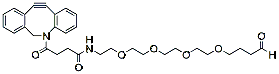
DBCO-PEG4-Butyraldehyde is a click chemistry PEG reagent containing a terminal butylraldehyde group. Butyraldehyde reacts with hydrazide to form a stable hydrazone linkage or with alkoxyamines to form a stable oxime bond. The hydrophilic PEG spacer arm improves water solubility and provides a long and flexible connection that minimizes steric hindrance involved with ligation. DBCO is commonly used for copper-free Click Chemistry reactions. Reagent grade, for research use only.
Detail
DBCO-PEG4-Butyraldehyde is a click chemistry PEG reagent containing a terminal butylraldehyde group. Butyraldehyde reacts with hydrazide to form a stable hydrazone linkage or with alkoxyamines to form a stable oxime bond. The hydrophilic PEG spacer arm improves water solubility and provides a long and flexible connection that minimizes steric hindrance involved with ligation. DBCO is commonly used for copper-free Click Chemistry reactions. Reagent grade, for research use only.
Other Products
m-PEG5-propargyl
Product Info
Document
Product Info
Propargyl-PEG5-methane has a propargyl group which can react with azide compounds via copper catalyzed Click Chemistry reactions. The PEG units increase water-solubility of the molecule. Reagent grade, for research purpose. Please contact us for GMP-grade inquiries.
Document
Propargyl-PEG5-methane has a propargyl group which can react with azide compounds via copper catalyzed Click Chemistry reactions. The PEG units increase water-solubility of the molecule. Reagent grade, for research purpose. Please contact us for GMP-grade inquiries.
Clean-up & concentrate total RNA (including miRNA) in minutes
Clean-up & concentrate RNA from TRIzol®, TRI Reagent®, etc
Clean-up RNA from contaminants including enzymes, primers, nucleotides
Rapid spin-column protocol, elute in 20 µL
96-well format for high throughput processing & Micro-Elute spin column formats for 8 µL are available
Purified RNA is suitable for a variety of downstream applications, including Small RNA Sequencing. Find out more information on Norgen’s NGS services
Purification is based on spin column chromatography that uses Norgen’s proprietary resin separation matrix
These kits are designed to clean-up and concentrate RNA (including miRNA) from TRIzol® and TRI Reagent®, enzymatic reactions, in vitro transcription, labelling reactions, etc. These are robust kits for all clean-up and concentration purposes for up to 35 µg of RNA in solution. The purified RNA is of the highest purity and integrity, and can be used in a number of downstream applications. These kits purify all sizes of RNA, from large mRNA and ribosomal RNA down to miRNA, siRNA and lncRNA.
RNA Clean-Up and Concentration Kit (Spin Column)
Norgen’s RNA Clean-Up and Concentration Kit provides a rapid method for the purification, cleanup and concentration of up to 35 μg of RNA isolated using different methods including phenol/guanidine-based protocols, and from various upstream enzymatic reactions such as DNase treatment and labeling. The kit elutes RNA in 20 µL. Complete 10 purifications in 20 minutes.
RNA Clean-Up and Concentration 96-Well Kit (High Throughput)
Norgen’s RNA Clean-Up and Concentration 96-Well Kit provides a rapid method for the purification, cleanup and concentration of up to 50 μg of RNA isolated using different methods including phenol/guanidine-based protocols, and from various upstream enzymatic reactions such as DNase treatment and labeling. The kit elutes RNA in 75 µL. Complete 10 purifications in 30 minutes.
RNA Clean-Up and Concentration Micro-Elute Kit (Micro-Elute)
Norgen’s RNA Clean-Up and Concentration Micro-Elution Kit provides a rapid method for the purification, cleanup and concentration of up to 10 μg of RNA isolated using different methods including phenol/guanidine-based protocols, and from various upstream enzymatic reactions such as DNase treatment, labeling and in vitro transcription. This kit is made for eluting RNA in smaller volumes of 8 µL for all types of downstream applications, for the highest concentration of RNA sample. Complete 10 purifications in 20 minutes.
Storage Conditions and Product Stability All solutions should be kept tightly sealed and stored at room temperature. This kit is stable for 2 years after the date of shipment.