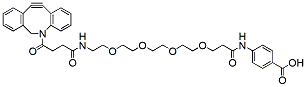
DBCO-PEG4-PABA is an analog of DBCO-Acid with PEG linker and a 4-Aminobenzoic acid (PABA) group. The DBCO groups is commonly used for copper-free Click Chemistry reactions due to its strain promoted high energy. The hydrophilic PEG chain allows for increased water solubility. Reagent grade, for research use only.
Detail
DBCO-PEG4-PABA is an analog of DBCO-Acid with PEG linker and a 4-Aminobenzoic acid (PABA) group. The DBCO groups is commonly used for copper-free Click Chemistry reactions due to its strain promoted high energy. The hydrophilic PEG chain allows for increased water solubility. Reagent grade, for research use only.
Other Products
AZtaq™ DNA Polymerase
Product Info
Document
Product Info
OverView
AZtaq™ DNA Polymerase is a high-quality DNA polymerase, originating form Thermus aquaticus. Being highly thermostable, AZtaq is ideal for use in polymerase chain reaction (PCR) applications.
The enzyme catalyses the synthesis of a complementary DNA strand using a primed DNA or cDNA strand as template. It possesses 5’-3’ exonuclease activity while lacking 3’-5’ proofreading activity.
AZtaq is compatible with the use of dUTP, enabling highly efficient removal of carry-over contamination with Cod UNG.
Key Features
Excellent qPCR Performance
Compatible with dUTP
Thermostable
Applications
PCR/qPCR
Figures
Properties
Quality Control
ArcticZymes is dedicated to the quality of our products. AZtaq is manufactured at our ISO 13485 certified facility in Norway.
Document
AZtaq™ DNA Polymerase is a high-quality DNA polymerase, originating form Thermus aquaticus. Being highly thermostable, AZtaq is ideal for use in polymerase chain reaction (PCR) applications.
Introducing the Fastin Assay Kit: Your Straightforward Solution for Elastin Quantification! Our user-friendly kit utilizes a dye-based method to measure elastin from in-vivo and in-vitro sources. It can be used to quantify various elastin forms, spanning from immature tropoelastin to mature, ‘insoluble’ elastin fibers.
Colorimetric Detection (513nm) (Endpoint)
Understanding Elastin: The Key to Tissue Flexibility
Tissues like lungs and arteries must maintain the ability to stretch and recoil repeatedly throughout an organism’s life. Elastin, a mature protein, is responsible for this elasticity and is usually present as insoluble fibers within the ECM. During development, these fibers are initially formed from a soluble precursor called tropoelastin.
What is the Fastin Assay?
The Biocolor Fastin assay is a user-friendly, dye-based means of quantifying elastins derived from both in-vivo and in-vitro sources. A variety of elastin forms can be assayed, from immature tropoelastin to mature ‘insoluble’ elastin fibres.
Further information on how the assay works can be found on the ‘Mode of Action‘ tab.
A list of suggested sample types can be found under the ‘Assay Specification‘ tab.
How does the Fastin assay detect Elastin?
The Fastin Dye Reagent contains an elastin-binding synthetic porphyrin, TPPS (5,10,15,20-tetraphenyl- 21H,23H-porphine). This affinity of TPPS for elastin was first observed when used as a ‘vital stain’ on live animals. Most tissues took up the dye initially but only elastin retained the TPPS molecules over time. [Winkelman, J. (1962), Cancer Res. 22, 589-596; Winkelman, J & Spicer, S. (1962), Stain Technol. 37, 303-305].
It has been proposed that the elastin binding of TPPS may be due to the retention of the acidic dye (which contains four charged sulfate groups) by the basic amino acid side chain residues of elastin.
How does the Fastin assay work?
Step 1. Incubation of samples containing soluble elastin with the Fastin Dye Reagent causes an elastin-dye complex to form. This insoluble complex then precipiates.
Step 2. Dye-labelled elastin is then isolated by centrifugation and the unbound dye removed. Elastin-bound dye is then eluted and measured spectrophotometrically.
Step 3. The elastin content of unknown samples can be calculated by comparison against a calibration curve prepared using a standard comprising water-soluble elastin (supplied with the kit).
Assay range
50 – 500µg/ml
Limit of Detection
50µg/ml
Detection Method
Colorimetric Detection (513nm) (Endpoint)
Measurements per kit
110 in total (allows a maximum of 48 samples to be run in duplicate alongside a standard curve).
Suitable Samples
In-vivo: tissues and fluids. Insoluble elastin will first require conversion to water soluble α-elastin using the oxalic acid reagents and extraction protocol supplied with the kit.
In-vitro: Elastin produced by cells during 2D/3D cell culture. NB elastin in conditioned cell media is typically below the detection limit of the kit.
Precautions
This kit is designed for research use only. Not for use in diagnostic procedures. Kit requires access to a centrifuge, heated water bath or block, as well as a spectrophotometer or colorimeter capable of absorbance detection at 513nm. Specific sample preparation protocols may require customer to provide further reagents, consult assay manual for further information.
Fastin elastin kit contents:
1. Dye Reagent (1x110ml)
2. α-elastin Reference Standard (1x5ml, 1.0 mg/ml soluble Bovine elastin)
6. 1.5ml micro-centrifuge tubes for dye-labelling reaction.
7. Assay kit manual
NB: Additional reagents may be required for sample preparation prior to assay. Consult manual or contact us for further details.
Document
Introducing the Fastin Assay Kit: Your Straightforward Solution for Elastin Quantification! Our user-friendly kit utilizes a dye-based method to measure elastin from in-vivo and in-vitro sources. It can be used to quantify various elastin forms, spanning from immature tropoelastin to mature, ‘insoluble’ elastin fibers. Colorimetric Detection (513nm) (Endpoint)
This product is designed for purification of high-molecular-weight genomic or mitochondrial DNA from a variety of tissue and culture cells. The convenient, scalable purification procedure removes contaminants and enzyme inhibitors such as proteins and divalent cation, and purified DNA is ready for immediate use in sensitive downstream applications or for archiving.
Details
Specifications
Features
Specifications
Main Functions
Isolation total DNA from tissue using economic salt out method
Cells are lysed with ananionic detergent in the presence of a DNA stabilizer. The DNA stabilizer limits the activity of intracellular DNases and also DNases found elsewhere in the environment. RNA is then removed by treatment with an RNA digesting enzyme. Other contaminants, such as proteins, are removed by salt precipitation. Finally, the genomic DNA is recovered by precipitation with alcohol and dissolved in Buffer TE. Purified DNA typically has an A260/A280 ratio between 1.7 and 1.9, and is up to 200 kb in size. The DNA can be safely stored at 2-8°C, -20°C, or -80°C.
Advantages
Safe – without phenol chloroform extraction
Environment friendly – the reagents used are safe, non-toxic and without pollution
High molecular weight – the molecular weight of genomic DNA is about 50-150kb
High purity – the purified DNA has A260/280=1.8-1.9, A260/230=2.0-2.5
Unlimited sample size – solution type operation, sample volume can be adjusted at will
Cost performance – the most economical nucleic acid extraction technology
Kit Contents
Contents
D331201
D331202
D331203
Purification Times
1 g
5 g
50 g
Proteinase K
330 µl
1.8 ml
18 ml
Buffer WTL
33 ml
160 ml
2 x 800 ml
Buffer PPS
12 ml
55 ml
500 ml
RNase Solution
330 µl
1.8 ml
18 ml
Buffer TE
12 ml
60 ml
200 ml
Storage and Stability
RNase Solution should be stored at 2-8°C upon arrival. However, short-term storage (up to 24 weeks) at room temperature (15-25°C) does not affect their performance. The remaining kit components can be stored dry at room temperature (15-25°C) and are stable for at least 18 months under these conditions. The entire kit can be stored at 2-8°C, but in this case buffers should be redissolved before use. Make sure that all buffers are at room temperature when used.
Document
This product is designed for purification of high-molecular-weight genomic or mitochondrial DNA from a variety of tissue and culture cells. The convenient, scalable purification procedure removes contaminants and enzyme inhibitors such as proteins and divalent cation, and purified DNA is ready for immediate use in sensitive downstream applications or for archiving.