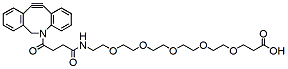
DBCO-PEG5-acid is an analog of DBCO-Acid with PEG linker and a DBCO group. DBCO group is a highly reactive cycloalkyne which is commonly used for copper-free Click Chemistry reactions. The hydrophilic PEG chain allows for increased water solubility of compounds in aqueous media. The terminal carboxylic acid can react with primary amine groups in the presence of activators (e.g. EDC, or HATU) to form a stable amide bond. Reagent grade, for research purpose. Please contact us for GMP-grade inquiries.
Detail
DBCO-PEG5-acid is an analog of DBCO-Acid with PEG linker and a DBCO group. DBCO group is a highly reactive cycloalkyne which is commonly used for copper-free Click Chemistry reactions. The hydrophilic PEG chain allows for increased water solubility of compounds in aqueous media. The terminal carboxylic acid can react with primary amine groups in the presence of activators (e.g. EDC, or HATU) to form a stable amide bond. Reagent grade, for research purpose. Please contact us for GMP-grade inquiries.
Attogene’s Lead Rapid Lab Lateral Flow Kit can be used for the screening of Lead in water and food samples at greater than or equal to 10 ppb in a laboratory setting. Unlike the field-based kit, the lab kit is intended for a more technical end user who will be evaluating samples in a laboratory setting.
Lead contamination is a serious worldwide environmental problem. As it is difficult to detoxify by chemical or biological methods, gradual Lead ion accumulation in the nervous and cardiovascular systems of the human body can subsequently cause serious diseases. Long-term health consequences of drinking Lead-contaminated food and water include brain, heart, kidney, lungs and immune system problems for adults, and the physical and mental development delays in infants and children. Attogene’s Lead Lateral Flow test gives results conforming of 10ppb or greater in 5-15 minutes.
This is a revolutionary product designed to make Lead testing in easy and affordable. This fast screening test kit contains 10 tests with everything needed for accurate results of unsafe lead levels. With reliable results in only 10 minutes, this test kit clearly gives results confirming Lead in water and conforming to the EPA guideline of 15 ppb (µg/L).
Sample Collection:
1. Take a first-draw sample
Immediately after opening a faucet or valve, collect a 250 mL sample. This sample should be from each tap used for consumption.
2. Take a flush sample
If first-draw sample results show elevated lead levels of 5 ppb or higher, collect a flush sample. To do this, ensure water has not been used for between 8 to 18 hours, then collect the sample at 30 seconds.
3. Take sequential samples
If you want to test a lead service line, collect 8 to 10 sequential samples, depending on how far the line is from the tap.
Standards and Regulations and recommendations for Lead
High Blood lead levels (i.e., greater than 700ppb) can cause serious health effects, including seizure, coma, and death. Blood levels as low as 100ppb have been associated with adverse effects on cognitive development, growth, and behavior among children aged 1-5 years.
Document
Screening of Lead in water samples at 5-10 ppb Format: 10 tests (5 tests/5 controls) Run Time: 15 Minutes
Nucleic acid testing (NAT) is the method of choice for detection and quantification of a wide range of micro organisms. Primerdesign manufactures and supplies high quality quantitative real-time PCR kits for the detection and simultaneous quantification of numerous significant pathogens . A copy number standard curve is provided for quantification and an the internal extraction template (DNA or RNA), controls for the quality of the nucleic acid extraction and eliminates false negative results.
The kit is designed with the broadest possible detection profile to ensure that all clinically relevant strains and subtypes are detected. Target sequences are selected by working with data from key opinion leaders in the field. Multiple sequence alignments and unprecedented real-time PCR expertise in design and validation ensure the best possible kit.
Details of the target and priming specificity are included in the individual handbooks above.
Packaged, optimised and ready to use. Expect Better Data.
Document
Exceptional value for money Rapid detection of all clinically relevant subtypes Positive copy number standard curve for quantification Highly specific detection profile High priming efficiency Broad dynamic detection range (>6 logs) Sensitive to < 100 copies of target
Accurate controls to confirm findings
The 16S V1-V3 Library Preparation Kit for Illumina consists of the reagents and components required for library preparation of the 16S V1-V3 amplicon libraries to be used for next-generation sequencing on Illumina platforms. All molecular reagents including primers, enzyme mixes, indexes, and buffers are provided. Instructions for PCR clean up with the AMPure XP Magnetic Beads (supplied by customer) are also included for rapid purification of nucleic acid products generated at two steps of the workflow. The library prep workflow could be used for purified DNA inputs from different sources including stool, soil, water, saliva, plant, urine, skin swab, vaginal swab, cheek swab, nasal swab, plasma/serum, tongue swab, gum swab, and others.
The 16S V1-V3 Library Preparation Kit for Illumina has a streamlined procedure that reduces the handling time such that the library prep procedure can be completed in approximately 4 hours (see diagram below). Input DNA is first subjected to targeted PCR to amplify the V1-V3 region of the DNA encoding 16S rRNA. The post-PCR reaction is then cleaned up using AMPure XP beads. Dual index primers are then added using a limited-cycle PCR. The indexed amplicons flanked by 5′ and 3′ barcoded adaptors are then cleaned using AMPure XP beads. The libraries are then ready for quantification, pooling and sequencing.
Storage Conditions and Product Stability Norgen’s 16S V1-V3 Library Prep Kit for Illumina is shipped as one kit box (for the 24 prep kit) or two sub-component kits (for the 96 prep kit). All kits should be stored at -20°C upon arrival.
All kit components should remain stable for at least 1 year when stored at the specified storage conditions.