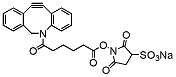
DBCO-Sulfo-NHS ester is a water-soluble sulfocated reagent containing DBCO moiety. It can be used for simple and efficient labeling of antibodies, proteins and any other primary amine-bearing macromolecules with DBCO moiety in 100% aqueous buffers. DBCO is commonly used for copper-free Click Chemistry reactions. Reagent grade, for research purpose. Please contact us for GMP-grade inquiries.
Detail
DBCO-Sulfo-NHS ester is a water-soluble sulfocated reagent containing DBCO moiety. It can be used for simple and efficient labeling of antibodies, proteins and any other primary amine-bearing macromolecules with DBCO moiety in 100% aqueous buffers. DBCO is commonly used for copper-free Click Chemistry reactions. Reagent grade, for research purpose. Please contact us for GMP-grade inquiries.
Other Products
[DM2160] FluoroBand™ 100 bp Fluorescent DNA Ladder, 500 μl
Product Info
Document
Product Info
Description
The DM2160 FluoroBand™ 100 bp Fluorescent DNA Ladder is a ready-to-use DNA ladder, which is pre-mixed with high sensitivity DNA binding fluorescent dye and loading dye for direct gel loading. The DNA Ladder DM2160 is composed of 11 individual DNA fragments: 1.5k, 1k, 900, 800, 700, 600, 500, 400, 300, 200 and 100 bp derived from a mixture of PCR products and specifically digested plasmid DNA; these bands can be visualized when illuminated with 470 nm blue light or UV light. This product contains two enhanced bands (1.5 kb and 500 bp) for easier reference. In addition, two tracking dyes, Xylene cyanol FF and Orange G which mimic the migration of 4,000 bp and 50 bp dsDNA during electrophoresis are also added for real time monitoring. Real time observation of the electrophoresis is also possible if compatible light source is fitted to the electrophoresis tank.
Features
Sharp bands
Quick reference— enhanced bands
Ready-to-use— premixed with loading dye for direct loading
Stable— room temperature storage over 6 months
Directly observed by UV or blue light— premixed with high sensitive DNA fluorescent dye
Source
Phenol extracted PCR products and dsDNA digested with specific restriction enzymes, equilibrated in 10 mM Tris-HCl (pH 8.0) and 10 mM EDTA.
Range
100 ~ 1,500 bp
Concentration
52.2 µg/ 500 µl
Recommended loading volume
5 µl/ well
Storage
Protected from light Room temperature for 6 months 4°C for 12 months -20°C for 24 months
Document
The DM2160 FluoroBand™ 100 bp Fluorescent DNA Ladder is a ready-to-use DNA ladder, which is pre-mixed with high sensitivity DNA binding fluorescent dye and loading dye for direct gel loading. The DNA Ladder DM2160 is composed of 11 individual DNA fragments: 1.5k, 1k, 900, 800, 700, 600, 500, 400, 300, 200 and 100 bp derived from a mixture of PCR products and specifically digested plasmid DNA; these bands can be visualized when illuminated with 470 nm blue light or UV light. This product contains two enhanced bands (1.5 kb and 500 bp) for easier reference. In addition, two tracking dyes, Xylene cyanol FF and Orange G which mimic the migration of 4,000 bp and 50 bp dsDNA during electrophoresis are also added for real time monitoring. Real time observation of the electrophoresis is also possible if compatible light source is fitted to the electrophoresis tank.
Purification and enrichment of intact exosomes from plasma, serum, urine, cell culture media and saliva in less than 30 minutes.
Versatile sample input ranging from 250 µL to 30 mL
Urine Exosome Purification Mini Kit (250 µL – 1 mL urine)
Urine Exosome Purification Midi Kit (2 mL – 10 mL urine)
Urine Exosome Purification Maxi Kit (11 mL – 30 mL urine)
Exosome purification is based on Norgen’s proprietary resin separating matrix through exosomes’ surface proteins.
No precipitation reagents, overnight incubation, protease or coagulant treatments required
No time-consuming ultracentrifugation, filtration or special syringes required
Purify intact exosomes with a size ranging from 40-200 nm depending on sample input type
Purified exosomes are compatible with functional studies.
Purified exosomes are free from any protein-bound cell-free circulating RNA
Purified exosomes are compatible with NanoSight® or Electron Microscopy for assessing the approximate exosome size range and concentration.
Exosomal RNA can be extracted from the purified exosomes using Norgen’s Exosomal RNA Purification technology or any other RNA extraction method.
The Urine Exosome Purification Kits provide a fast, reliable and convenient method to purify and enrich for pure intact exosomes from different urine sample volumes ranging from 250 µL to 30 mL. These kits also allow for the purification of intact extracellular vesicles (EVs) from different urine sample volumes, and these EVs are ready for any downstream application. The purification is based on Norgen’s proprietary resin.
These kits provide a clear advantage over other available methods since they do not require any special instrumentation, ultracentrifugation, precipitation reagents or any protease treatments. More importantly, the purified exosomes will not be contaminated with any other RNA-binding proteins that may contaminate your exosomal RNA, which is essential if studying exosomal RNA gene expression.
NanoSight® Analysis
Exosomes enriched with Norgen’s Urine Exosome Purification Kits can be analyzed using NanoSight® for assessing the approximate exosome size range and concentration.
Exosomal RNA Analysis
Exosomal RNA can be isolated using Norgen’s Exosomal RNA Isolation Kit from exosomes enriched using Norgen’s Urine Exosome Purification Kits for gene expression analysis using RT-qPCR, microarray or NGS and for Biomarker discovery.
Storage Conditions and Product Stability All buffers should be kept tightly sealed and stored at room temperature. These kits are stable for 2 years after the date of shipment.
Important Note Urine samples stored at -70°C, -20°C or at 4°C will develop some precipitation due to the aggregation of some of the highly abundant proteins in urine. Eliminating these precipitates using centrifugation or filtration may cause the loss of exosomes. Furthermore, these precipitates may affect the quality of the purified nucleic acid. We recommend the use of Norgen’s Urine Preservative when collecting urine samples, which is designed for the preservation of nucleic acids and proteins in fresh urine samples at ambient temperatures. The components of the Urine Preservative allow samples to be stored for over 2 years at room temperature with no detected degradation of urine DNA, RNA or proteins. Norgen’s Urine Preservative is available as a liquid format in Norgen’s Urine Preservative Single Dose Ampules, as well as in a dried format in Norgen’s Urine Collection and Preservation Tubes.