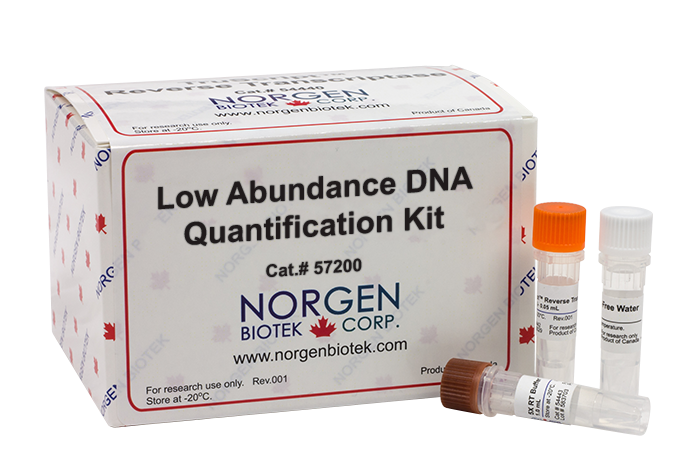
Quantify DNA of a wide spectrum of concentrations, including the lower ng per µL, pg per µL and sub-pg per µL range
Compatible with any Real-Time PCR system
DNA is accurately quantified using a standard curve constructed from the provided DNA standard
Norgen’s Low Abundance DNA Quantification Kit offers a PCR-based detection procedure to quantify DNA of a wide spectrum of concentrations, including the lower ng per µL, pg per µL and sub-pg per µL range. The kit consists of a specially designed primer mix, that is used in conjunction with the provided 2x PCR Master Mix, to amplify human DNA from different types of inputs (such as various liquid biopsies). The kit is compatible with any Real-Time PCR system with the addition of fluorescent nucleic acid stains such as SYBR Green. The unknown DNA is accurately quantified by using a standard curve constructed from the provided DNA Standard.
Storage Conditions Upon receipt, store Norgen’s Low Abundance DNA Quantification Kit at -20°C or lower. Avoid multiple freeze-thaw cycle. If needed, prepare smaller working aliquots and store at -20°C or lower.
The series of DNA Size Selection Kits (Magnetic Beads) were developed for DNA size selection using magnetic beads. A total of 11 kits are available, with different selection ranges spanning from 50 bp to over 10 kb. The kits provide a simple and quick approach for the enrichment of a specific range of DNA fragments. The kit workflow allows double-sided or single-sided size selection for specific size cutoffs.
Gel images of different ranges of size selection. Sheared human genomic DNA was used as input.
.
DNA size selection is a selective capture of DNA fragments of a specific range of size for next-generation sequencing (NGS) library preparations, PCR, ChIP assay, DNA ligations, endonuclease digestions, adapter removal, and other genomics and molecular biology applications. DNA size selection is preferred after NGS library prep in most of the cases. The NGS library preparation is related to the quality of the sequencing data. Precise NGS library size selection can increase sequencing efficiency, improve data quality, and reduce costs.
There are two types of sequencing technologies: short-read sequencing and long-read sequencing. Short-read sequencing uses DNA libraries that contain small insert DNA fragments of similar sizes, usually several hundred base pairs. The sequencing efficiency can be improved if the DNA size selection is in the right range. Cat.# 20104S and 20104L are the best kits for NGS library size selection of illumina paired-end 100 (PE100) sequencing with 100-200 bp library inserts; Cat.# 20105S and 20105L are the best kits for NGS library size selection of illumina paired-end 150 (PE150) sequencing with 150-300 bp library inserts; and Cat.# 20106S and 20106L are the best kits for NGS library size selection of illumina paired-end 300 (PE300) sequencing with 300-600 bp library inserts.
Long-read sequencing uses a large DNA fragment as input and makes very long reads. Usually, library size selection is preferred to remove smaller fragments. Cat.# 20110S and 20110L are the best kits for long-read sequencing size selection with DNA sizes >5 kb, and Cat.# 20111S and 20111L are the best kits for long-read sequencing size selection with DNA sizes >10 kb.
The magnetic beads technology uses paramagnetic particles, also known as SPRI (Solid Phase Reversible Immobilization) beads, to bind DNA reversibly and selectively. DNA fragments can be size-selected and purified by changing the properties of the magnetic beads or SPRI beads. The magnetic beads can easily separate the beads-binding DNA from the contaminants and unwanted components in the samples. The samples after DNA size selection are free of contaminants such as buffer components, enzymes, proteins, salts, dNTPs, primers, and adapters. Our proprietary magnetic beads reagents improve yield, selectivity, and reproducibility.
Specific DNA fragments at a certain length range can be purified simply using magnetic separation with different beads components, avoiding tedious and time-consuming gel extraction and column-based purification. The magnetic beads method is popular for common DNA size selection, including library size selection. The first beads-binding step, referred to as the right-side clean-up, removes large DNA fragments. The large DNA fragments are bound to the beads and are discarded. The desired DNA fragments in the supernatant are transferred to a new well, and new beads are added to the supernatant for the second beads-binding, referred to as the left-side clean-up. The double-size selected DNA fragments are eluted after ethanol rinsing.
DNA size selection with dual clean-ups.
.
A single clean-up is needed for DNA size selection with large fragments. In this case, only the large DNA fragments are bound to the beads. The selected larger DNA fragments are eluted after ethanol rinsing.
DNA size selection with single clean-up for >5 kb and >10 kb DNA.
.
Features of DNA size selection and library size selection
High specificity and high recovery of size selection
11 selection ranges are available, including 5 ranges for NGS library size selection
50-100 bp
100-200 bp
200-500 bp
250-350 bp: ideal for illumina PE100 sequencing
300-450 bp: ideal for illumina PE150 sequencing
450-750 bp: ideal for illumina PE300 sequencing
500-1000 bp
1-3 kb
1-5 kb
>5 kb: ideal for long-read sequencing
>10 kb: ideal for long-read sequencing
Fast and simple
20-min protocol
No gel purification required
No columns required
No centrifugation required
Efficient removal of contaminants and unwanted components
Lateral Flow Assay designed for the detection of IgG antibodies against PF4/polyanion-complexes in human citrated plasma or Serum
This product is only available in Germany!
Method/Platform
lateral flow, immunoassay
Range/Assay Sensivity
Test Principle
IgG antibodies are resposible for the heparin induced thrombocytopenia.
Immobilized anti-human IgG on the membrane of the test unit binds patients IgG-antibodies which are previously captured by the PF4/polyanion-complex which is detected by intensely colored gold nanoparticles.
The presence of PF4/polyanion-complex becomes visible at a colored test line. The surplus of gold particles continues to migrate through the membrane and is captured at the control line by specific antibodies.
Document
0 tests Lateral Flow Assay designed for the detection of IgG antibodies against PF4/polyanion-complexes in human citrated plasma or Serum