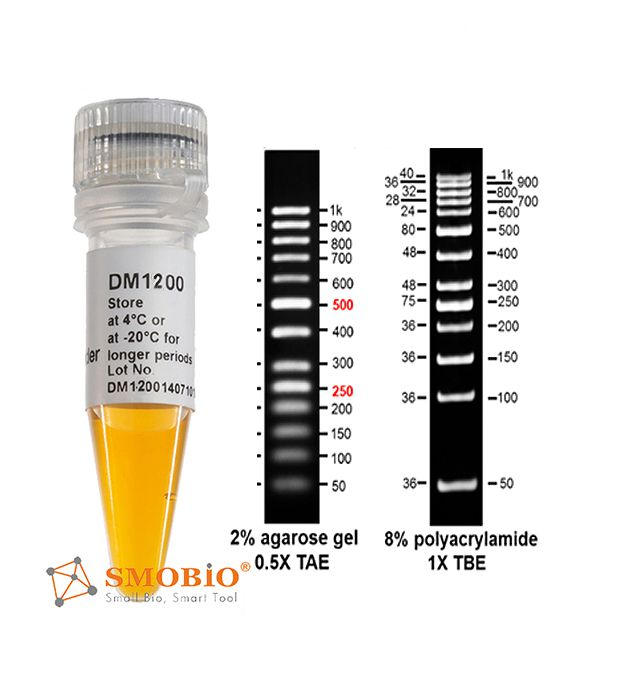
AccuBand™ 50 bp DNA Ladder II is composed of 13 individual DNA fragments, presenting 1k, 900, 800, 700, 600, 500, 400, 300, 250, 200, 150, 100 and 50 bp sharp bands respectively. This product contains 2 enhanced bands (500 bp and 250 bp) for easy band identification. AccuBand™ 50 bp DNA Ladder II is ready-to-use, containing loading buffer with a tracking dye (orange G). AccuBand™ 50 bp DNA Ladder II provides a sufficient amount of DNA for clear observation of all DNA bands ranging from 50 bp to 1 kb, either in agarose gel or in polyacrylamide gel electrophoresis.
Detail
Description
AccuBand™ 50 bp DNA Ladder II is composed of 13 individual DNA fragments, presenting 1k, 900, 800, 700, 600, 500, 400, 300, 250, 200, 150, 100 and 50 bp sharp bands respectively. This product contains 2 enhanced bands (500 bp and 250 bp) for easy band identification. AccuBand™ 50 bp DNA Ladder II is ready-to-use, containing loading buffer with a tracking dye (orange G). AccuBand™ 50 bp DNA Ladder II provides a sufficient amount of DNA for clear observation of all DNA bands ranging from 50 bp to 1 kb, either in agarose gel or in polyacrylamide gel electrophoresis.
Features
Sharp bands
Suitable for polyacrylamide gel electrophoresis
Quick reference— enhanced bands
Ready-to-use— premixed with loading dye for direct loading
Stable— room temperature storage over 6 months
Source
Phenol extracted PCR products and dsDNA digested with specific restriction enzymes, equilibrated in 10 mM Tris-HCl (pH 8.0) and 10 mM EDTA.
Range
50 ~ 1,000 bp
Concentration
55.5 µg/ 500 µl
Recommended loading volume
5 µl/ well
Storage
Room temperature for 6 months 4°C for 12 months -20°C for 36 months
Other Products
Shrimp Alkaline Phosphatase
Product Info
Document
Product Info
OverView
ArcticZymes’ Shrimp Alkaline Phosphatase (SAP), including its recombinant version (rSAP), is the gold standard and the first heat-labile, all-purpose alkaline phosphatase on the market.
Originally isolated from Pandalus borealis (Arctic shrimp), it has been purified from a recombinant source since 2010. Unlike other alkaline phosphatases, rSAP can be fully inactivated by a short heat treatment of 15 minutes at 65°C.
This added convenience through complete heat inactivation has made SAP one of the most sold DNA modifying enzymes.
For added flexibility, especially when lyophilisation may be desired, rSAP is also available in a Glycerol FREE format. First launched in 1993, SAP’s unique features continue to make it a valuable tool in various applications.
Key Features
Gold standard heat labile, all-purpose alkaline phosphatase.
Completely inactivated after 5 min at 65°C or 1 min at 75°C.
Robust: Active in most restriction enzyme buffers, no need for supplemental zinc or other additives for activity.
Simple, hassle-free dephosphorylation of DNA, RNA, dNTPs and proteins for subsequent use in cloning or end-labelling of probes.
No vector purification necessary.
Easy inactivation of unincorporated dNTPs in PCR products prior to DNA sequencing or SNP analysis.
Ideal for MALDI-TOF, cloning, HLA typing, genotyping and sequencing.
Preparing substrate in protein kinase studies.
Figures
Properties
Document
ArcticZymes’ Shrimp Alkaline Phosphatase (SAP), including its recombinant version (rSAP), is the gold standard and the first heat-labile, all-purpose alkaline phosphatase on the market.
Q-PAGE™ TGN (Tris-Glycine Novel) Precast Gels are ready-to-use acrylamide gels for SDS-PAGE running in Tris-Glycine buffer system. With unique formula, Q-PAGE™ TGN Precast Gels perform enhanced speed, better separation, and longer shelf life as compared with conventional Laemmli Tris-HCl gels. The protein migration patterns in Q-PAGE™ TGN series, however, are similar with typical Laemmli Tris-HCl gels, and thus Q-PAGE™ TGN Precast Gels are compatible to traditional SDS-PAGE and subsequent analyses.
Q-PAGE™ TGN Precast Gels are available in gradient (4 to 15%) and fixed (10%) concentrations of polyacrylamide in 12- and 15-well formats. Two available cassette sizes, Mini (10 x 8.3 cm) and Midi (10 x 10 cm), are compatible with most popular protein electrophoresis systems. Q-PAGE™ Mini (QP4XXX) Gels are suitable for Bio-Rad® and other systems. Q-PAGE™ Midi (QP5XXX) Gels are suitable for Invitrogen® XCell SureLock® Mini-Cell, Invitrogen® Mini Gel Tank, Hoefer SE260, and other systems.
Key Features
User-friendly gel cassette:
Numbered and framed wells for sample loading
Labeled warning sign and green tape as reminder
Enhanced gel performance:
Enhanced gel electrophoresis speed
Better band separation
Stable for shipping at ambient temperature
Easy compatibility:
Available as homogeneous and adjusted gradient gels for a wide range of protein separation.
Compatible with most popular protein electrophoresis systems
Storage and stability
Store Q-PAGE™ Precast Gels at 4°C for periods up to 12 months.
Do not freeze Q-PAGE™ Precast Gels. Remove tape and comb before electrophoresis.
Keep Q-PAGE™ Precast Gels flat during storage.
Document
Q-PAGE™ TGN (Tris-Glycine Novel) Precast Gels are ready-to-use acrylamide gels for SDS-PAGE running in Tris-Glycine buffer system. With unique formula, Q-PAGE™ TGN Precast Gels perform enhanced speed, better separation, and longer shelf life as compared with conventional Laemmli Tris-HCl gels. The protein migration patterns in Q-PAGE™ TGN series, however, are similar with typical Laemmli Tris-HCl gels, and thus Q-PAGE™ TGN Precast Gels are compatible to traditional SDS-PAGE and subsequent analyses.
Q-PAGE™ TGN Precast Gels are available in gradient (4 to 15%) and fixed (10%) concentrations of polyacrylamide in 12- and 15-well formats. Two available cassette sizes, Mini (10 x 8.3 cm) and Midi (10 x 10 cm), are compatible with most popular protein electrophoresis systems. Q-PAGE™ Mini (QP4XXX) Gels are suitable for Bio-Rad® and other systems. Q-PAGE™ Midi (QP5XXX) Gels are suitable for Invitrogen® XCell SureLock® Mini-Cell, Invitrogen® Mini Gel Tank, Hoefer SE260, and other systems.
This product is suitable for rapid extraction of DNA from tissue, cells, blood, saliva, swabs, blood spots, semen and other clinical samples. DNA can be used directly for PCR, quantitative PCR, Southern Blot, test of virus DNA and so on.
Details
Specifications
Features
Specifications
Main Functions
Isolation total DNA from blood, buffy coat, tissue and other samples
Applications
Second generation sequencing, PCR, real time PCR, etc.
Purification method
Polydisperse magnetic beads
Purification technology
Magnetic beads technology
Process method
Manual or automatic
Sample type
Anticoagulant blood, concentrated blood, buffy coat, lymphocytes and cultured cells
This product is based on the purification method of high binding magnetic particles. The sample is lysed and digested under the action of lysate and protease. DNA is released into the lysate. After adding magnetic particles and binding solution, DNA will be adsorbed on the surface of magnetic particles, and impurities such as proteins will be removed without adsorption. The adsorbed particles were washed with washing solution to remove proteins and impurities, washed with ethanol to remove salts, and finally DNA was eluted by Elution Buffer.
Advantages
High purity – OD 260 / 280 : 1.7- 1.9, OD 260 / 230 : 1.5 – 2.0
Economy – less than 50% of the price of Qiagen and other imported products
High yield – most optimal process, ensuring the recovery up to 90%
Strong processing ability – samples including animal blood, cultured cells, animal tissues, etc.
Proteinase K, RNase A, MagPure Particles should be stored at 2-8°C upon arrival. However, short-term storage (up to 24 weeks) at room temperature (15-25°C) does not affect their performance. The remaining kit components can be stored at room temperature (15-25°C) and are stable for at least 18 months under these conditions.
Experiment Data
Document
This product is suitable for rapid extraction of DNA from tissue, cells, blood, saliva, swabs, blood spots, semen and other clinical samples. DNA can be used directly for PCR, quantitative PCR, Southern Blot, test of virus DNA and so on.