
Description
Specifications
| Clone | IHC697 |
| Source | Mouse Monoclonal |
| Positive Control | Colon Cancer |
| Dilution Range | 1:200 |

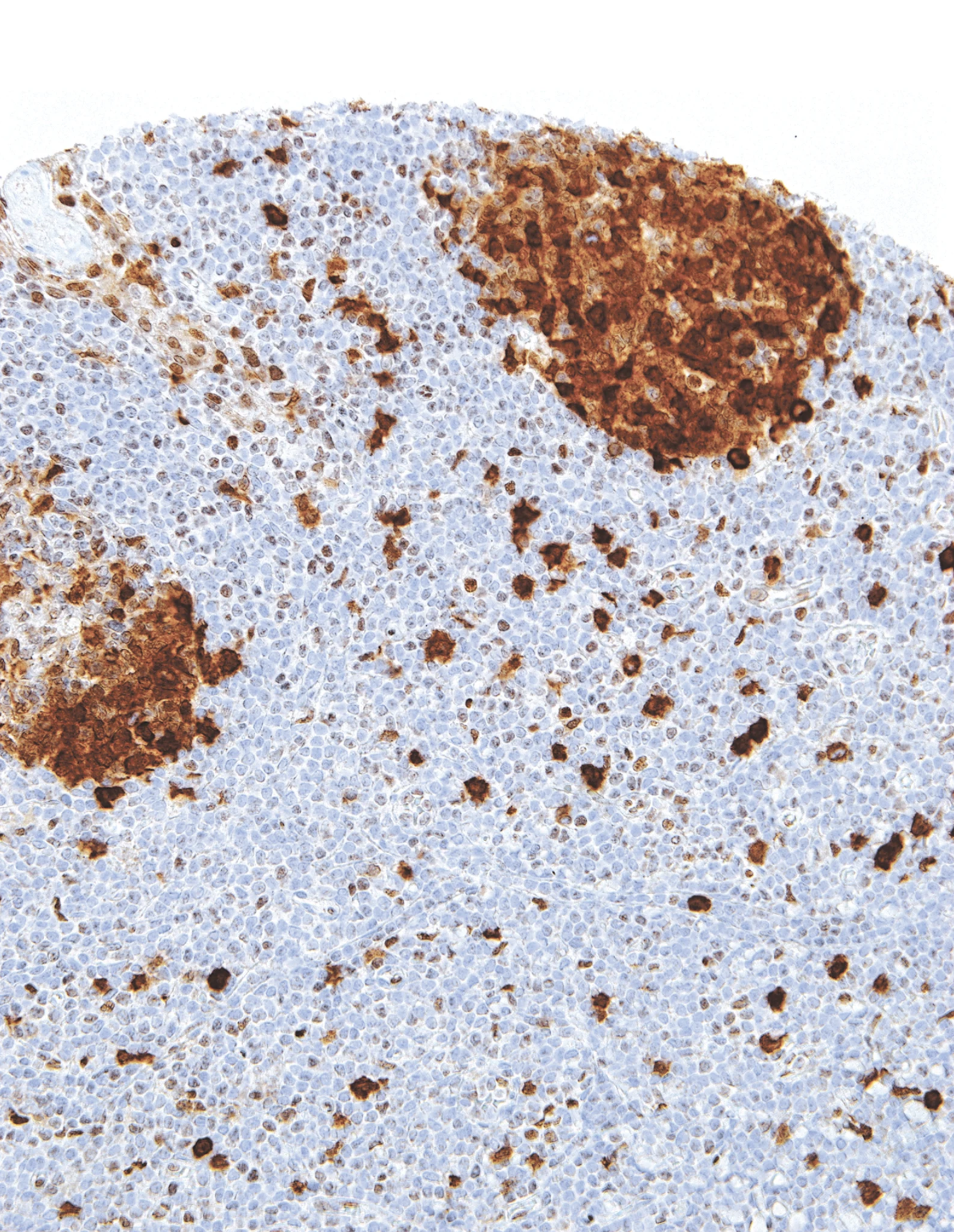
| Clone | IHC697 |
| Source | Mouse Monoclonal |
| Positive Control | Colon Cancer |
| Dilution Range | 1:200 |

The NGS Cell Free DNA Library Prep Kit (illumina and MGI Platforms) was developed for the construction of high quality cell-free DNA (cfDNA) libraries using 1 ng to 50 ng of cell-free DNA as input. The kit has a simple work flow and a fast procedure. Multiplexing of the cell free DNA library is possible based on the index type.

NGS Cell Free DNA Library Prep Kit Workflow
The main source of cell-free DNA (cfDNA) is derived from apoptotic hematopoietic cells in blood and found in the plasma. The length of the cfDNA is about 150-200 bp in length. Circulating tumor DNA (ctDNA) derived from malignant tumors is a part of cfDNA. Both cfDNA and ctDNA can be used as a noninvasive biomarker since it offers a better approach in comparison to invasive tissue biopsies.
NGS has been used for cfDNA and ctDNA sequencing in the field of liquid biopsy as it provides a whole genome level of molecular profiling. One of the hurdles for cfDNA sequencing is the difficulty of library preparation from the limited amount of cfDNA obtained from plasma. Our cell-free NGS kit makes it easy to get enough libraries from limited input in just 1.5 hours.
Three index types are available for the NGS Cell Free DNA Library Prep Kit of the illumina platform:
Non-index (Cat.# 30029): Libraries do not have index.
Index(Cat.# 30031): Each of our index primers contains a unique 6-base index sequence that can be used for sample identification. Total 48 library multiplexing is possible. Index information can be downloaded here.
Unique dual index (Cat.# 30033): Cell-free DNA library multiplexing up to 96 samples is possible with the unique dual indexes. We have developed a Four-Base Difference Index System. The system have at least 4 bases different from each other in the 8 bases index length. The primers effectively minimize sequencing errors such as mis-assignment, index hopping, index contamination etc. Index information can be downloaded here.
Indexes are available for the MGI platform kits (Cat.# 34031).
Kit advantages:

Comparison of library conversion efficiency with different samples under the same condition.

Comparison of library yield with different samples under the same condition.
The NGS Cell Free DNA Library Prep Kit (illumina and MGI Platforms) was developed for the construction of high quality cell-free DNA (cfDNA) libraries using 1 ng to 50 ng of cell-free DNA as input. The kit has a simple work flow and a fast procedure. Multiplexing of the cell free DNA library is possible based on the index type.


Methyltetrazine-PEG4-DBCO is a PEG linker with a terminal TCO reactive reagent and a DBCO group. DBCO is commonly used for copper-free Click Chemistry reactions. Methyltetrazine can be used to convert azido-containing peptides or proteins into tetrazine-modified peptides or protein without catalyst or axillary reagents. Reagent grade, for research purpose. Please contact us for GMP-grade inquiries.

Methyltetrazine-PEG4-DBCO is a PEG linker with a terminal TCO reactive reagent and a DBCO group. DBCO is commonly used for copper-free Click Chemistry reactions. Methyltetrazine can be used to convert azido-containing peptides or proteins into tetrazine-modified peptides or protein without catalyst or axillary reagents. Reagent grade, for research purpose. Please contact us for GMP-grade inquiries.