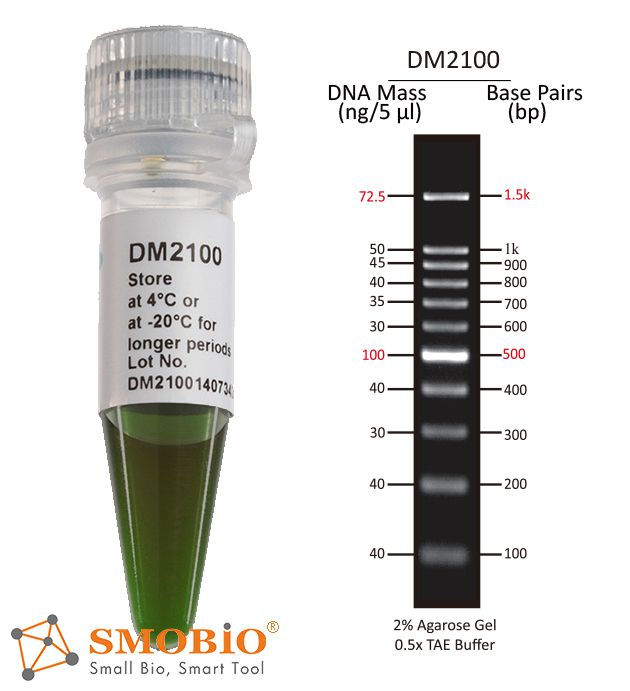
The DM2100 ExcelBand™ 100 bp DNA Ladder is a ready-to-use DNA ladder, which is pre-mixed with loading dye for direct gel loading. The DNA ladder DM2100 is composed of 11 individual DNA fragments: 1.5k, 1k, 900, 800, 700, 600, 500, 400, 300, 200 and 100 bp derived from a mixture of PCR products and specifically digested plasmid DNA. This product contains two enhanced bands (1.5 kb and 500 bp) for easier reference. In addition, two tracking dyes, Xylene cyanol FF and Orange G which mimic the migration of 4,000 bp and 50 bp dsDNA during electrophoresis are also added for real time monitoring.
Detail
Description
The DM2100 ExcelBand™ 100 bp DNA Ladder is a ready-to-use DNA ladder, which is pre-mixed with loading dye for direct gel loading. The DNA ladder DM2100 is composed of 11 individual DNA fragments: 1.5k, 1k, 900, 800, 700, 600, 500, 400, 300, 200 and 100 bp derived from a mixture of PCR products and specifically digested plasmid DNA. This product contains two enhanced bands (1.5 kb and 500 bp) for easier reference. In addition, two tracking dyes, Xylene cyanol FF and Orange G which mimic the migration of 4,000 bp and 50 bp dsDNA during electrophoresis are also added for real time monitoring.
Features
Sharp bands
Quick reference— enhanced bands
Ready-to-use— premixed with loading dye for direct loading
Stable— room temperature storage over 6 months
Source
Phenol extracted PCR products and dsDNA digested with specific restriction enzymes, equilibrated in 10 mM Tris-HCl (pH 8.0) and 10 mM EDTA.
Range
100 ~ 1,500 bp
Concentration
52.2 µg/ 500 µl
Recommended loading volume
5 µl/ well
Storage
Room temperature for 6 months 4°C for 12 months -20°C for 36 months
Other Products
endo-BCN-PEG4-amine
Product Info
Document
Product Info
endo-BCN-PEG4-amine is a click chemistry crosslinker reagent. The BCN groupis very reactive with azide-tagged molecules. The amino group is reactive with carboxylic acids, activated NHS esters, carbonyls (ketone, aldehyde) etc. Reagent grade, for research purpose. Please contact us for GMP-grade inquiries.
Document
endo-BCN-PEG4-amine is a click chemistry crosslinker reagent. The BCN groupis very reactive with azide-tagged molecules. The amino group is reactive with carboxylic acids, activated NHS esters, carbonyls (ketone, aldehyde) etc. Reagent grade, for research purpose. Please contact us for GMP-grade inquiries.
YesBlot™ Western Marker I is a ready-to-use mixture with ten IgG-binding proteins covering a wide range of molecular weights from 15 to 200 kDa in Tris-Glycine buffer. YesBlot™ Western Marker I performs dual functions. First, it contains 4 pre-stained proteins (10, 25, 45 and 70 kDa) for monitoring protein separation during SDS-PAGE, verification of Western transfer efficiency on membranes (nitrocellulose, PVDF, or nylon) and for approximating the protein size. Second, ten IgG-binding proteins can be immuno-detected on film or by CCD imaging. YesBlot™ Western Marker I is compatible for chemiluminescent, fluorescent, chromogenic or other detection systems. In addition, YesBlot™ Western Marker I has two reference bands with enhanced intensity (at 30 kDa and 80 kDa). The marker is supplied in the gel loading buffer and is ready to use. Do NOT heat, dilute, or add reducing agents before loading.
Features
Direct visualization — 10 IgG-binding proteins for direct visualization on Western blots
Pre-stained bands — 4 prestained proteins for monitoring protein separation during electrophoresis and Western blotting transferring efficiency on membrane
Wide range — 10 clear bands from 15 to 200 kDa for size estimation
Quick reference — two enhanced bands (30 and 80 kDa)
Contents
The YesBlot™ Western Marker I contains recombinant IgG binding proteins, prestained recombinant proteins, glycerol and SDS.
Storage
4°C for 3 months -20°C for 24 months
Document
YesBlot™ Western Marker I is a ready-to-use mixture with ten IgG-binding proteins covering a wide range of molecular weights from 15 to 200 kDa in Tris-Glycine buffer. YesBlot™ Western Marker I performs dual functions. First, it contains 4 pre-stained proteins (10, 25, 45 and 70 kDa) for monitoring protein separation during SDS-PAGE, verification of Western transfer efficiency on membranes (nitrocellulose, PVDF, or nylon) and for approximating the protein size. Second, ten IgG-binding proteins can be immuno-detected on film or by CCD imaging. YesBlot™ Western Marker I is compatible for chemiluminescent, fluorescent, chromogenic or other detection systems. In addition, YesBlot™ Western Marker I has two reference bands with enhanced intensity (at 30 kDa and 80 kDa). The marker is supplied in the gel loading buffer and is ready to use. Do NOT heat, dilute, or add reducing agents before loading.
110 mL of prepared reagent (e.g. 500 assays of 0.22 mL)
Content:
110 mL of prepared reagent (e.g. 500 assays of 0.22 mL)
Shipping Temperature:
Ambient
Storage Temperature:
Short term stability: 2-8oC, Long term stability: See individual component labels
Stability:
> 2 years under recommended storage conditions
Analyte:
Acetic Acid
Assay Format:
Auto-analyser
Detection Method:
Absorbance
Wavelength (nm):
340
Signal Response:
Increase
Linear Range:
up to 1.8 g/L of acetic acid per assay
Limit of Detection:
~ 10 mg/L
Reaction Time (min):
8 min at 25oC or 5 min at 37oC
Application examples:
Wine, beer, fruit and fruit juices, soft drinks, vinegar, vegetables, pickles, dairy products (e.g. cheese), meat, fish, bread, bakery products (and baking agents), ketchup, soy sauce, mayonnaise, dressings, paper (and cardboard), tea, pharmaceuticals (e.g. infusion solutions), feed and other materials (e.g. biological cultures, samples, etc.).
Method recognition:
Improved method
The Acetic Acid GK format test kit is for use with auto-analysers and is suitable for the specific measurement and analysis of acetic acid (acetate) especially in wines, fruit juices, beverages and food products.
As part of Megazyme’s overall commitment to providing the highest quality products, we have developed this acetic acid kit that provides a specific and rapid assay for use with auto-analysers. The kit assay is based on the conversion of NAD+ to NADH and therefore provides a positive reaction (increase in absorbance) which offers a more robust assay.
The reagents, as supplied, are stable for a minimum of 2 years and the prepared reagents are stable for a minimum of 1 week (on-board stability). In addition, the prepared reagents can be stored frozen for longer term stability (see K-ACETGK Booklet for more details).
View more of our acetic acid and organic acid assay kits.
Advantages
Excellent reagent stability
> 7 days at 4oC or > 2 years below -10oC when prepared for auto-analyser applications
> 2 years as supplied
Very rapid reaction (~ 5 min at 37oC)
Linear calibration (R2 ~ 0.997 up to 1.8 g/L sample)
Document
The Acetic Acid GK format test kit is for use with auto-analysers and is suitable for the specific measurement and analysis of acetic acid (acetate) especially in wines, fruit juices, beverages and food products.