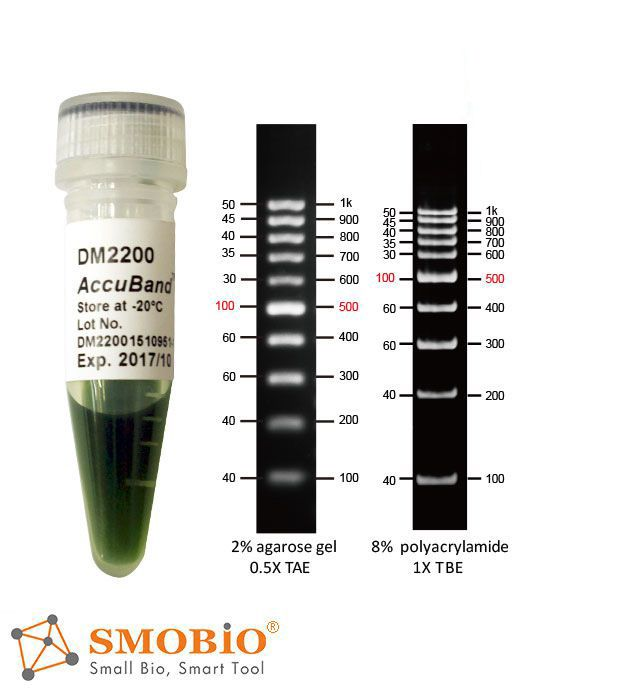
AccuBand™ 100 bp DNA Ladder II is composed of 10 individual DNA fragments, presenting 1k, 900, 800, 700 600, 500, 400, 300, 200 and 100 bp sharp bands respectively. This product contains 1 enhanced band (500 bp) for easy identification of bands. AccuBand™ 100 bp DNA Ladder II is ready-to-use, containing loading buffer with dual color tracking dyes (orange G and Xylene cyanol FF). AccuBand™ 100 bp DNA Ladder II provides a sufficient amount of DNA for clear observation of all DNA bands ranging from 100 bp to 1 kb, either in agarose gel or in polyacrylamide gel electrophoresis.
Features
Sharp bands
Suitable for polyacrylamide gel electrophoresis
Quick reference— enhanced bands
Ready-to-use— premixed with loading dye for direct loading
Stable— room temperature storage over 6 months
Source
Phenol extracted PCR products and dsDNA digested with specific restriction enzymes, equilibrated in 10 mM Tris-HCl (pH 8.0) and 10 mM EDTA.
Range
100 ~ 1,000 bp
Concentration
50 µg/ 500 µl
Recommended loading volume
5 µl/ well
Storage
Room temperature for 6 months 4°C for 12 months -20°C for 36 months
Other Products
Lyophilized RNA Amplification Kit Below 20 Degree Format Easy And Efficient
Product Info
Document
Product Info
Product Description
Lyophilized RNA Amplification Kit -20°C Format Easy And Efficient
Product Detail
Kit Storage and term of Validity
Storage term: stored at ≤-20℃,keep away from light, avoid heavy weight and repeated freezing and thawing.
Term of Validity: 14 months
Isothermal nucleic acid Principle Summary
This kit is based on a rapid nucleic acid amplification technology at room temperature and constant temperature: at room temperature and constant temperature (generally 39 ºC~42 ºC), reverse transcriptase uses specific primers and template RNA to synthesize cDNA strands, and binds the auxiliary protein and single strand With the help of the protein, the recombinase and the primer form a complex; perform a homology search and bind the target homology domain, at this time a D-loop region is formed at the homology position and strand exchange begins; accompanied by the recombinase from the complex Upon dissociation, the polymerase also binds to the 3′ end of the primer, initiating chain extension. Relying on the action of nfo enzyme, adding specific molecular probes designed according to the template, and using colloidal gold technology (sandwich method) can detect the final result.
Isothermal nucleic acid Product Features
1/ High sensitivity and specificity, short reaction time.
2/ The reagent form is freeze-dried, stable and easy to operate.
3/ The reaction can be operated by metal bath and water bath pot without purchasing expensive PCR apparatus.
Technical Parameters:
Parameters
Details
Product Name
RNA Isothermal Amplification Kit NFO
Manufacturer
Amp-future
Storage Temperature
-20°C
Kit Components
Enzymes, Buffers ,Reagents
Packaging
48 Tests/box
Detection Limit
500-1000copies/µL
Shipping
ICE
Test Time
5-20mins
Isothermal nucleic acid Applications
Suitable for RNA isothermal rapid amplification kit(NFO type)
Primer: Require pair of nucleotide primers with the length of 25-35 bp.
RNA NFO kit reaction temperature is 39 to 42℃ and time is 5-20 minutes.
Notes
1/ Please avoid nucleic acid contamination and set blank control during reaction due to the high sensitivity of the kit.
2/ Please take out the required quantity of MIRA reaction units for the experiment, and put the rest under storage conditions when performing the experiment.
Biotin-PEG4-alkyne is a PEG linker containing a biotin group and a terminal alkyne. Biotin is useful for affinity-based applications such as pull-down assays or for ligating with streptavidin proteins while terminal alkynes are used in copper (I) click chemistry with azides to form stable triazoles with a target molecule. The inclusion of a PEG linker in this molecule improves its aqueous solubility.
Document
Biotin-PEG4-alkyne is a PEG linker containing a biotin group and a terminal alkyne. Biotin is useful for affinity-based applications such as pull-down assays or for ligating with streptavidin proteins while terminal alkynes are used in copper (I) click chemistry with azides to form stable triazoles with a target molecule. The inclusion of a PEG linker in this molecule improves its aqueous solubility.
PACE (PCR Allelic Competitive Extension) genotyping chemistry is a homogeneous, PCR-based allele-specific technology for the analysis of DNA sequence variants, most commonly SNPs (Single Nucleotide Polymorphisms) and Indels (insertion / deletions).
PACE genotyping chemistry is comprised of two parts:
PACE Genotyping Assay: two allele-specific forward primers and one common, reverse primer. The allele-specific forward primers each have different 3′ terminal bases reflecting the target variant, and a unique 5’ tail sequence which is incorporated as part of the fluorescent signal mechanism.
PACE Genotyping Master Mix: containing all remaining components required for PCR and the generation of fluorescent signals. PACE Genotyping Master Mix contains a novel, universal, fluorescent reporting cassette to produce machine-readable fluorescent signals (FAM and HEX) corresponding to the assay genotypes.
When combined with sample DNA, these components create a PACE Genotyping Reaction, as illustrated in the figure below.
We have extensive knowledge and experience in assay design, especially when it comes to allele-specific PCR. PACE Genotyping Assays are available to purchase either Validated and Unvalidated. Validated assays require customer DNA to validate and optimise, for guaranteed performance. Unvalidated assays are designed in silico and supplied untested.
REQUIRED COMPONENTS
qPCR machine or Thermocycler + Fluorescent plate reader
PCR plate or equivalent and appropriate optically clear seal
Template DNA
PCR-grade water
PACE Genotyping Master Mix or PACE 2.0 Genotyping Master Mix
STEPS TO YOUR PACE GENOTYPING ASSAY DESIGN
Place your order on this page. Our support team will contact you by email.
Fill out an Assay Design Template form with all the information we need to process your custom PACE Genotyping Assay order. We will email you a copy of the template when we first contact you, or your can download a copy here.
Using the information you provide us, we will create your PACE Genotyping Assay designs, order the oligos, and send you design sequences.
Once we receive the oligos, we assemble the assay(s) and then ship an aliquot to you (unvalidated) or test on your DNA samples before shipping the aliquot to you (validated).