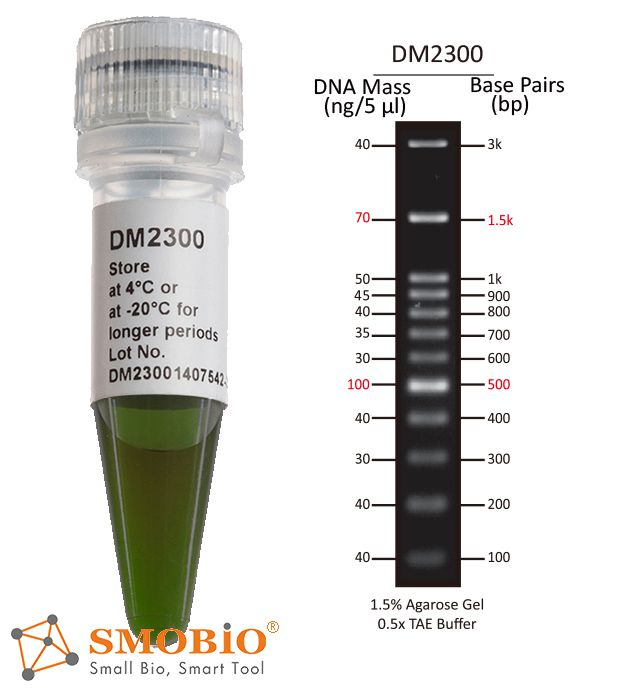
The DM2300 ExcelBand™ 100 bp+3K DNA Ladder is a ready-to-use DNA ladder, which is pre-mixed with loading dye for direct gel loading. The DNA ladder DM2300 is composed of 12 individual DNA fragments: 3k, 1.5k, 1k, 900, 800, 700, 600, 500, 400, 300, 200 and 100 bp derived from a mixture of PCR products and specifically digested plasmid DNA. This product contains two enhanced bands (1.5 kb and 500 bp) for easier reference. In addition, two tracking dyes, Xylene cyanol FF and Orange G which mimic the migration of 4,000 bp and 50 bp dsDNA during electrophoresis are also added for real time monitoring.
Detail
Description
The DM2300 ExcelBand™ 100 bp+3K DNA Ladder is a ready-to-use DNA ladder, which is pre-mixed with loading dye for direct gel loading. The DNA ladder DM2300 is composed of 12 individual DNA fragments: 3k, 1.5k, 1k, 900, 800, 700, 600, 500, 400, 300, 200 and 100 bp derived from a mixture of PCR products and specifically digested plasmid DNA. This product contains two enhanced bands (1.5 kb and 500 bp) for easier reference. In addition, two tracking dyes, Xylene cyanol FF and Orange G which mimic the migration of 4,000 bp and 50 bp dsDNA during electrophoresis are also added for real time monitoring.
Features
Sharp bands
Quick reference— enhanced bands
Ready-to-use— premixed with loading dye for direct loading
Stable— room temperature storage over 6 months
Source
Phenol extracted PCR products and dsDNA digested with specific restriction enzymes, equilibrated in 10 mM Tris-HCl (pH 8.0) and 10 mM EDTA.
Range
100 ~ 3,000 bp
Concentration
56 µg/ 500 µl
Recommended loading volume
5 µl/ well
Storage
Room temperature for 6 months 4°C for 12 months -20°C for 36 months
Other Products
IVD3018 HiPure Universal DNA Kit
Product Info
Document
Product Info
Introduction
This product is suitable for rapid extraction of total DNA from tissue, cells, blood, saliva, swabs, blood spots, semen and other clinical samples. DNA can be used directly for PCR, quantitative PCR, Southern Blot, test of virus DNA and so on.
Details
Specifications
Features
Specifications
Main Functions
Isolation total DNA from tissue / blood / body fluid / swab /dry blood spots
Applications
PCR, qPCR, southern bolt and virus detection, etc.
Purification method
Mini spin column
Purification technology
Silica technology
Process method
Manual (centrifugation or vacuum)
Sample type
Tissue, cell, blood, saliva, swab, blood spot, semen and other clinical samples
This product is based on silica Column purification. The sample is lysed and digested with lysate and protease, DNA is released into the lysate. Transfer to an adsorption column. Nucleic acid is adsorbed on the membrane, while protein is not adsorbed and is removed with filtration. After washing proteins and other impurities, nucleic acid was finally eluted with low-salt buffer (10mm Tris, pH9.0, 0.5mm EDTA).
Advantages
High quality DNA – meet a variety of downstream applications, including PCR, qPCR, enzyme digestion, hybridization, etc.
Fast – without separation of leukocytes, organic extraction or ethanol precipitation
Simple – all nucleic acids can be obtained by direct digestion
Wide applicability – It can handle various liquid samples, animal tissues and cultured cells
Kit Contents
Contents
IVD3018
Purification Times
100
HiPure DNA Mini Columns I
100
2ml Collection Tubes
2 x 100
Buffer ATL
60 ml
Buffer AL
60 ml
Buffer GW1
44 ml
Buffer GW2
50 ml
Proteinase K
60 mg
Protease Dissolve Buffer
5 ml
Buffer AE
15 ml
Storage and Stability
Proteinase K should be stored at 2–8°C upon arrival. However, short-term storage (up to 12 weeks) at room temperature (15–25°C) does not affect their performance. The remaining kit components can be stored at room temperature (15–25°C) and are stable for at least 18 months under these conditions. The entire kit can be stored at 2–8°C, but in this case buffers should be redissolved before use. Make sure that all buffers are at room temperature when used.
Experiment Data
Document
This product is suitable for rapid extraction of total DNA from tissue, cells, blood, saliva, swabs, blood spots, semen and other clinical samples. DNA can be used directly for PCR, quantitative PCR, Southern Blot, test of virus DNA and so on.
Dietary fiber can generally be described as the carbohydrate content of food that is not digested in the human small intestine. It passes into the large intestine where it is partially or fully fermented. These characteristics of dietary fiber are associated with its numerous well documented health benefits.
Dietary Fiber is a mixture of complex organic substances, including hydrophilic compounds, such as soluble and insoluble polysaccharides and non-digestable oligosaccharides, as well as a range of non-swellable, more or less hydrophobic, compounds such as cutins, suberins and lignins. The procedures for the determination and analysis of total dietary fiber as outlined in our assay protocol are based on the methods of Lee et al.1 and Prosky et al.2,3 (AOAC 991.43, AOAC 985.29, AACC 32-07.01 and AACC 32-05.01). However, the enzymes in the Megazyme Total Dietary Fiber Kit can also be used in other dietary fiber analytical methods such as AACC Method 32-21.01 and AACC Method 32-06.01.
1. Association of Official Analytical Chemists. (1985). Official Methods of Analysis, 14th ed., 1st suppl. Secs. 43, A14-43, A20, p.399. 2. Association of Official Analytical Chemists. (1986). Changes in methods. J. Assoc. Off. Anal. Chem., 69, 370. 3. Association of Official Analytical Chemists. (1987). Changes in methods. J. Assoc. Off. Anal. Chem., 70, 393.
See General Referee Reports: Journal of AOAC INTERNATIONAL, Vol. 81, No. 1, 1998.
Two separate methods are described in the associated assay protocol:
METHOD 1: DETERMINATION OF TOTAL, SOLUBLE AND INSOLUBLE DIETARY FIBER Based on AOAC Method 991.43 “Total, Soluble, and Insoluble Dietary Fiber in Foods” (First Action 1991) and AACC Method 32-07.01 “Determination of Soluble, Insoluble, and Total Dietary Fiber in Foods and Food Products” (Final Approval 10-16-91).
METHOD 2: DETERMINATION OF TOTAL DIETARY FIBER Based on AACC method 32-05.01 and AOAC Method 985.29.
Note that a letter of endorsement from the original method developer, Dr. Leon Prosky, is included in the Documents Tab.