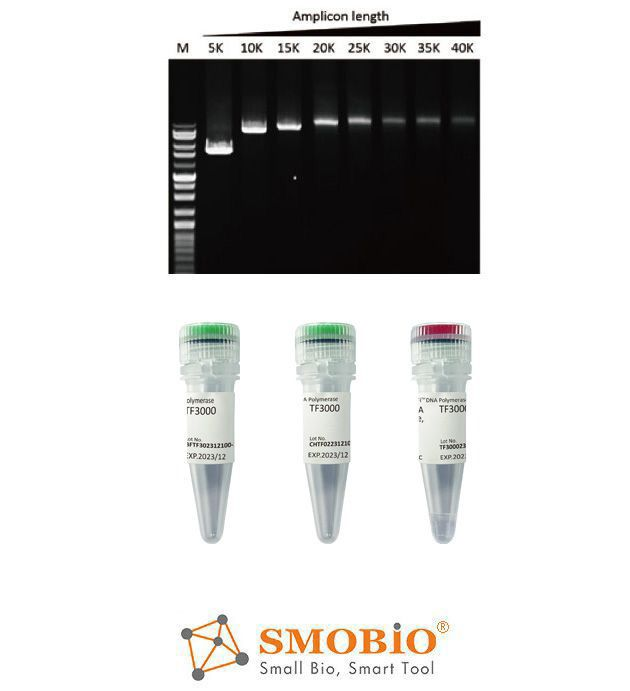
The G-HiFi™ DNA Polymerase is a new genetically modified, recombinant DNA polymerase suitable for GC-rich templates that are difficult to amplify. The fidelity of G-HiFi™ DNA Polymerase is 70 times higher than that of Taq DNA polymerase. The high extension rate of G-HiFi™ DNA Polymerase is achieved by blending the DNA polymerase with an elongation enhancer. The optimized 5X G-HiFi™ Buffer includes special ingredients that suppress non-specific amplification as well as plateau effect produced by conventional PCR. With the optimized 5X G-HiFi™ Buffer, G-HiFi™ DNA Polymerase is capable to amplify most templates, such as longer targets (up to 40 kb from lambda DNA) and that contain GC-rich sequences.
Detail
Description
The G-HiFi™ DNA Polymerase is a new genetically modified, recombinant DNA polymerase suitable for GC-rich templates that are difficult to amplify. The fidelity of G-HiFi™ DNA Polymerase is 70 times higher than that of Taq DNA polymerase. The high extension rate of G-HiFi™ DNA Polymerase is achieved by blending the DNA polymerase with an elongation enhancer. The optimized 5X G-HiFi™ Buffer includes special ingredients that suppress non-specific amplification as well as plateau effect produced by conventional PCR. With the optimized 5X G-HiFi™ Buffer, G-HiFi™ DNA Polymerase is capable to amplify most templates, such as longer targets (up to 40 kb from lambda DNA) and that contain GC-rich sequences.
Features
5’→3’ DNA polymerase activity
3’→5’ exonuclease (proofreading) activity
Suitable for GC-rich templates
High reaction rate: 7 seconds/kb
High fidelity: 70 times higher than Taq polymerase
Generates blunt end amplicons
Vast elongation capability (up to 40 kb)
Thermo-stable for more than 10 hrs at 95°C
Storage
[TF3000] G-HiFi™ DNA Polymerase
-20°C for 24 months
Other Products
Propargyl-PEG8-bromide
Product Info
Document
Product Info
Propargyl-PEG8-bromide is a PEG reagent containing an alkyne group and a bromide group. The alkyne group can react with azide-bearing compounds or biomolecules in Click Chemistry reactions under the catalyzation of copper. The PEG spacer increases water-solubility of the molecule in aqueous media. Reagent grade, for research purpose. Please contact us for GMP-grade inquiries.
Document
Propargyl-PEG8-bromide is a PEG reagent containing an alkyne group and a bromide group. The alkyne group can react with azide-bearing compounds or biomolecules in Click Chemistry reactions under the catalyzation of copper. The PEG spacer increases water-solubility of the molecule in aqueous media. Reagent grade, for research purpose. Please contact us for GMP-grade inquiries.
Short term stability: 2-8oC, Long term stability: See individual component labels
Stability:
> 2 years under recommended storage conditions
Analyte:
Fructan
Assay Format:
Spectrophotometer
Detection Method:
Absorbance
Wavelength (nm):
410
Signal Response:
Increase
Linear Range:
2.3 to 55 µg of D-fructose or D-glucose per assay
Limit of Detection:
0.16 g/100 g
Total Assay Time:
~ 90 min
Application examples:
Flours, infant formula, animal feed, pet foods, plant materials (e.g. onion), food products and other materials
Method recognition:
AACC Method 32-32.01, AOAC Method 999.03, AOAC Method 2016.14, AOAC Method 2018.07 and CODEX Method Type III
The Fructan Assay Kit is suitable for the specific measurement of fructan in plant extracts, animal feed and food products containing starch, sucrose and other sugars. It is used in three validated methods for the determination of fructan: AOAC method 999.03 (foods), AOAC method 2018.07 (Animal Feed) and AOAC method 2016.14 (infant formula and adult nutritionals).
New, improved procedure.
In the most recent development, a recombinant endo-levanase has been incorporated into the fructanase mixture, extending the use of the method to the measurement of levan-type fructans as are present in grasses such as timothy, cocksfoot, ryegrass and red fescue.
The method described in this booklet employs ultra-pure, recombinant enzymes and specifically measures fructans including inulin-type fructans from chicory, dahlia, jerusalem artichoke; highly branched fructans from onion and wheat stems and leaves; and levan-type fructans from pasture grasses such as timothy grass. The enzymes employed are completely devoid of contaminating enzymes active on β-glucan or gluco-oligosaccharides.
All kit reagents stable for > 2 years after preparation
Unaffected by high sucrose / reducing sugar concentrations
Fructan kits are only available from Megazyme
Simple format
Mega-Calc™ software tool is available from our website for hassle-free raw data processing
Standard included
Document
The Fructan Assay Kit is suitable for the specific measurement of fructan in plant extracts, animal feed and food products containing starch, sucrose and other sugars. It is used in three validated methods for the determination of fructan: AOAC method 999.03 (foods), AOAC method 2018.07 (Animal Feed) and AOAC method 2016.14 (infant formula and adult nutritionals).
Q-PAGE™ TGN (Tris-Glycine Novel) Precast Gels are ready-to-use acrylamide gels for SDS-PAGE running in Tris-Glycine buffer system. With unique formula, Q-PAGE™ TGN Precast Gels perform enhanced speed, better separation, and longer shelf life as compared with conventional Laemmli Tris-HCl gels. The protein migration patterns in Q-PAGE™ TGN series, however, are similar with typical Laemmli Tris-HCl gels, and thus Q-PAGE™ TGN Precast Gels are compatible to traditional SDS-PAGE and subsequent analyses.
Q-PAGE™ TGN Precast Gels are available in gradient (4 to 15%) and fixed (10%) concentrations of polyacrylamide in 12- and 15-well formats. Two available cassette sizes, Mini (10 x 8.3 cm) and Midi (10 x 10 cm), are compatible with most popular protein electrophoresis systems. Q-PAGE™ Mini (QP4XXX) Gels are suitable for Bio-Rad® and other systems. Q-PAGE™ Midi (QP5XXX) Gels are suitable for Invitrogen® XCell SureLock® Mini-Cell, Invitrogen® Mini Gel Tank, Hoefer SE260, and other systems.
Key Features
User-friendly gel cassette:
Numbered and framed wells for sample loading
Labeled warning sign and green tape as reminder
Enhanced gel performance:
Enhanced gel electrophoresis speed
Better band separation, equivalent to commercially 4-20% TG gels
Stable for shipping at ambient temperature
Easy compatibility:
Available as homogeneous and adjusted gradient gels for a wide range of protein separation.
Compatible with most popular protein electrophoresis systems
Storage and stability
Store Q-PAGE™ Precast Gels at 4°C for periods up to 12 months.
Do not freeze Q-PAGE™ Precast Gels. Remove tape and comb before electrophoresis.
Keep Q-PAGE™ Precast Gels flat during storage.
Document
Q-PAGE™ TGN (Tris-Glycine Novel) Precast Gels are ready-to-use acrylamide gels for SDS-PAGE running in Tris-Glycine buffer system. With unique formula, Q-PAGE™ TGN Precast Gels perform enhanced speed, better separation, and longer shelf life as compared with conventional Laemmli Tris-HCl gels. The protein migration patterns in Q-PAGE™ TGN series, however, are similar with typical Laemmli Tris-HCl gels, and thus Q-PAGE™ TGN Precast Gels are compatible to traditional SDS-PAGE and subsequent analyses.
Q-PAGE™ TGN Precast Gels are available in gradient (4 to 15%) and fixed (10%) concentrations of polyacrylamide in 12- and 15-well formats. Two available cassette sizes, Mini (10 x 8.3 cm) and Midi (10 x 10 cm), are compatible with most popular protein electrophoresis systems. Q-PAGE™ Mini (QP4XXX) Gels are suitable for Bio-Rad® and other systems. Q-PAGE™ Midi (QP5XXX) Gels are suitable for Invitrogen® XCell SureLock® Mini-Cell, Invitrogen® Mini Gel Tank, Hoefer SE260, and other systems.