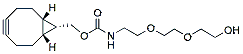
endo-BCN-PEG2-alcohol is a click chemistry PEG linker. The BCN group is very reactive with azide-tagged molecules. The hydroxyl group enables further derivatization or replacement with other reactive functional groups. Reagent grade, for research purpose. Please contact us for GMP-grade inquiries.
Detail
endo-BCN-PEG2-alcohol is a click chemistry PEG linker. The BCN group is very reactive with azide-tagged molecules. The hydroxyl group enables further derivatization or replacement with other reactive functional groups. Reagent grade, for research purpose. Please contact us for GMP-grade inquiries.
Other Products
m-PEG12-propargyl
Product Info
Document
Product Info
Propargyl-PEG12-methane is a PEG linker that can react with azide-bearing compounds or biomolecules via copper catalyzed Click Chemistry to form a stable triazole linkage. The PEG chain enhances the solubility of the molecule in aqueous media. Reagent grade, for research purpose. Please contact us for GMP-grade inquiries.
Document
Propargyl-PEG12-methane is a PEG linker that can react with azide-bearing compounds or biomolecules via copper catalyzed Click Chemistry to form a stable triazole linkage. The PEG chain enhances the solubility of the molecule in aqueous media. Reagent grade, for research purpose. Please contact us for GMP-grade inquiries.
N-t-Boc-Aminooxy-PEG4-N-(PEG2-Propargyl) is a click chemistry crosslinker. The propargyl group is reactive with azide-containing compounds or biomolecules through copper catalyzed Click Chemistry to yield a stable triazole linkage. t-Boc-aminooxy can be deprotected under mild acidic conditions. The hydrophilic PEG linker improves solubility in aqueous media.
Document
N-t-Boc-Aminooxy-PEG4-N-(PEG2-Propargyl) is a click chemistry crosslinker. The propargyl group is reactive with azide-containing compounds or biomolecules through copper catalyzed Click Chemistry to yield a stable triazole linkage. t-Boc-aminooxy can be deprotected under mild acidic conditions. The hydrophilic PEG linker improves solubility in aqueous media.
Fourteen discrete fragments ranging from 25 bp to 650 bp in 50 bp increments
Double intensity reference bands at 200 bp and 400 bp
The Norgen MiniSizer 50 bp DNA Ladder is prepared to ensure quality and batch-to-batch consistency. This Ladder contains fourteen discrete fragments ranging from 25 bp to 650 bp in 50 bp increments with double intensity reference bands at 200 bp and 400 bp. The MiniSizer is ideal for PCR product size confirmation.
Contents:
1mL of premixed DNA ladder (0.5µg/10µL) in loading buffer (10mM EDTA, 10% glycerol, 0.015% bromophenol blue, and 0.17% SDS).
MiniSizer 50 bp DNA Ladder (Cat# 11200) – 100 loads
Ladder Properties: • Fourteen discrete bands, ranging from 50 bp to 650 bp • Higher intensity bands at 200 bp and 400 bp for easy reference
Fragment
Size (bp)
Mass (ng)
1
650
61
2
600
46
3
550
36
4
500
30
5
450
35
6
400
85
7
350
27
8
300
25
9
250
16
10
200
54
11
150
33
12
100
21
13
50
17
14
25
14
Recommended Use:
Mix thoroughly. For best results, load 10µL of DNA ladder per well. For precise mass determination with a densitometer, stain gel after electrophoresis using 0.5µg/mL ethidium bromide for 30-40 minutes. The table above shows the size and mass for each band based on 10µL ladder per well.
Storage:
Stable at room temperature. For longer term storage, -20°C is recommended.
This ladder was standardized using 10µL of DNA per lane on a 0.8 cm thick, 13 x 15 cm, 1.0% agarose gel run in TAE buffer.