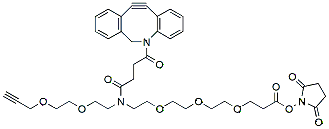
N-(Propargyl-PEG2)-DBCO-PEG3-NHS ester is a PEG linker with a terminal NHS ester to perform facile reactions with amine groups of molecules as well as a propargyl to react with azides to form a triazole. The DBCO can participate in copper-free Click Chemistry reactions.
Detail
N-(Propargyl-PEG2)-DBCO-PEG3-NHS ester is a PEG linker with a terminal NHS ester to perform facile reactions with amine groups of molecules as well as a propargyl to react with azides to form a triazole. The DBCO can participate in copper-free Click Chemistry reactions.
Other Products
Listeria monocytogenes Quantified Bacterial DNA Standard
Product Info
Document
Product Info
Overview
Quantified standard to be used as a positive control or PCR quantification standard
Vigorously quantified using multiple methods
Listeria monocytogenes has emerged as a significant foodborne pathogen that poses a serious public health problem. As the causative agent of Listeriosis, L. monocytogenes has the highest rate of fatality among all foodborne pathogens. L. monocytogenes is a facultatively intracellular, Gram-positive bacterium. Due to its ability to survive high and low temperatures as well as low pH, it could resist various food processing technologies, as well as grow at food storage temperatures. L. monocytogenes is known to be associated with raw meat, unpasteurized milk and dairy products, vegetables, and seafood. As little as 1000 organisms may cause the disease with pregnant, new-born, and immunocompromised individuals being the most susceptible.
Norgen’s Listeria monocytogenes Quantified Bacterial DNA Standard is prepared from cultured bacteria using Norgen’s sample preparation technology. The purified DNA is quantified vigorously using multiple methods including spectrophotometry, gel densitometry and real-time PCR. It is intended to be used as a positive control or PCR quantification standard for Listeria monocytogenes.
Upon receipt, store Norgen’s Listeria monocytogenes Quantified Bacterial DNA Standard at -20oC or lower. Avoid multiple freeze-thaw cycle. If needed, prepare smaller working aliquots and store at -20oC or lower.
Amino-Tri-(Propargyl-PEG2-ethoxymethyl)-methane TFA Salt
Product Info
Document
Product Info
Amino-Tri-(Propargyl-PEG2-ethoxymethyl)-methane TFA Salt is a crosslinker consisting of an amino group with three propargyl groups. The amino group is reactive with carboxylic acids, activated NHS esters, carbonyls (ketone, aldehyde) etc. The propargyl groups can form triazole linkage with azide-bearing compounds or biomolecules via copper catalyzed Click Chemistry. Reagent grade, for research purpose. Please contact us for GMP-grade inquiries.
Document
Amino-Tri-(Propargyl-PEG2-ethoxymethyl)-methane TFA Salt is a crosslinker consisting of an amino group with three propargyl groups. The amino group is reactive with carboxylic acids, activated NHS esters, carbonyls (ketone, aldehyde) etc. The propargyl groups can form triazole linkage with azide-bearing compounds or biomolecules via copper catalyzed Click Chemistry. Reagent grade, for research purpose. Please contact us for GMP-grade inquiries.
Our SNPsig® kits use our own proprietary genotyping method to enable the identification of SARS-CoV-2 variants of concern. These products can be used on any real-time PCR machine using familiar protocols, whilst resulting in exceptional genotyping data.
Positive control templates for wild-type and variants are supplied in every kit to make data interpretation simple.
Our SNPsig® technology provides an alternative to sequencing as well as S gene target failure (SGTF) that enables scientists to analyse and monitor these specific genomic mutations. Our kits can provide a pivotal role in screening for SARS-CoV-2 variants for the purpose of genomic surveillance and studies.
Document
For the detection of the SARS-CoV-2 (20H/501Y.V2 South Africa) Rapid detection of specific detection profiles High priming efficiency Sensitive to < 100 copies of target
Positive copy number standard curve for quantification
Accurate controls to confirm findings
96 reactions, includes master mix