CE-IVD marked version available for in vitro diagnostic use
Available in TaqMan format for analysis
Epstein-Barr Virus (EBV) is a member of the Herpes family of virus and is one of the most common viruses in humans. The virus occurs globally and causes infectious mononucleosis. Most individuals become infected with EBV and develop adaptive immunity, with the majority of adults between the ages of 35 and 40 having been infected. The virus has been implicated as having a primary role in multiple autoimmune diseases, several lymphoproliferative disorders and cancers, particularly Hodgkin’s disease and Burkitt’s lymphoma. Many children become infected with EBV once maternal antibody protection disappears, however these infections usually do not result in symptom development. During adolescence the virus will cause mononucleosis in up to 69% of infections
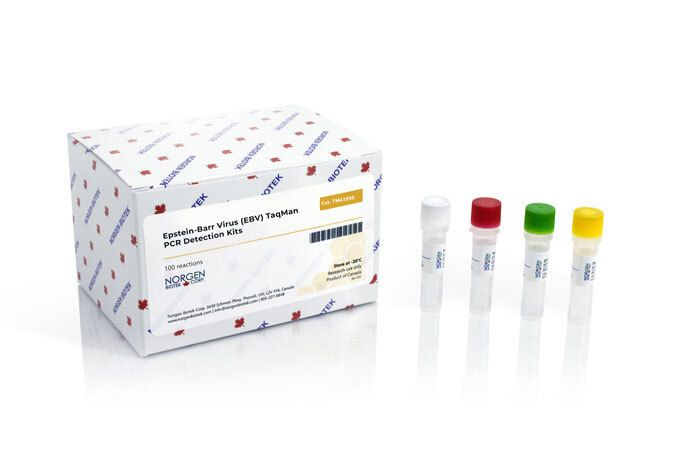
EBV TaqMan PCR Kit, 100 reactions
Ready to use format, including Master Mix for the target and PCR control to monitor for PCR inhibition and validate the quality
Specific Primer and Probe mix for the pathogen/virus/viroid of interest
Primer and Probe mix
Positive and negative control to confirm the integrity of the kit reagents
EBV TaqMan PCR Probe/Primer Set and Controls, 100 reactions
Specific Primer/Probe mix and Positive Control for the pathogen/virus/viroid of interest
Nuclease-free water
Can be used together with Norgen’s PCR Master Mix (#28007) or customer supplied master mix
Storage Conditions and Product Stability All kit components can be stored for 2 years after the date of production without showing any reduction in performance.
All kit components should be stored at -20°C upon arrival. Repeated thawing and freezing (> 2 x) of the Master Mix and Positive Control should be avoided, as this may affect the performance of the assay. If the reagents are to be used only intermittently, they should be frozen in aliquots.
Component
Cat. TM41050 (100 preps)
Cat. TM41010 (100 preps)
MDx TaqMan 2X PCR Master Mix
2 x 700 μL
–
EBV Primer & Probe Mix
280 μL
280 μL
EBV Positive Control
150 μL
150 μL
Nuclease-Free Water (Negative Control)
1.25 mL
1.25 mL
Product Insert
1
1
Other Products
FFPE DNA Purification Kit
Product Info
Document
Product Info
Overview
Fast and easy processing using rapid and convenient spin-columns
Isolate high quality and high yield DNA
DNA is free of inhibitors and ready for downstream use including SNP (single nucleotide polymorphism) and short-tandem repeat (STR) genotyping
This kit provides a rapid method for the isolation and purification of DNA from formalin-fixed paraffin-embedded (FFPE) tissue samples. Using formalin to fix tissues leads to crosslinking of the nucleic acids and proteins, and the process of embedding the tissue samples can also lead to fragmentation of the nucleic acids over time. Norgen’s FFPE DNA Purification Kit provides conditions that allow for the partial reversing of the formalin modifications, resulting in a high quality and yield of nucleic acids. The purified DNA is of high yield and integrity and is free of inhibitors, ready for use in a number of downstream applications including qPCR, mutation screening, microarray analysis, sequencing, single nucleotide polymorphism (SNP) and short-tandem repeat (STR) genotyping. The protocol can be completed in as little as 1 hour.
Storage Conditions and Product Stability All solutions should be kept tightly sealed and stored at room temperature. The Proteinase K should be stored at -20°C upon arrival and after reconstitution. This kit is stable for 1 year after the date of shipment.
A highly efficient, easily automated agarose gel or PCR purification system that delivers superior quality DNA with no salt carryover. Requiring no centrifugation or filtration. The Kit can be easily used in manual and automated 96 or 384-well formats.
Details
Specifications
Features
Specifications
Main Functions
Recover DNA fragments >100bp from agarose gel(<0.3g), purification of DNA from PCR, enzymatic reaction solution or crude gDNA
The Kit method contains magnetic particles in an optimized binding buffer to selectively bind DNA fragments (>100bp) and larger to paramagnetic beads. Excess primers, nucleotides, salts, and enzymes can be removed using a simple washing procedure.
Advantages
High recovery efficiency – up to 80% DNA recovery
General – recover DNA from gel or enzyme-driven reaction solutions such as PCR
Kit Contents
Contents
D500101
D500102
D500103
Purification Times
50 Preps
500 Preps
5000 Preps
Buffer GDP
30 ml
250 ml
3 x 900 ml
MagPure Particles
1.6 ml
15 ml
3 x 50 ml
Buffer DW1
20 ml
180 ml
2 x 800 ml
Elution Buffer(10mmTris, pH8.5)
10 ml
60 ml
500 ml
Storage and Stability
MagPure Particles should be stored at 2-8°C upon arrival. However, short-term storage (up to 24 weeks) at room temperature (15-25°C) does not affect their performance. The remaining kit components can be stored at room temperature (15-25°C) and are stable for at least 18 months under these conditions.
Experiment Data
Document
A highly efficient, easily automated agarose gel or PCR purification system that delivers superior quality DNA with no salt carryover. Requiring no centrifugation or filtration. The Kit can be easily used in manual and automated 96 or 384-well formats.
The series of DNA Size Selection Kits (Magnetic Beads) were developed for DNA size selection using magnetic beads. A total of 11 kits are available, with different selection ranges spanning from 50 bp to over 10 kb. The kits provide a simple and quick approach for the enrichment of a specific range of DNA fragments. The kit workflow allows double-sided or single-sided size selection for specific size cutoffs.
Gel images of different ranges of size selection. Sheared human genomic DNA was used as input.
.
DNA size selection is a selective capture of DNA fragments of a specific range of size for next-generation sequencing (NGS) library preparations, PCR, ChIP assay, DNA ligations, endonuclease digestions, adapter removal, and other genomics and molecular biology applications. DNA size selection is preferred after NGS library prep in most of the cases. The NGS library preparation is related to the quality of the sequencing data. Precise NGS library size selection can increase sequencing efficiency, improve data quality, and reduce costs.
There are two types of sequencing technologies: short-read sequencing and long-read sequencing. Short-read sequencing uses DNA libraries that contain small insert DNA fragments of similar sizes, usually several hundred base pairs. The sequencing efficiency can be improved if the DNA size selection is in the right range. Cat.# 20104S and 20104L are the best kits for NGS library size selection of illumina paired-end 100 (PE100) sequencing with 100-200 bp library inserts; Cat.# 20105S and 20105L are the best kits for NGS library size selection of illumina paired-end 150 (PE150) sequencing with 150-300 bp library inserts; and Cat.# 20106S and 20106L are the best kits for NGS library size selection of illumina paired-end 300 (PE300) sequencing with 300-600 bp library inserts.
Long-read sequencing uses a large DNA fragment as input and makes very long reads. Usually, library size selection is preferred to remove smaller fragments. Cat.# 20110S and 20110L are the best kits for long-read sequencing size selection with DNA sizes >5 kb, and Cat.# 20111S and 20111L are the best kits for long-read sequencing size selection with DNA sizes >10 kb.
The magnetic beads technology uses paramagnetic particles, also known as SPRI (Solid Phase Reversible Immobilization) beads, to bind DNA reversibly and selectively. DNA fragments can be size-selected and purified by changing the properties of the magnetic beads or SPRI beads. The magnetic beads can easily separate the beads-binding DNA from the contaminants and unwanted components in the samples. The samples after DNA size selection are free of contaminants such as buffer components, enzymes, proteins, salts, dNTPs, primers, and adapters. Our proprietary magnetic beads reagents improve yield, selectivity, and reproducibility.
Specific DNA fragments at a certain length range can be purified simply using magnetic separation with different beads components, avoiding tedious and time-consuming gel extraction and column-based purification. The magnetic beads method is popular for common DNA size selection, including library size selection. The first beads-binding step, referred to as the right-side clean-up, removes large DNA fragments. The large DNA fragments are bound to the beads and are discarded. The desired DNA fragments in the supernatant are transferred to a new well, and new beads are added to the supernatant for the second beads-binding, referred to as the left-side clean-up. The double-size selected DNA fragments are eluted after ethanol rinsing.
DNA size selection with dual clean-ups.
.
A single clean-up is needed for DNA size selection with large fragments. In this case, only the large DNA fragments are bound to the beads. The selected larger DNA fragments are eluted after ethanol rinsing.
DNA size selection with single clean-up for >5 kb and >10 kb DNA.
.
Features of DNA size selection and library size selection
High specificity and high recovery of size selection
11 selection ranges are available, including 5 ranges for NGS library size selection
50-100 bp
100-200 bp
200-500 bp
250-350 bp: ideal for illumina PE100 sequencing
300-450 bp: ideal for illumina PE150 sequencing
450-750 bp: ideal for illumina PE300 sequencing
500-1000 bp
1-3 kb
1-5 kb
>5 kb: ideal for long-read sequencing
>10 kb: ideal for long-read sequencing
Fast and simple
20-min protocol
No gel purification required
No columns required
No centrifugation required
Efficient removal of contaminants and unwanted components