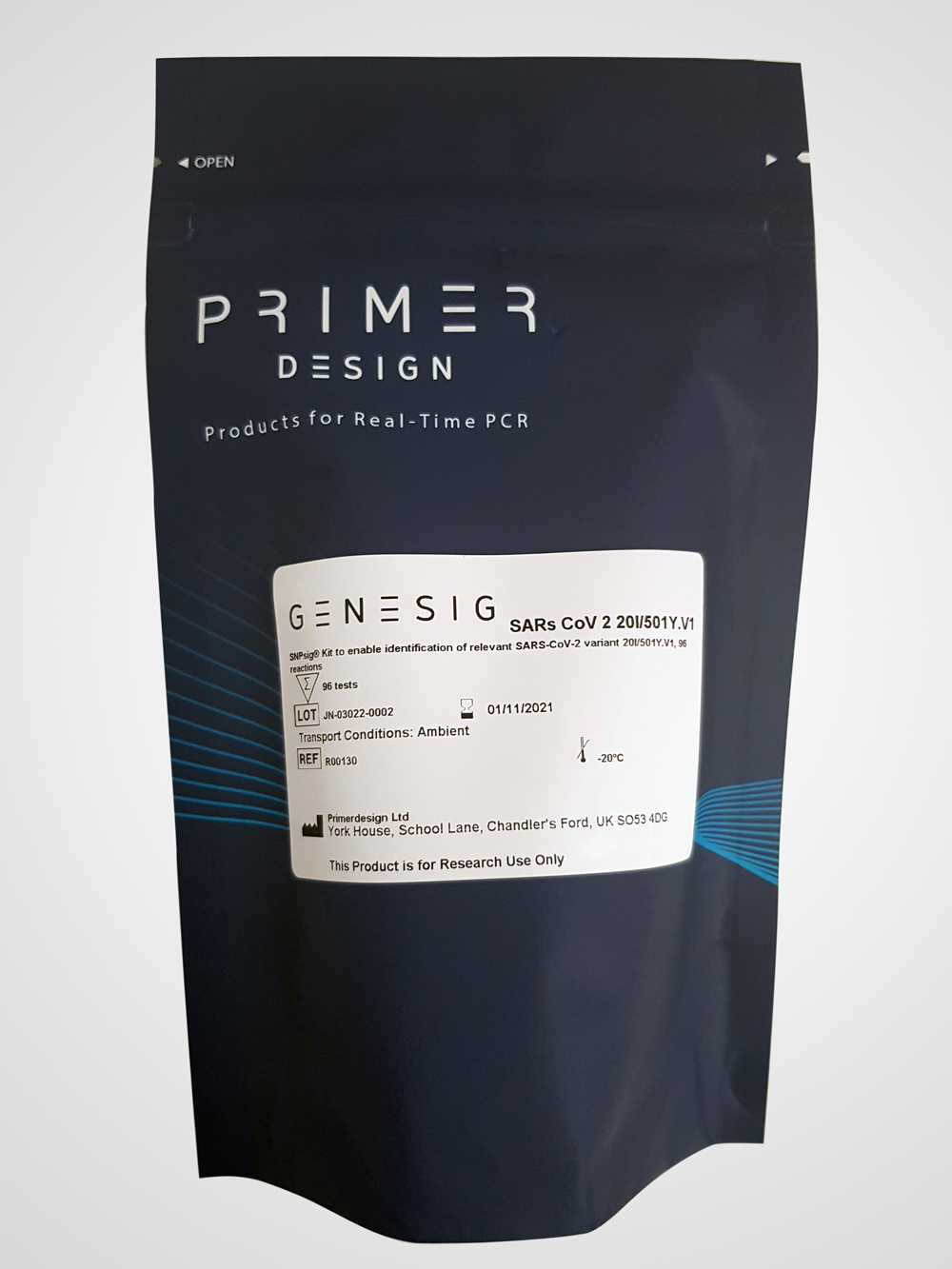
For the detection of the SARS-CoV-2 (20J/501Y.V3 Brazil) Rapid detection of specific detection profiles High priming efficiency Sensitive to < 100 copies of target
Positive copy number standard curve for quantification
Accurate controls to confirm findings
96 reactions, includes master mix
Our SNPsig® kits use our own proprietary genotyping method to enable the identification of SARS-CoV-2 variants of concern. These products can be used on any real-time PCR machine using familiar protocols, whilst resulting in exceptional genotyping data.
Positive control templates for wild-type and variants are supplied in every kit to make data interpretation simple.
Our SNPsig® technology provides an alternative to sequencing as well as S gene target failure (SGTF) that enables scientists to analyse and monitor these specific genomic mutations. Our kits can provide a pivotal role in screening for SARS-CoV-2 variants for the purpose of genomic surveillance and studies.
Other Products
P1231 HiPure Plasmid EF Midi Kit
Product Info
Document
Product Info
Introduction
The HiPure Midi system provides a fast, simple, and cost-effective plasmid DNA midiprep method for routine molecular biology laboratory applications. HiPure Midiprep Kits use silica membrane technology to eliminate the cumbersome steps associated with loose resins or slurries. Plasmid DNA purified with Mini Kits is immediately ready for use. Phenol extraction and ethanol precipitation are not required, and high quality plasmid DNA is eluted in a small volume of Tris buffer or water.
Details
Specifications
Features
Specifications
Main Functions
Isolation up to 500µg endotoxin-free plasmid DNA from 25-50ml bacterial culture. Recommend for High copy vector, Low elution volume, High concentration
Applications
Cell transfection, animal injection, etc.
Purification method
Midi spin column
Purification technology
Silica technology
Process method
Manual (centrifugation or vacuum)
Sample type
High copy plasmid vector
Sample amount
25-50ml LB
Yield
10-500μg
Elution volume
≥0.1ml
Time per run
≤60 minutes
Liquid carrying volume per column
4ml
Binding yield of column
250μg
Principle
The HiPure Plasmid procedure is based on alkaline lysis of bacterial cells followed by adsorption of DNA onto silica in the presence of high salt. The unique silica membrane used in the kit completely replaces glass or silica slurries for plasmid DNA minipreps. The procedure consists of 3 basic steps: Preparation and clearing of a bacterial lysate by alkaline method,then transfer the supernatant to column to bind DNA. After washing proteins and other impurities, nucleic acid was finally eluted with low-salt buffer (10mm Tris, pH9.0, 0.5mm EDTA).
Advantages
High purity – purified plasmid can be directly used in sequencing, enzyme digestion and PCR, etc.
Fast – silica gel column purification is much faster than ion exchange
High concentration – easily obtain concentrations >1000ng/μl
Small amount large extraction – using a small amount of column to achieve a large extraction yield (500μg)
Low endotoxin content – the obtained plasmid can be directly used in cell transfection and animal injection
Kit Contents
Contents
P123102
P123102B
Purification Times
50 Preps
50 Preps
RNase A
30 mg
30 mg
Buffer E1
150 ml
150 ml
Buffer E2
150 ml
150 ml
Buffer E3
150 ml
150 ml
Buffer E4
150 ml
150 ml
Buffer E5
150 ml
150 ml
Buffer PW2*
50 ml
50 ml
Elution Buffer
30 ml
30 ml
MaxPure EF Mini Column
50
50
2 ml Collection Tubes
50
50
Lysate Clear Midi Syringe
50
50
Extend Tubes
50
50
50ml Centrifuge Tubes
50
Support Tubes
50
Storage and Stability
The kit components can be stored dry at room temperature (15-25°C) and are stable for at least 18 months under these conditions. If any precipitates form in the buffers, warm at 37℃ to dissolve. After addition of RNase A and optional LyseBlue reagent, Buffer P1 is stable for 6 months when stored at 2–8°C.
The HiPure Midi system provides a fast, simple, and cost-effective plasmid DNA midiprep method for routine molecular biology laboratory applications. HiPure Midiprep Kits use silica membrane technology to eliminate the cumbersome steps associated with loose resins or slurries. Plasmid DNA purified with Mini Kits is immediately ready for use. Phenol extraction and ethanol precipitation are not required, and high quality plasmid DNA is eluted in a small volume of Tris buffer or water.
50 assays of each (manual) / 500 assays of each (microplate)
Content:
50 assays of each (manual) / 500 assays of each (microplate)
Shipping Temperature:
Ambient
Storage Temperature:
Short term stability: 2-8oC, Long term stability: See individual component labels
Stability:
> 2 years under recommended storage conditions
Analyte:
Ammonia, L-Glutamine
Assay Format:
Spectrophotometer, Microplate
Detection Method:
Absorbance
Wavelength (nm):
340
Signal Response:
Decrease
Linear Range:
1 to 40 µg of L-glutamine per assay
Limit of Detection:
0.54 mg/L (L-glutamine), 0.06 mg/L (ammonia)
Reaction Time (min):
~ 10 min
Application examples:
Cell culture media and cultures, dietary supplements, vegetables and other materials (e.g. biological samples, etc.).
Method recognition:
Novel method
This product has been discontinued.
The L-Glutamine/Ammonia (Rapid) test kit is a novel method for the specific, convenient, cost effective and rapid measurement and analysis of L-glutamine and ammonia in culture media/supernatants and other materials.
Note for Content: The number of manual tests per kit can be doubled if all volumes are halved. This can be readily accommodated using the MegaQuantTM Wave Spectrophotometer (D-MQWAVE).
Extended cofactors stability. Dissolved cofactors stable for > 1 year at 4oC.
Very rapid reaction due to use of high activity glutaminase and uninhibited glutamate dehydrogense
All enzymes supplied as stabilised suspensions
Only enzymatic kit available
Very cost effective
All reagents stable for > 2 years after preparation
Mega-Calc™ software tool is available from our website for hassle-free raw data processing
Standard included
Document
The L-Glutamine/Ammonia (Rapid) test kit is a novel method for the specific, convenient, cost effective and rapid measurement and analysis of L-glutamine and ammonia in culture media/supernatants and other materials.
endo-BCN-PEG3-Gly represents an ADC linker featuring a BCN group, a hydrophilic PEG3 linker, and glycine residue. The BCN group is a click chemistry handle that readily reacts with azide groups on a target molecule to form stable triazole linkages. The PEG units enhance the aqueous solubility of the compound and may assist in fine-tuning DMPK properties. This compound may be applied to the synthesis of antibody-drug conjugates.
Document
endo-BCN-PEG3-Gly represents an ADC linker featuring a BCN group, a hydrophilic PEG3 linker, and glycine residue. The BCN group is a click chemistry handle that readily reacts with azide groups on a target molecule to form stable triazole linkages. The PEG units enhance the aqueous solubility of the compound and may assist in fine-tuning DMPK properties. This compound may be applied to the synthesis of antibody-drug conjugates.