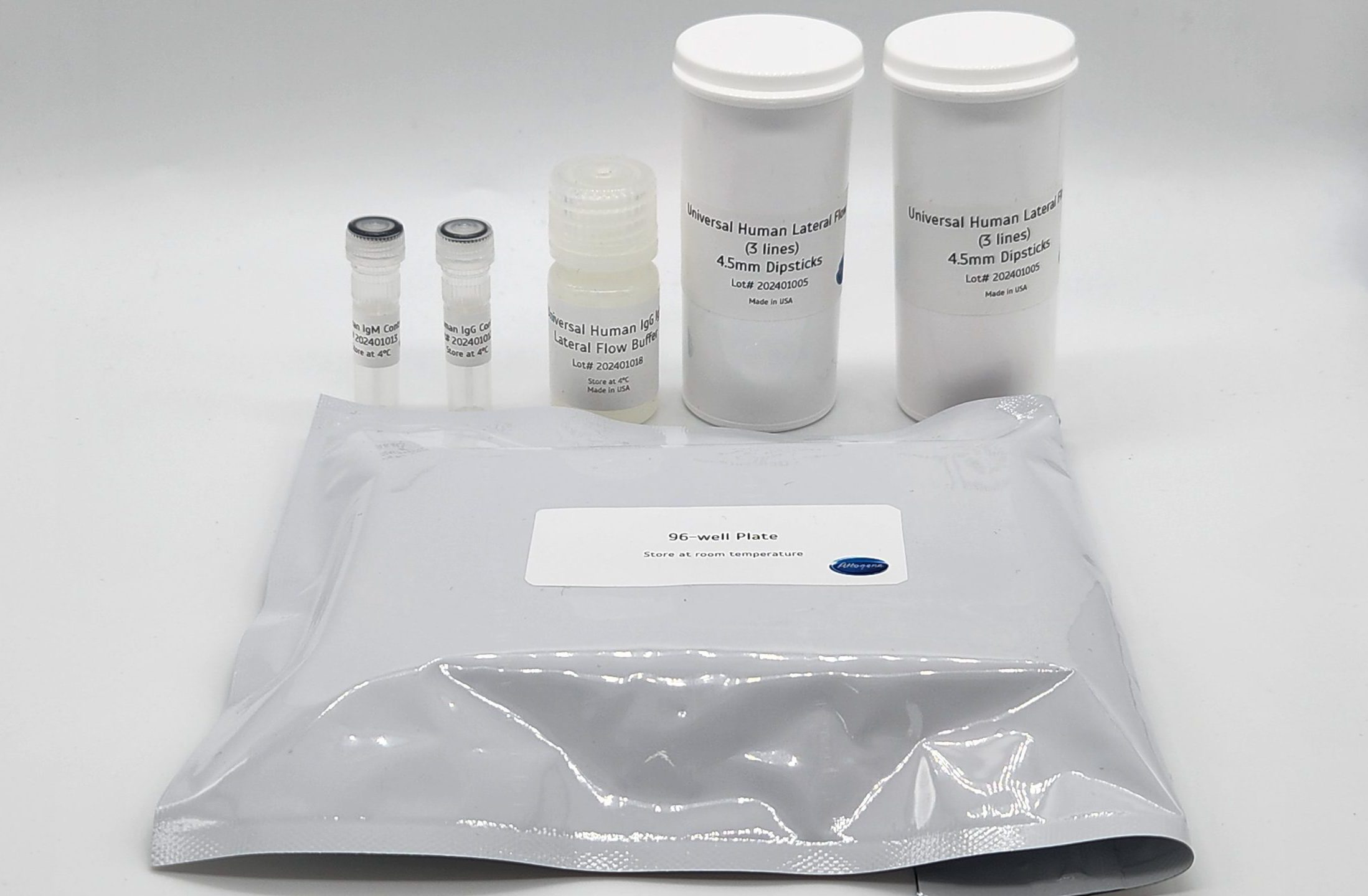
Fluorescent Universal Human IgG/IgM Lateral Flow Serology Kit (Quantum Dots)
Facebook
X
Pinterest
Email
Antibody tests are a method of choice to determine if a person has been exposed to a pathogen or not. They are also incredibly valuable in the detection of autoantibodies that can be found in human autoimmune disorders. In this test, a biotinylated antigen (User supplied) is mixed with a biotinylated rabbit IgG (bind to goat anti rabbit control line) and sample (human sera or plasma) is simply mixed into with the specially designed assay running buffer in a well of the supplied 96-well plate, mixed and is then added to the sample port of the cassette. Generally, the reaction is complete in 10-15 minutes. It is very important to note that the relative stoichiometry between the biotinylated antigen, biotinylated rabbit IgG added, and the streptavidin gold is critical for assay optimization. The appropriate concentration of biotinylated antigen to use with strips is dependent upon the purity and sequence and a standard curve can be used to determine the relative ratio (generally between 1ng-100ng per test). A positive control line (biotin-rabbit IgG) antibody will bind to the goat anti rabbit (GAR) line on the test to ensure the assay is running appropriately.
Attogene’s Human IgG/IgM universal fluorescent lateral flow assay kit is a ready-to-use, universal test strip, which is based on the lateral flow technology that uses 655nm Emission Quantum Dot particles containing streptavidin to conveniently capture biotinylated antigens. The device is designed to easily develop qualitative or quantitative rapid test systems for detection of anti-human IgG and IgM antibody that react to the any antigen that can be biotinylated (i.e. viral antigen, autoimmune antigen) and is easily customizable providing every laboratory with the possibility to perform assay feasibility.
Formats (fluorescent broad range UV light excitation range of 300nm to 400nm, 610nm emission) Streptavidin conjugate pad):
Other Products
R4801 MagZol Reagent
Product Info
Document
Product Info
Introduction
MagZol Reagent is a reagent system for the isolation of total RNA from cells and tissues. The reagent, a single-phase solution consisting of phenol and guanidine isothiocyanate, is modification of the single-step RNA isolation method developed by Chomczynski and Sacchi. The sample is homogenized and lysed in MagZol Reagent which maintains the integrity of the RNA, while disrupting and denaturing endogenous RNases and other cellular components. Extraction of the lysate with chloroform further denatures proteins and separates the mixture into an organic and an aqueous phase. RNA remains exclusively in the aqueous phase, and is subsequently recovered by isopropanol.
This method is suitable for small quantities of tissue (<100mg) and cells (<5 X10⁶), and large quantities of tissue (up to 1g) and cells (<108), of human, animal, plant, or bacterial origin. The simplicity of the MagZol Reagent method allows simultaneous processing of a large number of samples. The entire procedure can be completed in one hour. Total RNA prepared in this manner can be used for Northern blot analysis, dot blot hybridization, poly(A) + selection, in vitro translation, RNase protection assay, and molecular cloning. For use in amplification by thermal cycling, treatment of the isolated RNA with RNase-free DNase I is recommended when the two amplimers lie within a single exon.
Details
Specifications
Features
Specifications
Main Functions
RNA isolation solvent (substitution for Trizol/Qiazol reagent)
Applications
RT-PCR, Northern hybridization, poly (a) enrichment, etc.
Extensive – suitable for various kinds of biological samples, including animals, plants, cultured cells, bacteria, etc.
High yield – efficient cleavage releases more RNA
High purity – purified RNA is suitable for various downstream applications
Flexible – sample amount can be adjusted according to the demand
High cost performance compared with similar products
Storage and Stability
MagZol Reagent should be stored at 2-8°C upon arrival and is stable for at least 24 months under the condition. However, short-term storage (up to 12 weeks) at room temperature (15-25°C) does not affect its performance.
Experiment Data
Document
MagZol Reagent is a reagent system for the isolation of total RNA from cells and tissues. The reagent, a single-phase solution consisting of phenol and guanidine isothiocyanate, is modification of the single-step RNA isolation method developed by Chomczynski and Sacchi. The sample is homogenized and lysed in MagZol Reagent which maintains the integrity of the RNA, while disrupting and denaturing endogenous RNases and other cellular components. Extraction of the lysate with chloroform further denatures proteins and separates the mixture into an organic and an aqueous phase. RNA remains exclusively in the aqueous phase, and is subsequently recovered by isopropanol.
This product provides fast and easy methods for purification of total DNA for reliable PCR and Southern blotting. Total DNA(e.g., genomic, viral, mitochondrial) can be purified from small volume of blood, tissue and dry blood spots.
Details
Specifications
Features
Specifications
Main Functions
Isolation total DNA from 1-10μl blood, <10mg tissue, urine, blood stain, seminal stain
Applications
PCR, southern bolt and virus detection, etc.
Purification method
Mini spin column
Purification technology
Silica technology
Process method
Manual (centrifugation or vacuum)
Sample type
Animal tissues, blood stain, urine, seminal stain and various forensic samples
Sample amount
Blood:1-100μl, Tissue:<10mg
Elution volume
Time per run
Liquid carrying volume per column
Binding yield of column
Principle
This product is based on silica Column purification. The sample is lysed and digested with lysate and protease, DNA is released into the lysate. Transfer to an adsorption column. Nucleic acid is adsorbed on the membrane, while protein is not adsorbed and is removed with filtration. After washing proteins and other impurities, nucleic acid was finally eluted with low-salt buffer (10mmTris, pH9.0, 0.5mm EDTA).
Advantages
Fast – several samples can be extracted in 20 minutes (after digestion)
High purity – purified DNA can be directly used in various downstream applications
High recovery – DNA can be recovered at the level of PG
Good repeatability – silica technology can obtain ideal results every time
Kit Contents
Contents
D312502
D312503
Purification Times
50 Preps
250 Preps
Buffer ATL
15 ml
60 ml
Buffer AL
15 ml
60 ml
Buffer GW1*
22 ml
66 ml
Buffer GW2*
20 ml
2 x 50 ml
Carrier RNA
310 μg
2 x 310 µg
Proteinase K
24 mg
120 mg
Protease Dissolve Buffer
1.8 ml
10 ml
Buffer AE
15 ml
60 ml
HiPure DNA Mini Columns I
50
2 x 125
2 ml Collection Tubes
100
5 x 100
Storage and Stability
Carrier RNA and Proteinase K should be stored at 2–8°C upon arrival. However, short-term storage (up to 12 weeks) at room temperature (15–25°C) does not affect its performance. The remaining kit components can be stored dry at room temperature (15–25°C) and are stable for at least 18 months under theseconditions.
Experiment Data
Document
This product provides fast and easy methods for purification of total DNA for reliable PCR and Southern blotting. Total DNA(e.g., genomic, viral, mitochondrial) can be purified from small volume of blood, tissue and dry blood spots.
For selective isolation and culture of Staphylococcus aureus.
Principle:
Peptone and beef extract powder provides carbon, nitrogen, vitamins and minerals; D- mannitol to fermentable sugars; higher levels of sodium chloride to provide a higher osmotic pressure, suppress most non-staphylococcal microorganisms ; phenolsulfonphthalein as pH indicator; agar is medium coagulant. Typical pathogenic staphylococci (coagulase positive) D- mannitol produce acid fermentation and produce yellow colonies with a yellow halo, typically non-pathogenic Staphylococcus unfermented D- mannitol to form red colonies.
Formulation(per liter): Pancreatic digest of casein 5.0g Pancreatic digest of animal tissue 5.0g Beef Extract 1.0g Sodium Chloride 75.0g Mannitol 10.0g Phenol Red 0.025g Agar 15.0g Final PH 7.4±0.2
How to use: 1.Suspend 111g in 1L of distilled water , stirring heated to boiling to completely dissolve ,autoclave at 121℃ for 15 minutes. 2.Diluted and treated samples.
Quality control:
Item
The name and number of strain
Growth
Colony Color
1
Staphylococcus aureus CMCC (B) 26003
Good
Golden yellow
2
Staphylococcus epidermidis CMCC (B) 26069
Good
Red
3
Escherichia coli CMCC (B) 44102
Inhibition
—
Storage: Keep container tightly closed, store in a cool, dry place, away from bright light. Storage period of 3 years.