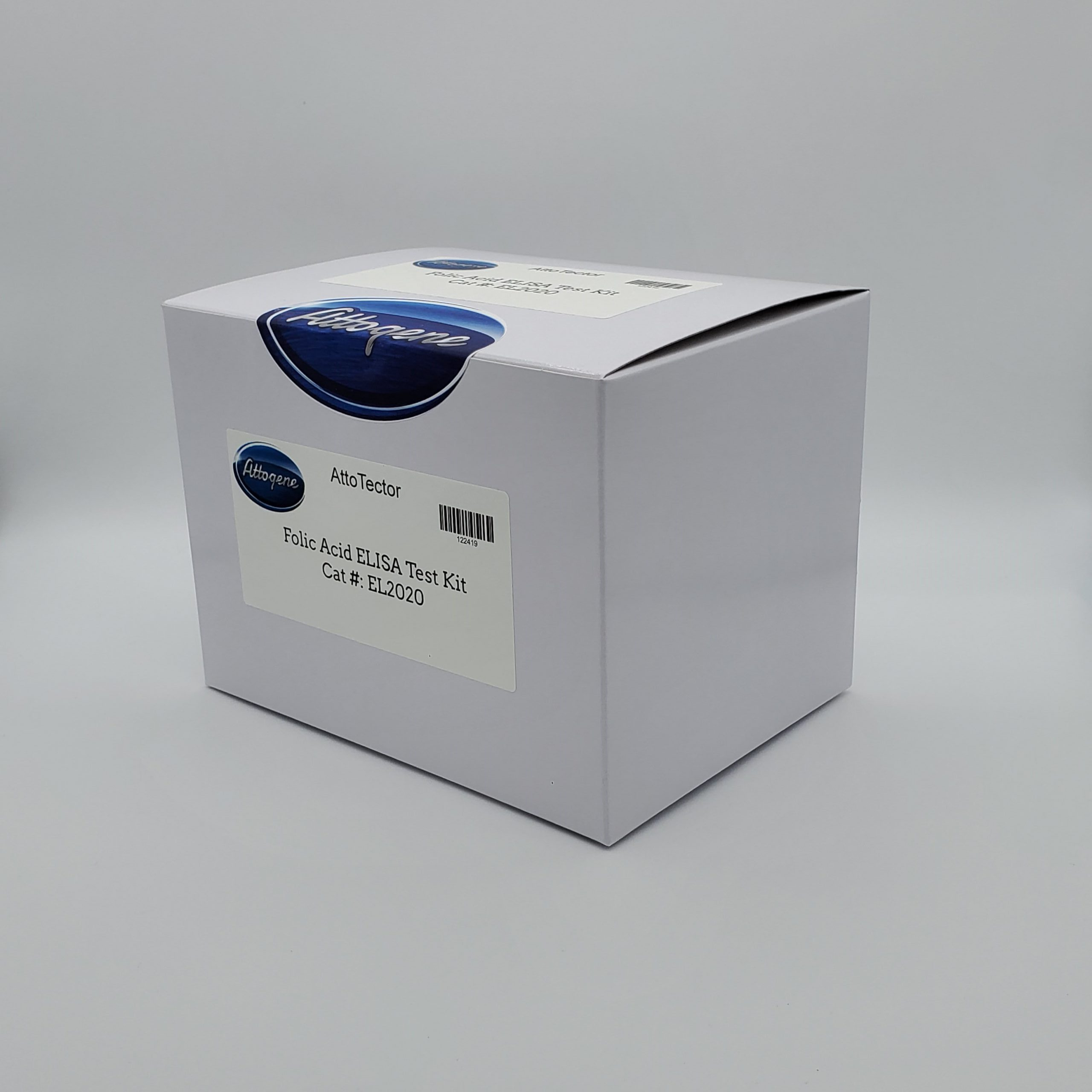
Folic acid, is one of the B vitamins used to treat anemia caused by folic acid deficiency.
This kit is a product based on indirect-competitive ELISA, which is fast, easy, accurate and sensitive compared with common instrumental analysis.
Detection limit if folic acid in liquid samples
Other Products
ProteoSpin™ Total Protein Concentration, Detergent Clean-Up and Endotoxin Removal Kits
Product Info
Document
Product Info
Overview
Columns bind proteins of interest while endotoxins flow through
Reduce endotoxin levels to less than 0.01 EU/µg of protein
Proteins are desalted
Greater than 95% protein recovery
Concentrate protein samples and remove detergents at the same time
Effectively remove a wide range of detergents including SDS, Triton® X-100, CHAPS, NP-40, and Tween 20
Purification is based on spin column chromatography that uses Norgen’s resin separation matrix
The ProteoSpin™ Total Protein Concentration, Detergent Clean-Up and Endotoxin Removal Kits are designed for the rapid removal of endotoxins from previously purified proteins or peptides, with protein recoveries of > 95% being achieved. Endotoxins, also known as lipopolysaccharides, are cell-membrane components of Gram-negative bacteria such as E. coli. Endotoxins liberated by Gram-negative bacteria are frequent contaminations of protein solutions derived from bioprocesses. Due to the high toxicity of endotoxins in vivo and in vitro, their removal from protein preparations is often necessary prior to the use of the protein in downstream applications. These kits efficiently reduce endotoxin levels to ≤ 0.01 EU/mg of protein, using spin column chromatography based on Norgen’s proprietary resin as the separation matrix. These kits are highly efficient in removing many different salts commonly used in the laboratory including, but not limited to, MgCl2, NaCl, KCl, CaCl2, LiCl and CsCl. The purified protein samples can be used in a number of downstream applications including sequencing, cloning, and in vitro and in vivo introduction into cells and organisms for various purposes. The simultaneous removal of salts while concentrating a dilute protein solution makes the kit a convenient method for preparing proteins before running many downstream applications such as SDS-PAGE, isoelectric focusing, X-ray crystallography, NMR spectroscopy, mass spectroscopy and other applications.
Mini Kit
The ProteoSpin™ Total Protein Concentration, Detergent Clean-Up and Endotoxin Removal Mini Kit is designed for the rapid removal of endotoxins from up to 200 μg of previously purified proteins or peptides, with protein recoveries of > 95% being achieved.
Maxi Kit
The ProteoSpin™ Total Protein Concentration, Detergent Clean-Up and Endotoxin Removal Maxi Kit is designed for the rapid removal of endotoxins from up to 4 mg of previously purified proteins or peptides, with protein recoveries of > 95% being achieved.
Including Triton® X-100, CHAPS, NP-40 and Tween 20
Minimum Elution Volume
50 μL
Time to Complete 10 Purifications
20 minutes
Storage Conditions All solutions should be kept tightly sealed and stored at room temperature. This kit is stable for 2 years from the date of shipment.
Component
Cat. 22800 (25 preps)
Cat. 22200 (4 preps)
Binding Buffer J
8 mL
8 mL
Binding Buffer N
4 mL
20 mL
Wash Solution M
50 mL
130 mL
Wash Solution CIP
20 mL
60 mL
Wash Solution N
30 mL
130 mL
Wash Solution NIP
20 mL
60 mL
Elution Buffer G
6 mL
20 mL
Endotoxin Removal Solution
1.5 mL
1.5 mL
Protein Neutralizer EF
2 mL
2 mL
Maxi Spin Columns (assembled with Collection Tubes)
–
4
Mini Spin Columns
25
–
Collection Tubes
25
–
Maxi Spin Columns (assembled with Collection Tubes)
Usages: For the differentiation of Gram-negative bacteria on the basis of citrate utilization.
Principle: Magnesium ions in various metabolic cofactors; ammonium dihydrogen phosphate to provide nitrogen; dipotassium hydrogen phosphate is the buffer; sodium citrate as a carbon source; agar as medium coagulant.
Formulation(per liter): Sodium chloride 5g Magnesium sulfate 0.2g Ammonium dihydrogen phosphate 0.2g Sodium ammonium phosphate 0.8g Sodium citrate 2g Agar 15g Bromothymol blue 0.08g Final pH 7.0 ± 0.2
How to use: 1.Suspend 23.3g in 1 L of distilled water , stirring heated to boiling until completely dissolved, dispensing flask, 121 autoclave for 15min. 2.Diluted and treated samples.
Storage: Keep container tightly closed, store in a cool, dry place, away from bright light. Storage period of 3 years.
Magen’s HiPure columns are prepared by high quality glass fiber filter membrane as raw materials through membrane cutting, membrane release, ring release, ring pressing, gland, weighing and other processes. HiPure nucleic acid adsorption columns have the characteristics of long-term stability and high binding capacity. Experiments show that the highest binding capacity and binding efficiency of HiPure nucleic acid adsorption columns are basically unchanged when stored at room temperature for 4 years.
The series of nucleic acid columns produced by Magen Biotech are based on carefully selected imported glass fiber membranes (GF/B, GF/D, GF/F). Columns production processes such as polypropylene injection molding materials, injection molding process, and downstream membrane packing and compression rings are strictly controlled. This is to ensure that the column has extremely high adsorption capacity and long-term stability. Compared with conventional products on the market, Magen’s columns are with varieties, and binding rate will not change when stored at room temperature for 4 years.
Details
Specifications
Features
Specifications
Recommended application
Small amounts of nucleic acid isolation, viral nucleic acid from cell free samples
Preservation conditions
Room temperature
Stability
Up to 4 years
Filter membrane
High quality glass fiber filter GF/F, 2 layers
Membrane aperture
0.7μm
Maximum binding yield of plasmid
30 μg
Maximum yield of alcohol mediated Binding
100 μg
Single liquid carrying capacity of column
900 μl
Minimum elution volume
80 μl
Withstand centrifugal force
5,000 x g
Centrifuge
Low speed centrifuge, Swing out Rotor, can placed a height of 6.5cm square, (height of HiPure DNA Plate & 1.6ml Collection Plate: height, 6.2cm)
Adsorption Mechanism
Based on the negatively charged DNA skeleton, it has a high affinity for positively charged glass fibers. In high salt and ethanol solutions, DNA/RNA binds to glass fiber and interacts with hydrophilic matrix on silica through hydrogen bond. DNA/RNA is tightly bound. All pollutants can be removed by washing solution. At high salt concentration, nucleic acids selectively bind to silica gel membrane, while other pollutants, mainly proteins, are removed by membrane washing.
Ordering information
CAT.No.
Product Name
Package
C13130
HiPure DNA Plate (2 x GF/F)with 1.6ml Collection Plate
10/Bag
Purchase Guide
Item No.
Product Name
Membrane type/number of layers
Collection tubes
Plasmid DNA binding capacity (Physical adsorption)
Note: GF/B pore size is for 1.0μM glass fiber membrane; GF/F pore size is for 0.7μm glass fiber membrane.
Document
Magen’s HiPure columns are prepared by high quality glass fiber filter membrane as raw materials through membrane cutting, membrane release, ring release, ring pressing, gland, weighing and other processes. HiPure nucleic acid adsorption columns have the characteristics of long-term stability and high binding capacity. Experiments show that the highest binding capacity and binding efficiency of HiPure nucleic acid adsorption columns are basically unchanged when stored at room temperature for 4 years.