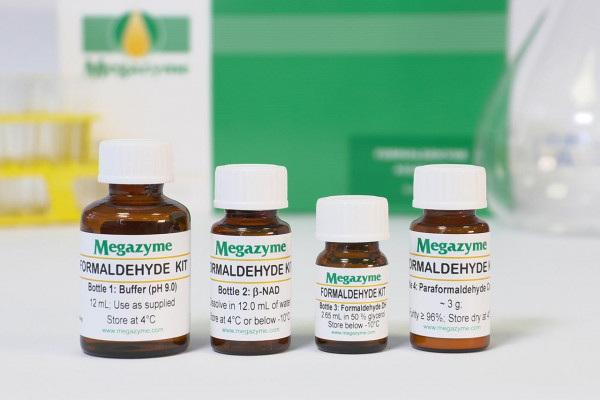
Short term stability: 2-8oC, Long term stability: See individual component labels
Stability:
> 2 years under recommended storage conditions
Analyte:
Formaldehyde
Assay Format:
Spectrophotometer, Microplate, Auto-analyser
Detection Method:
Absorbance
Wavelength (nm):
340
Signal Response:
Increase
Linear Range:
0.1 to 14 μg of formaldehyde per assay
Limit of Detection:
0.033 mg of formaldehyde per test or 0.016 mg/mL of formaldehyde in a sample treated as per the standard procedure
Limit of Quantification:
0.11 mg of formaldehyde per test or 0.054 mg/mL of formaldehyde in a sample treated as per the standard procedure
Reproducibility (%):
~ 3%
Reaction Time (min):
~ 15 min
Application examples:
Environmental samples, food and beverage samples.
The Formaldehyde Assay Kit provides a simple robust method for the measurement of formaldehyde.
Note for Content: The number of manual tests per kit can be doubled if all volumes are halved. This can be readily accommodated using the MegaQuantTM Wave Spectrophotometer (D-MQWAVE).
Extended cofactors stability. Dissolved cofactors stable for > 1 year at 4oC.
All reagents stable for > 2 years
Specific for formaldehyde
Suitable for manual and auto-analyser formats Suitable for manual, microplate and auto-analyser formats
Standard included
Mega-Calc™ software tool is available from our website for hassle-free raw data processing
Other Products
RNA/DNA Purification Kits
Product Info
Document
Product Info
Overview
Sequentially isolate and purify total RNA and DNA from a single sample
Two column system: one for DNA and one for RNA
The RNA column is for the purification of total RNA including microRNA
No need to split the lysate, or to use phenol or precipitation methods
Rapid and efficient spin column procedure – it takes only 30 minutes
Purification is based on spin column chromatography that uses Norgen’s proprietary resin separation matrix
These kits provide a rapid method for the isolation and purification of total RNA and DNA sequentially from a single sample of cultured animal cells and tissues, blood, bacteria, yeast, or fungi. The lysate is passed over two columns: 1) a DNA column and 2) an RNA column. Total RNA of all sizes is purified, including microRNA. Both DNA and RNA are of the highest purity and yield.
These kits are ideal for researchers who are interested in studying the genome and transcriptome of a single sample, such as for studies of microRNA profiling, gene expression including gene silencing experiments or mRNA knockdowns, studies involving biomarker discovery, and for characterization of cultured cell lines. Norgen’s RNA/DNA Purification Kits are especially useful for researchers who are isolating macromolecules from precious, difficult to obtain or small samples such as biopsy materials or single foci from cell cultures, as they eliminate the need to fractionate the sample. Furthermore, analysis will be more reliable since the RNA and DNA are derived from the same sample, thereby eliminating inconsistent results. The purified macromolecules are of the highest purity and can be used in a number of different downstream applications
RNA/DNA Purification Kit (Spin Column)
Maximum column binding capacity of 50 μg for RNA and 20 μg for DNA.
RNA/DNA Purification Micro Kit (Micro)
The purified RNA and DNA fractions can be eluted in as little as 20 μL. Ideal for cell number inputs of 500,000 and as little as 5 cells. Maximum column binding capacity of 35 μg for RNA and 10 μg for DNA.
Maximum Amount of Starting Material: Animal Cells Animal Tissues Blood Bacteria Yeast Fungi Plant Tissues
5 x 10⁶ cells 25 mg (for most tissues)** 200 μL 1 x 10⁹ cells 1 x 10⁸ cells 50 mg 50 mg
Time to Complete 10 Purifications
30 minutes
Average Yield*: HEK 293 Cells (1 x 10⁶ cells) HEK 293 Cells (1 x 10⁶ cells) Liver (15 mg) Liver (15 mg)
10-15 μg RNA 2-4 μg DNA 30-35 μg RNA 4-6 μg DNA
*Average Yield will vary depending upon a number of factors including species, growth conditions used, and development stage.
**Tissue inputs of up to 40 mg may be used, however for inputs greater than the recommended 25 mg, cross-contamination of the RNA and DNA fractions is possible.
Storage Conditions and Product Stability Store Proteinase K at -20°C upon arrival. All other solutions should be kept tightly sealed and stored at room temperature. This kit is stable for 1 year after the date of shipment.
Attogene’s Microcystin Test Kit (Rapid – Lab) can be used to detect microcystins in liquid samples.
• Format: 10 tests
• Run Time: 10 Minutes
The most frequently reported cyanobacterial toxins are the hepatotoxic microcystins (MCs). MCs are peptides with a molecular weight ranging from 900 to 1,100 Da. They consist of seven amino acids of which the two terminal amino acids of the linear peptide are condensed to form a cyclic compound.
A tiered notification system which takes different actions based on different numeric thresholds for microcytin-LR concentrations in recreational waters has been developed. This is guidance that allows states to take various actions—such as posting information about harmful algal blooms (HABs), issuing a recreational public health advisory, or temporarily closing recreational waters through a no contact advisory—depending on the severity of the bloom event.
Microcystin-LR
Informational sign postings about HABs at recreational waters: < 6 μg/L Recreational public health advisory: 6 μg/L Elevated recreational public health advisory (e.g. no contact): 20 μg/L
DBCO-PEG6-DBCO is a monodisperse click chemistry linker containing two terminal DBCO groups with hydrophilic PEG spacer arm. DBCO will react with azide-bearing compounds or biomolecules to form a stable triazole linkage without copper catalyst. PEG spacer arm can increase water solubility and membrane permability. Reagent grade, for research purpose. Please contact us for GMP-grade inquiries.
Document
DBCO-PEG6-DBCO is a monodisperse click chemistry linker containing two terminal DBCO groups with hydrophilic PEG spacer arm. DBCO will react with azide-bearing compounds or biomolecules to form a stable triazole linkage without copper catalyst. PEG spacer arm can increase water solubility and membrane permability. Reagent grade, for research purpose. Please contact us for GMP-grade inquiries.