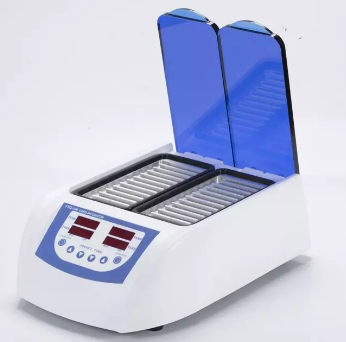
Digital incubator for the Gel cards. Blood card/ID card incubator holds 2 independent incubation zones with a capacity for 12 Gel cards, It can be suitable for many types of gel cards from different manufacturers.
Features
1. Keep 24-Gel Cards in temperature of 37 degree. 2. 2 independent incubation zones with a capacity for 12 Gel cards 3. Digital display to set up time and keep the temperature 4. Audible programmable alarm to notify end of incubation period
Short term stability: 2-8oC, Long term stability: See individual component labels
Stability:
> 2 years under recommended storage conditions
Analyte:
D-Gluconate, D-Glucono-δ-lactone
Assay Format:
Spectrophotometer, Microplate, Auto-analyser
Detection Method:
Absorbance
Wavelength (nm):
340
Signal Response:
Increase
Linear Range:
0.8 to 50 µg of D-gluconic acid per assay
Limit of Detection:
0.792 mg/L
Reaction Time (min):
~ 6 min
Application examples:
Wine, meat, processed meat (e.g. additives), fruit juice, dairy products, pharmaceuticals, paper and other materials (e.g. biological cultures, samples, etc.).
Method recognition:
Methods based on this principle have been accepted by ISO, DIN and GOST
The D-Gluconic Acid/D-Glucono-δ-lactone test kit is suitable for the specific measurement and analysis of D-gluconic acid/D-gluconolactone in foods and beverages.
Note for Content: The number of manual tests per kit can be doubled if all volumes are halved. This can be readily accommodated using the MegaQuantTM Wave Spectrophotometer (D-MQWAVE).
Extended cofactors stability. Dissolved cofactors stable for > 1 year at 4oC.
All reagents stable for > 2 years after preparation
Very competitive price (cost per test)
Very rapid reaction
Mega-Calc™ software tool is available from our website for hassle-free raw data processing
Standard included
Suitable for manual, microplate and auto-analyser formats
Document
The D-Gluconic Acid/D-Glucono-δ-lactone test kit is suitable for the specific measurement and analysis of D-gluconic acid/D-gluconolactone in foods and beverages.
Ideal magnet for all of your low volume needs. From Low elution 96-well PCR applications to 384-well, the X396 has you covered. No need to purchase two separate plates anymore. 96-well volumes as low as 5 µL are achieved from 96-well, PCR plates on the inside of the magnet, while the outside of each magnet will pull beads to well sides in 384-well plates.
ANSI/ SBS Footprint (127.75mm x 85.50mm) to fit into any automated liquid handling robot on bottom. ANSI/SBS footprint on top to accept all common microplates.
Integrated Cushion base for maximum recovery. Helps aid in set-up, robot positioning inconsistencies, and labware consumable inconsistencies
Features include solid aluminum alloy construction and hard coat anodized finish for years of trouble-free use, and compatible with any magnetic beads
Ideal magnet for all of your low volume needs. From Low elution 96-well PCR applications to 384-well, the X396 has you covered. No need to purchase two separate plates anymore. 96-well volumes as low as 5 µL are achieved from 96-well, PCR plates on the inside of the magnet, while the outside of each magnet will pull beads to well sides in 384-well plates.
Effective EXO DNA Amplification Kit For Reliable Results
Product Info
Document
Product Info
Product Description
Product Detail
Applicable equipment:
It is recommended to use the Isothermal fluorescence detector developed by Amp-future, which is also suitable for fluorescence quantitative PCR apparatus with market known brands.
Kit Storage and Term of Validity
Storage term: stored at ≤-20℃,keep away from light, avoid heavy weight and repeated freezing and thawing.
Term of Validity: 14 months
Isothermal Nucleic Acid Principle Summary
This kit is based on a rapid nucleic acid amplification technology at room temperature and constant temperature: at room temperature and constant temperature (generally 39℃~42℃), with the help of auxiliary proteins and single-strand binding proteins,the recombinase and primers form a complex;Source search and combine the target homology domain, at this time,a D-loop region is formed at the homology position and strand exchange begins;along with the dissociation of the recombinase from the complex,the polymerase also binds to the 3′ end of the primer and begins chain extension. At the same time, relying on the function of exonuclease, adding specific molecular probes designed according to the template, and using fluorescence monitoring equipment can realize real-time monitoring of the amplification process of the target fragment.
Isothermal Nucleic Acid Product Features
1/ High sensitivity and specificity, short reaction time.
2/ The reagent form is freeze-dried, stable and easy to operate.
Technical Parameters:
Parameters
Details
Product Name
DNA Isothermal Amplification Kit EXO
Manufacturer
Amp-future
Storage Temperature
-20°C
Kit Components
Enzymes, Buffers ,Reagents
Packaging
48 Tests/box
Detection Limit
500-1000copies/µL
Shipping
ICE
Test Time
5-20mins
Isothermal Nucleic Acid Applications
Suitable for DNA isothermal rapid amplification kit(fluorescent type)
Primer: Require pair of nucleotide primers with the length of 25-35 bp.
Fluorescent Probe:Require the suitable length is 46-52nt.
DNA fluorescent kit reaction temperature is 39 to 42℃ and time is 5-20 minutes.
Notes
1/ Please avoid nucleic acid contamination and set blank control during reaction due to the high sensitivity of the kit.
2/ Please take out the required quantity of MIRA reaction units for the experiment, and put the rest under storage conditions when performing the experiment.