
Description
Specifications
| Clone | IHC018 |
| Source | Mouse Monoclonal |
| Positive Control | Breast, Breast Carcinoma |
| Dilution Range | 1:200 |
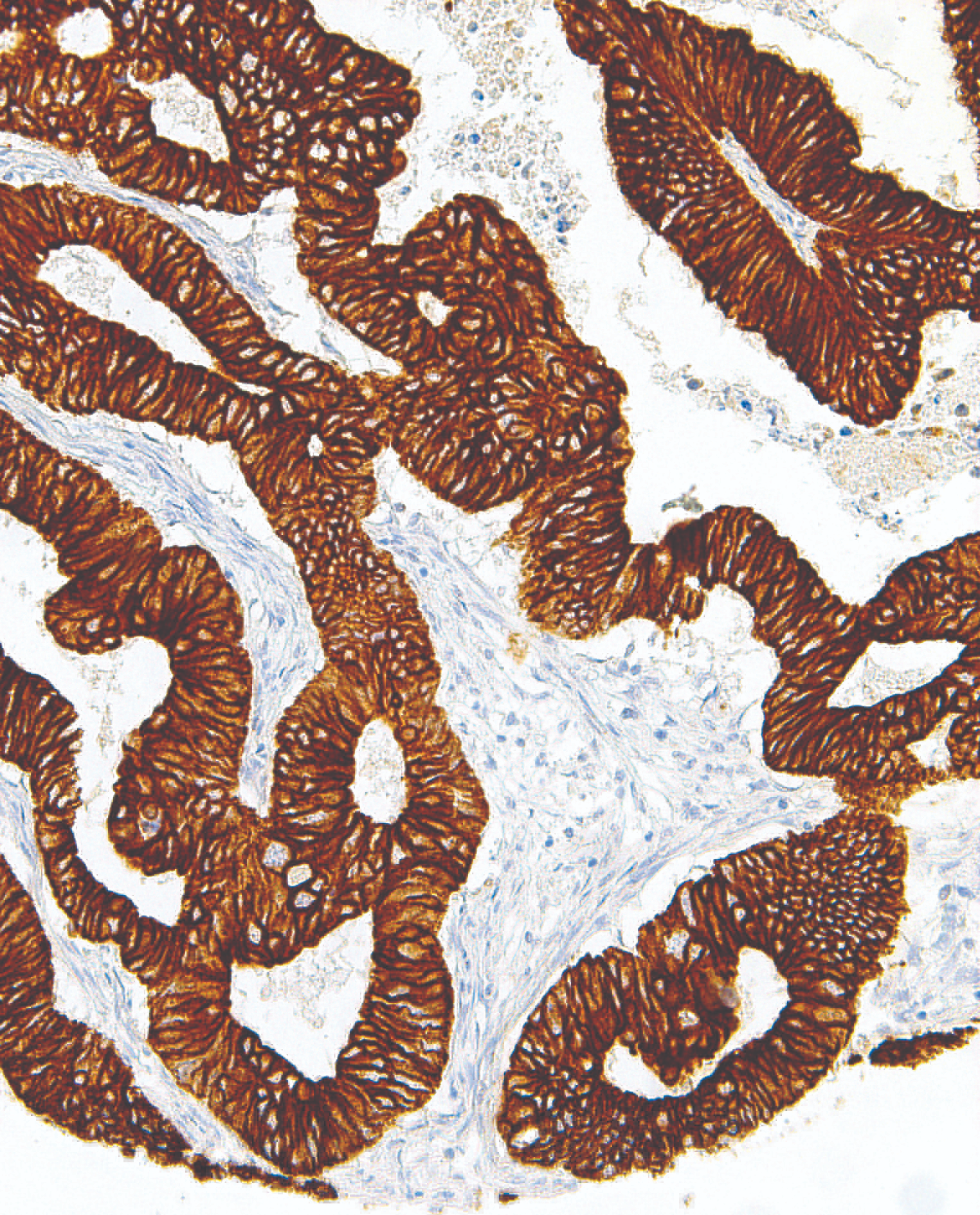
Cytokeratin 18 (CK18) is present in simple, glandular, and transitional epithelial cells, but is absent in stratified epithelial cells. CK18 usually multimerizes with Cytokeratin 8, and Anti-Cytokeratin 18 is useful for detecting adenocarcinomas of simple and glandular epithelium origin, as well as poorly differentiated squamous carcinoma cells.

| Clone | IHC018 |
| Source | Mouse Monoclonal |
| Positive Control | Breast, Breast Carcinoma |
| Dilution Range | 1:200 |
Intended Usage:
For cultivating fastidious bacteria.
Principle:
Tryptone, peptone, and yeast extract multivalent powder provides a nitrogen source, vitamins, and growth factors; sodium chloride to maintain osmotic balance; glucose carbon source; dipotassium hydrogen phosphate as a buffering agent.
Formulation(per liter):
Tryptose 20.0g
Glucose 2.0g
Dipotassium hydrogen phosphate 2.5g
Sodium chloride 5.0g
Final pH 7.3±0.2
How to use:
Suspend 29.5g in 1L of purified water. Heat with frequent agitation to dissolve the powder.
Sterilize at 121℃ for 15 minutes
Storage:
Keep the container tightly closed. Store in a cool, dry place, away from bright light. The storage period is 3 years.
Specification: 500g/bottle
500g
This kit provides a rapid method for the isolation and purification of small RNA molecules (< 200 nt) from cultured animal cells, small tissue samples, bacterial cells, plants, and blood.
Two columns are provided with this kit. The first column captures large RNA, while the small RNA are captured on a second column and are eluted concentrated in 25 µL of nuclease-free water.
The small RNA can be used in various downstream applications relating to miRNA profiling, gene regulation, and functional analysis. The eluted RNA is ready for RT-qPCR, microarrays, and NGS applications.
Background
These small RNAs include regulatory RNA molecules such as microRNA (miRNA) and short interfering RNA (siRNA), as well as tRNA and 5S rRNA. Small RNA molecules are often studied due to their ability to regulate gene expression. miRNAs and siRNAs are typically 20-25 nucleotides long and regulate gene expression by binding to mRNA molecules and affecting their stability or translation.
Figure 1 / 4
Click for expanded view
| Kit Specifications | |
| Maximum Column Binding Capacity | Up to 50 μg RNA |
| Maximum Column Loading Volume | 650 μL |
| Minimum Elution Volume | 20 μL |
| Size of RNA Purified | All sizes, including small RNA < 200 nt |
| Time to Complete 10 Purifications | 25 minutes |
| Maximum Amount of Starting Material: Animal Cells Animal Tissues Bacteria Plant Tissues Blood | 3 x 10⁶ cells 5-25 mg 1 x 10⁹ cells 50 mg 100 μL |
Storage Conditions and Product Stability
All solutions should be kept tightly sealed and stored at room temperature. This kit is stable for 1 year after the date of shipment.
| Component | Cat. 21300 (25 preps) |
|---|---|
| Buffer RL | 40 mL |
| Wash Solution A | 38 mL |
| Elution Solution A | 6 mL |
| Large RNA Removal Column | 25 |
| microRNA Enrichment Column | 25 |
| Collection Tube | 50 |
| Elution Tubes (1.7 mL) | 50 |
| Product Insert | 1 |
K-SORB
SKU: 700004339
58 assays (manual) / 580 assays (microplate) / 700 assays (auto-analyser)
| Content: | 58 assays (manual) / 580 assays (microplate) / 700 assays (auto-analyser) |
| Shipping Temperature: | Ambient |
| Storage Temperature: | Short term stability: 2-8oC, Long term stability: See individual component labels |
| Stability: | > 2 years under recommended storage conditions |
| Analyte: | D-Sorbitol, D-Xylitol |
| Assay Format: | Spectrophotometer, Microplate, Auto-analyser |
| Detection Method: | Absorbance |
| Wavelength (nm): | 492 |
| Signal Response: | Increase |
| Linear Range: | 1.0 to 20 µg of D-sorbitol (or xylitol) per assay |
| Limit of Detection: | 0.20 mg/L |
| Reaction Time (min): | ~ 15 min |
| Application examples: | Diabetic foods (e.g. honey, jam and chocolate), dietetic foods, chewing gum, candies, fruit juice (e.g. apple juice), ice-cream, sweets, bakery products (e.g. desserts), marzipan, paper (and cardboard), cosmetics, pharmaceuticals and other materials (e.g. biological cultures, samples, etc.). |
| Method recognition: | Methods based on this principle have been accepted by IFU and AIJN |
The D-Sorbitol/Xylitol test kit for the determination Of D-Sorbitol And Xylitol In Foodstuffs, such as bakery goods, diabetic foods, chocolate, fruit, sweets and more.
Sorbitol is non-cariogenic and finds many dietetic applications, but can cause gastrointestinal problems in adults if large quantities are consumed (10-50 g per day). It has been safely used in processed foods for almost half a century and finds applications in the cosmetics and pharmaceuticals industries.
Note for Content: The number of manual tests per kit can be doubled if all volumes are halved. This can be readily accommodated using the MegaQuantTM Wave Spectrophotometer (D-MQWAVE).
See our full range of alcohol test kits.
Advantages
The D-Sorbitol/Xylitol test kit for the determination Of D-Sorbitol And Xylitol In Foodstuffs, such as bakery goods, diabetic foods, chocolate, fruit, sweets and more.