
Description
Specifications
| Clone | IHC580 |
| Source | Mouse Monoclonal |
| Positive Control | Pituitary |
| Dilution Range | 1:200 |

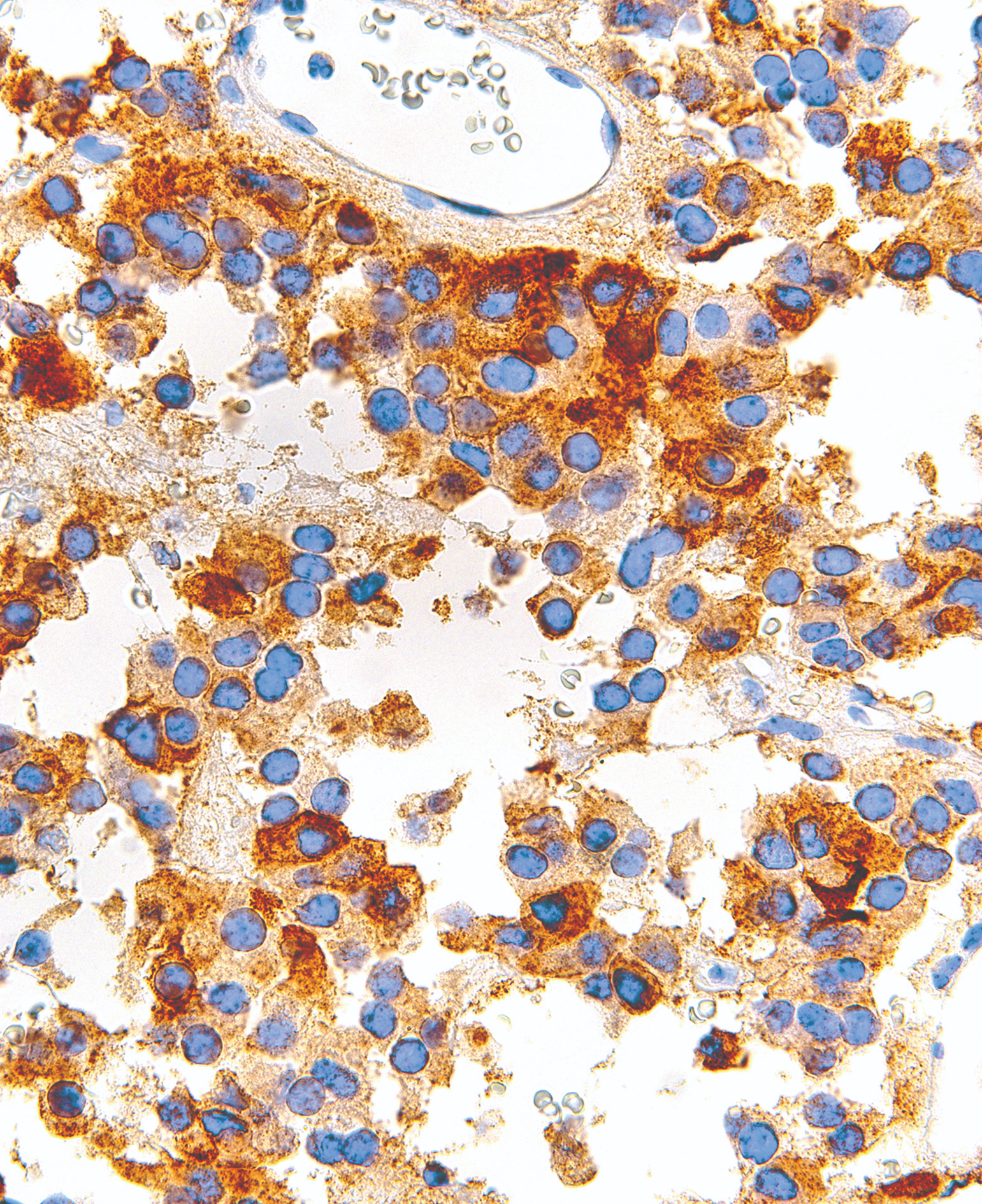
| Clone | IHC580 |
| Source | Mouse Monoclonal |
| Positive Control | Pituitary |
| Dilution Range | 1:200 |

Usages:
For pre-enrichment of Salmonella spp.
Principle:
Peptone provide carbon and nitrogen sources to meet the needs of bacterial growth; sodium chloride maintains osmotic equilibrium; potassium dihydrogen phosphate and disodium hydrogen phosphate as buffer.
Formulation(per liter):
Peptone: 10g
Sodium chloride:5g
Disodium hydrogen phosphate:3.5g
Potassium dihydrogen phosphate: 1.5g
Final pH7.2 ± 0.2
How to use:
1. Suspend 20g of product, adding 1L of distilled or deionized water, heated to boiling stirring until completely dissolved, dispensing into flask, autoclave at 121 for 15min, set aside.
2.Diluted and treated samples.
Quality control:
Item The name and number of strain Growth Colony Color
1 Salmonella typhi CMCC (B) 50071 good Cloudy broth
2 Salmonella typhimurium CMCC (B) 50115 good Cloudy broth
3 Paratyphoid Salmonella CMCC (B) 50093 good Cloudy broth
Storage: Keep container tightly closed, store in a cool, dry place, away from bright light. Storage period of 3 years.
500g

endo-BCN-OH is a click chemistry handle which readily reacts with azides. The primary alcohol allows it to be ligated to other linkers.

endo-BCN-OH is a click chemistry handle which readily reacts with azides. The primary alcohol allows it to be ligated to other linkers.

This product is suitable for extracting total viral nucleic acid from cell-free/low-content cell biological samples such as body fluids, serums, plasma, soaking solutions, tissue homogenate supernatant, and culture supernatant. The Purified DNA/RNA is used for RT-PCR and PCR detection.
Specifications
| Features | Specifications |
| Main Functions | IVD5412 precast kit for MagMix 32, smart 32 |
| Applications | RT-PCR,PCR,NGS |
| Products | Viral DNA / RNA, body cell DNA / RNA |
| Purification method | Polydisperse magnetic beads |
| Purification technology | Magnetic beads technolog |
| Process method | Manual or automatic |
| Sample type | |
| Sample amount | 200μl |
| Adaptive instrument | Nucleic acid extractor, pipetting workstation |
This product is based on the purification method of high binding magnetic particles. The sample is lysed and digested under the action of lysate and Protease. DNA/RNA is released into the lysate. After adding magnetic particles and binding solution, DNA/RNA will be adsorbed on the surface of magnetic particles, and impurities such as proteins will be removed without adsorption. The adsorbed particles were washed with washing solution to remove proteins and impurities, washed with ethanol to remove salts, and finally DNA/RNA was eluted by Nuclease Free Water.
Advantages
Kit Contents
| Cat.No | Reagent | IVD5412-TL-96 |
| PK/Carrier RNA | 24mg/310μg | |
| Protease Dissolve Buffer Blue | 1.8 ml | |
| Tip | 12 | |
| Prepackage Plate(2.0ml Plate) | Row 1/7:500µl Buffer MLBRow 2/8:500µl Buffer MW1Row 3/9:500µl Buffer CWRow 4/10:500µl Buffer CW&MPNRow 5/11:100µl Buffer AVE | 6 |
Storage and Stability
This kit is shipped and stored at room temperature and is valid for 12 months.
This product is suitable for extracting total viral nucleic acid from cell-free/low-content cell biological samples such as body fluids, serums, plasma, soaking solutions, tissue homogenate supernatant, and culture supernatant. The Purified DNA/RNA is used for RT-PCR and PCR detection.