
Description
Specifications
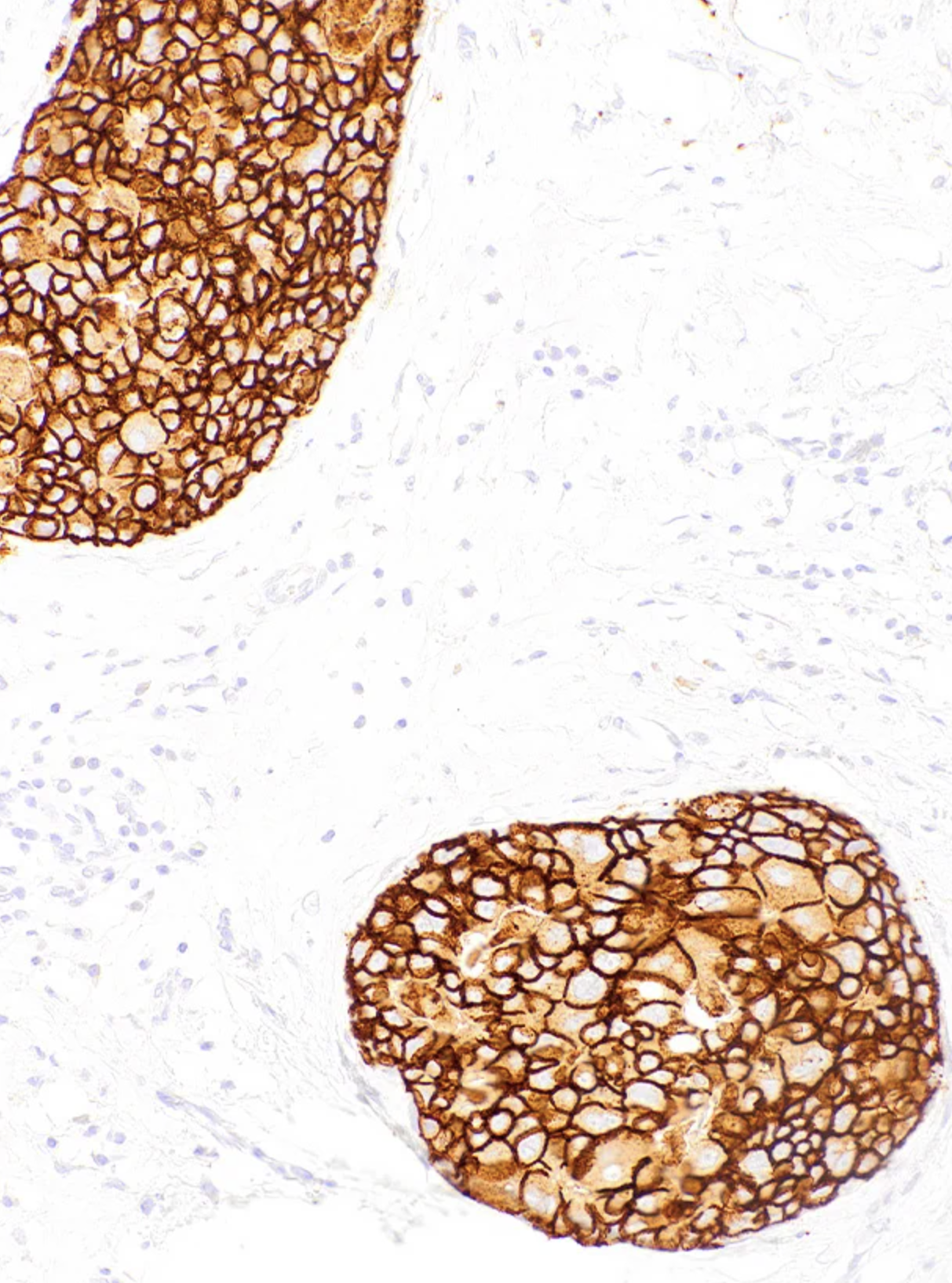
| Clone | IHC002 |
| Source | Mouse Monoclonal |
| Positive Control | Breast Carcinoma |
| Dilution Range | 1:200 |

| Clone | IHC002 |
| Source | Mouse Monoclonal |
| Positive Control | Breast Carcinoma |
| Dilution Range | 1:200 |

m-PEG6-DBCO is a monodisperse PEG reagents which can enable copper-free Click Chemistry through the reaction of DBCO with azide. Reagent grade, for research purpose. Please contact us for GMP-grade inquiries.

m-PEG6-DBCO is a monodisperse PEG reagents which can enable copper-free Click Chemistry through the reaction of DBCO with azide. Reagent grade, for research purpose. Please contact us for GMP-grade inquiries.

A highly efficient, easily automated agarose gel or PCR purification system that delivers superior quality DNA with no salt carryover. Requiring no centrifugation or filtration. The Kit can be easily used in manual and automated 96 or 384-well formats.
Specifications
| Features | Specifications |
| Main Functions | Recover DNA fragments >100bp from agarose gel(<0.3g), purification of DNA from PCR, enzymatic reaction solution or crude gDNA |
| Applications | PCR, NGS, chip analysis, etc. |
| Purification technology | Magnetic beads technology |
| Process method | Manual or automatic |
| Sample type | Agarose Gel, PCR products, enzymatic reaction solution |
| Sample amount | Agarose Gel: <0.3g, PCR products: ≤50µl |
| Recovery | 80% |
| Elution volume | ≥30μl |
| Time per run | ≤30 minutes |
The Kit method contains magnetic particles in an optimized binding buffer to selectively bind DNA fragments (>100bp) and larger to paramagnetic beads. Excess primers, nucleotides, salts, and enzymes can be removed using a simple washing procedure.
Advantages
Kit Contents
| Contents | D500101 | D500102 | D500103 |
| Purification Times | 50 Preps | 500 Preps | 5000 Preps |
| Buffer GDP | 30 ml | 250 ml | 3 x 900 ml |
| MagPure Particles | 1.6 ml | 15 ml | 3 x 50 ml |
| Buffer DW1 | 20 ml | 180 ml | 2 x 800 ml |
| Elution Buffer(10mmTris, pH8.5) | 10 ml | 60 ml | 500 ml |
Storage and Stability
MagPure Particles should be stored at 2-8°C upon arrival. However, short-term storage (up to 24 weeks) at room temperature (15-25°C) does not affect their performance. The remaining kit components can be stored at room temperature (15-25°C) and are stable for at least 18 months under these conditions.
Experiment Data

A highly efficient, easily automated agarose gel or PCR purification system that delivers superior quality DNA with no salt carryover. Requiring no centrifugation or filtration. The Kit can be easily used in manual and automated 96 or 384-well formats.

K-GAMINE
SKU: 700004290
50 assays (manual) / 500 assays (microplate) / 500 assays (auto-analyser)
| Content: | 50 assays (manual) / 500 assays (microplate) / 500 assays (auto-analyser) |
| Shipping Temperature: | Ambient |
| Storage Temperature: | Short term stability: 2-8oC, Long term stability: See individual component labels |
| Stability: | > 2 years under recommended storage conditions |
| Analyte: | N-Acetyl-D-Glucosamine, D-Glucosamine, D-Glucosamine sulphate |
| Assay Format: | Spectrophotometer, Microplate, Auto-analyser |
| Detection Method: | Absorbance |
| Wavelength (nm): | 340 |
| Signal Response: | Increase |
| Linear Range: | 4 to 80 µg of glucosamine per assay |
| Limit of Detection: | 1.33 mg/L |
| Reaction Time (min): | ~ 8 min |
| Application examples: | Food supplements, food products and beverages. |
| Method recognition: | Novel method |
The D-Glucosamine test kit is a high purity reagent for the measurement and analysis of D-glucosamine in neutraceutical/food products. This kit can also be used to measure N-Acetyl-D-Glucosamine and D-Glucosamine sulphate.
Note for Content: The number of manual tests per kit can be doubled if all volumes are halved. This can be readily accommodated using the MegaQuantTM Wave Spectrophotometer (D-MQWAVE).
See our complete list of monosaccharide and disaccharide assay kits.
Advantages
The D-Glucosamine test kit is a high purity reagent for the measurement and analysis of D-glucosamine in neutraceutical/food products. This kit can also be used to measure N-Acetyl-D-Glucosamine and D-Glucosamine sulphate.