
Description
Specifications
| Clone | IHC409 |
| Source | Mouse Monoclonal |
| Positive Control | Colon, Colon Carcinoma |
| Dilution Range | 1:200 |
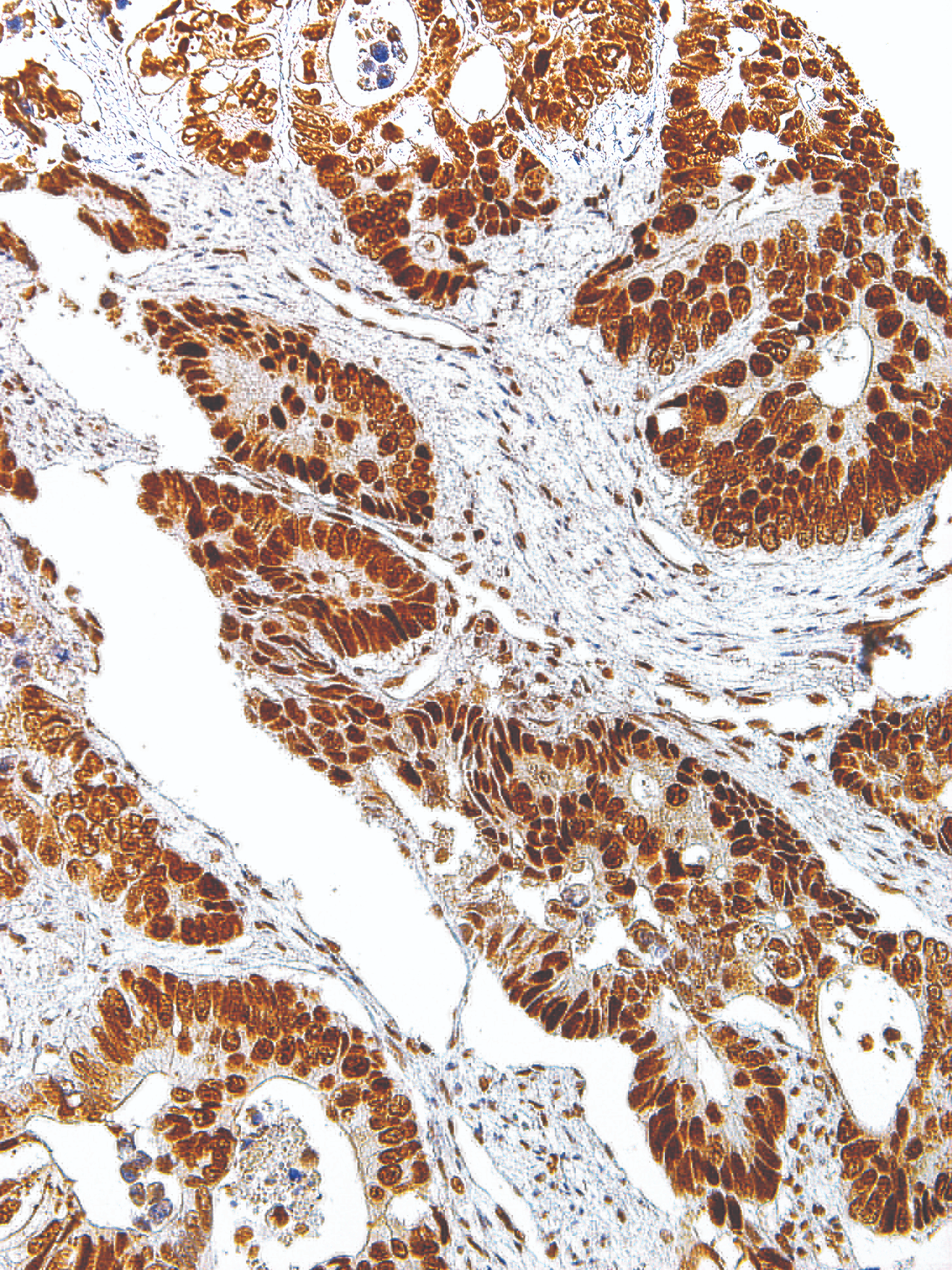
MutL Homolog 1 (MLH1) is a protein involved in the mismatch-repair pathway. This protein is commonly associated with hereditary non-polyposis colorectal cancer, as the MLH1 gene is frequently mutated in patients with this cancer. Studies have shown MLH1 to be deficient in a high percentage of patients with microsatellite instability, as well as endometrial and ovarian cancers. Use of Anti-MLH1 is optimized when paired in an IHC panel with MSH6, MSH2, and PMS2. Anti-MLH1 is useful in the detection of MLH1 in a number of normal and neoplastic tissues, and for identifying a loss of MLH1 in tumors that are microsatellite-unstable.

| Clone | IHC409 |
| Source | Mouse Monoclonal |
| Positive Control | Colon, Colon Carcinoma |
| Dilution Range | 1:200 |
This product is suitable for extracting total pathogen nucleic acid from biological samples with no/low cell content such as body fluid, serum, plasma, soaking solution, tissue homogenate supernatant, culture medium supernatant, etc. The purified DNA/RNA can be used for clinical in vitro detection.
Specifications
| Features | Specifications |
| Main Functions | Extract total pathogen nucleic acid from cell-free/low-content cell biological samples such as body fluids, serums, plasma, tissue homogenate supernatant. |
| Applications | RT-PCR,PCR |
| Products | Pathogen DNA / RNA |
| Purification method | Polydisperse magnetic beads |
| Purification technology | Magnetic beads technology |
| Process method | Manual or automatic |
| Sample type | cell-free/low-content cell biological samples such as body fluids, serums, plasma, tissue homogenate supernatant |
| Sample amount | 200-300μl |
| Adaptive instrument | Nucleic acid extractor, pipetting workstation |
This product is based on the purification method of high binding magnetic particles. The sample is lysed and digested under the action of lysate and Protease. After adding magnetic particles and binding solution, DNA/RNA will be adsorbed on the surface of magnetic particles, and impurities such as proteins will be removed without adsorption. The adsorbed particles were washed with washing solution to remove proteins and impurities, washed with ethanol to remove salts, and finally DNA/RNA was eluted by Buffer NFW.
Advantages
Kit Contents
| Contents | IVD6672-50 | IVD6672 |
| Purification Times | 50 Preps | 200 Preps |
| Bead Tube C | 50 | 4 x 50 |
| MagPure Particle | 1.6 ml | 7.0 ml |
| Proteinase K | 24 mg | 100 mg |
| Protease Dissolve Buffer | 1.8 ml | 6 ml |
| Buffer MLBN | 30 ml | 120 ml |
| Buffer MW1* | 22 ml | 53 ml |
| Buffer MW2* | 20 ml | 50 ml |
| Buffer NFW | 10 ml | 30 ml |
Storage and Stability
MagPure Particles and Proteinase K should be stored at 2–8°C upon arrival. However, short-term storage (up to 8 weeks) at room temperature (15–25°C) does not affect their performance. The remaining kit components can be stored at room temperature (15–25°C) and are stable for 18 months under these conditions.
This product is suitable for extracting total pathogen nucleic acid from biological samples with no/low cell content such as body fluid, serum, plasma, soaking solution, tissue homogenate supernatant, culture medium supernatant, etc. The purified DNA/RNA can be used for clinical in vitro detection.
Functionally Tested in Lateral Flow-made by Attogene in Austin Texas
Bulk pricing and manufacturing supply contracts available.
| Number of particles/mL | 1.5-2 x 10¹⁰ |
| Gold Concentration (mg/mL) | 3.6-4.1 x 10⁻² |
| Molar Concentration (moles/liter) | 2.5-3.4 x 10⁻¹¹ |
| Particle Diameter | 60 nm /- 4.5 |
60nm Colloidal Gold for Lateral Flow is a highly stable and uniform 60 nm gold nanoparticles can be supplied in a range from 1 OD to 100 OD. The quality and performance of a conjugate is critical to successful lateral flow test manufacturing. Our products are made in USA and produced in a state-of-the-art manufacturing facility that enable rapid turnaround times while ensuring batch to batch consistency and reliability.
Product Description
Kit Storage and term of Validity
Storage term: stored at ≤-20℃,keep away from light, avoid heavy weight and repeated freezing and thawing.
Term of Validity: 14 months
Isothermal nucleic acid Principle Summary
The kit is based on room and constant temperature nucleic acid rapid amplification technology, its principle is that at room and constant temperature, the recombinase and primer form a protein/single-stranded nucleotide complex Rec/ssDNA, and invade the double-stranded DNA template with the help of auxiliary proteins and single-stranded binding protein SSB; then form a D-loop region at the invasion point and start to scan the DNA duplex, after finding the target region complementary to the primer and disintegration of the complex Rec/ssDNA, the polymerase also binds to the 3′ end of the primer to start the chain extension. The kit relies on the role of NFO enzyme and adds the designed specific molecular probes according to the template, and get the result by colloidal gold technology (sandwich method).
Isothermal nucleic acid Product Features
1/ High sensitivity and specificity, short reaction time.
2/ The reagent form is freeze-dried, stable and easy to operate.
3/ The reaction can be operated by metal bath and water bath pot without purchasing expensive PCR apparatus.
Technical Parameters:
| Parameters | Details |
|---|---|
| Product Name | DNA Isothermal Amplification Kit NFO |
| Manufacturer | Amp-future |
| Storage Temperature | -20°C |
| Kit Components | Enzymes, Buffers ,Reagents |
| Packaging | 48 Tests/box |
| Detection Limit | 500-1000copies/µL |
| Shipping | ICE |
| Test Time | 5-20mins |
Isothermal nucleic acid Applications
Suitable for DNA isothermal rapid amplification kit(NFO type)
Primer: Require pair of nucleotide primers with the length of 25-35 bp.
DNA basic kit reaction temperature is 39 to 42℃ and time is 5-20 minutes.
Notes
1/ Please avoid nucleic acid contamination and set blank control during reaction due to the high sensitivity of the kit.
2/ Please take out the required quantity of MIRA reaction units for the experiment, and put the rest under storage conditions when performing the experiment.