
Description
Specifications
| Clone | IHC634 |
| Source | Mouse Monoclonal |
| Positive Control | Seminoma |
| Dilution Range | 1:200 |
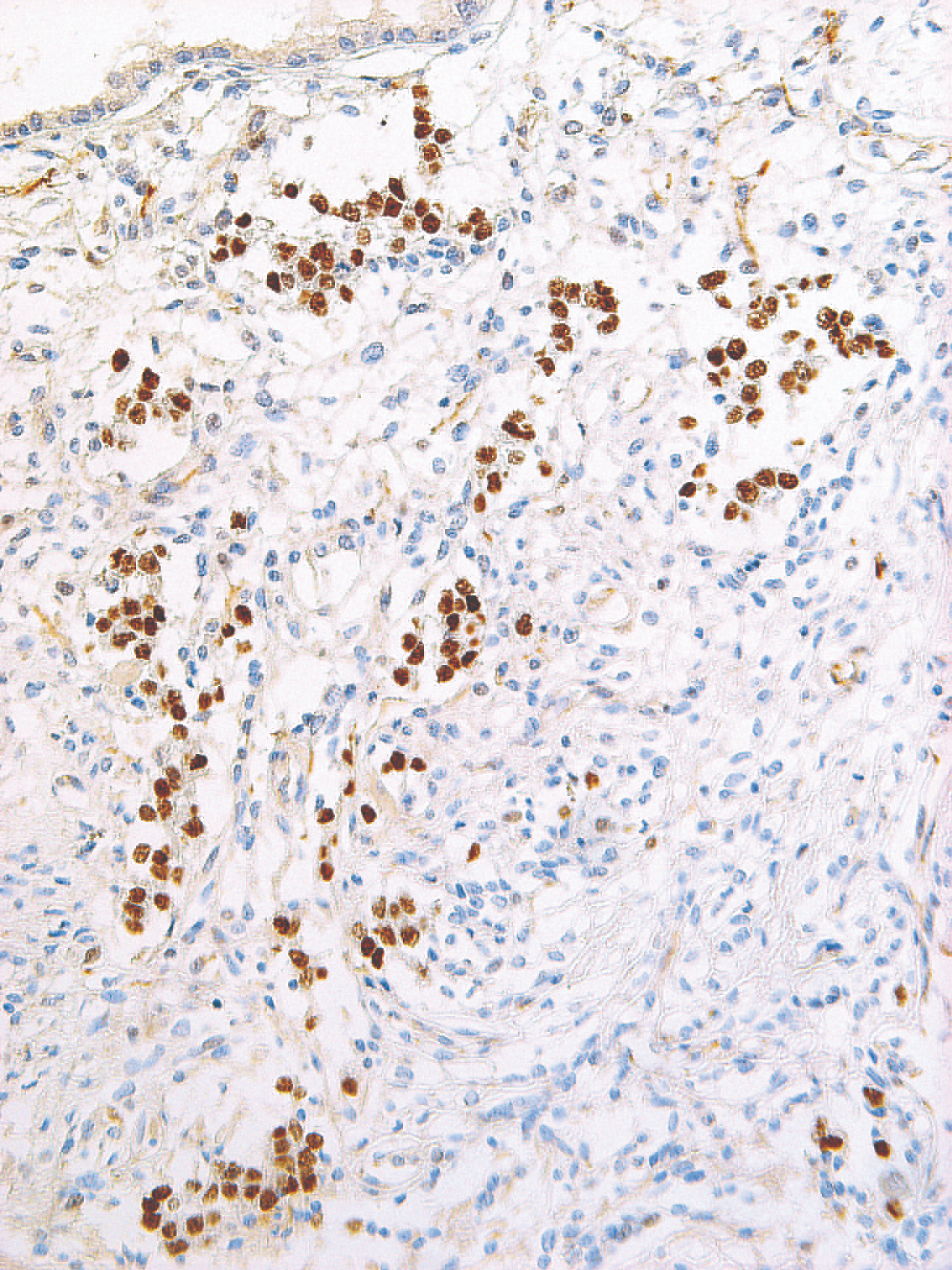
Nanog is a homeoprotein that functions with pluripotent factors such as Oct4 and Sox2 to maintain embryonic stem cell pluripotency. Expression of this protein has been noted in seminoma, dysgerminoma, embryonal carcinoma, and other undifferentiated germ cell tumors, while nanog expression is absent in normal adult organ tissues. Anti-Nanog may be useful in distinguishing between undifferentiated germ cell tumors and non-germ cell tumors.

| Clone | IHC634 |
| Source | Mouse Monoclonal |
| Positive Control | Seminoma |
| Dilution Range | 1:200 |
Magen’s HiPure columns are prepared by high quality glass fiber filter membrane as raw materials through membrane cutting, membrane release, ring release, ring pressing, gland, weighing and other processes. HiPure nucleic acid adsorption columns have the characteristics of long-term stability and high binding capacity. Experiments show that the highest binding capacity and binding efficiency of HiPure nucleic acid adsorption columns are basically unchanged when stored at room temperature for 4 years.
The series of nucleic acid columns produced by Magen Biotech are based on carefully selected imported glass fiber membranes (GF/B, GF/D, GF/F). Columns production processes such as polypropylene injection molding materials, injection molding process, and downstream membrane packing and compression rings are strictly controlled. This is to ensure that the column has extremely high adsorption capacity and long-term stability. Compared with conventional products on the market, Magen’s columns are with varieties, and binding rate will not change when stored at room temperature for 4 years.
Specifications
| Features | Specifications |
| Recommended application | gDNA maxi yield preparation, total RNA maxi preparation |
| Preservation conditions | Room temperature |
| Stability | Up to 4 years |
| Filter membrane | High quality glass fiber filter GF/B, 4 layers |
| Membrane aperture | 1.0μm |
| Maximum binding yield of plasmid | 500 μg |
| Maximum yield of alcohol mediated binding | 5 mg |
| gDNA or RNA yield (>30%ethanol) | Up to 5mg |
| Single liquid carrying capacity of column | 20 ml |
| Minimum elution volume | 800 μl |
| Withstand centrifugal force | 3,000~5,000 x g |
| Centrifuge | Low speed centrifuge for 50mlcentrifuge tubes, >3000 x g, swing-out Rotor |
Adsorption Mechanism
Based on the negatively charged DNA skeleton, it has a high affinity for positively charged glass fibers. In high salt and ethanol solutions, DNA/RNA binds to glass fiber and interacts with hydrophilic matrix on silica through hydrogen bond. DNA/RNA is tightly bound. All pollutants can be removed by washing solution. At high salt concentration, nucleic acids selectively bind to silica gel membrane, while other pollutants, mainly proteins, are removed by membrane washing.
Ordering information
| CAT.No. | Product Name | Package |
| C13122 | HiPure gDNA Maxi Column (4 x GF/B)with 50ml Collection Tubes | 100/Bag |
| Item No. | Product Name | Membrane type/number of layers | Collection tubes | Plasmid DNA binding capacity (Physical adsorption) | gDNA/RNA binding capacity (Alcohol-mediated adsorption) | Minimum Elution volume | Liquid volume capacity |
| C13010 | HiPure DNA Nano Column | 2 layers GF/F | 2ml without cap | 5μg | 20μg | 10μl | 700μl |
| C13011 | HiPure DNA Micro Column | 3 layers GF/F | 2ml without cap | 10μg | 50μg | 15μl | 700μl |
| C13100 | HiPure DNA Mini Column I | 2 layers GF/B | 2ml without cap | 15μg | 100μg | 30μl | 700μl |
| C13110 | HiPure DNA Mini Column II | 4 layers GF/B | 2ml without cap | 35μg | 200μg | 50μl | 800μl |
| C13111 | HiPure RNA Mini Column | 3 layers GF/B | 2ml without cap | 30μg | 200μg | 30μl | 800μl |
| C13112 | HiPure Viral Mini Column | 3 layers GF/F | 2ml without cap | 30μg | 200μg | 30μl | 800μl |
| C13113 | HiPure CFDNA Mini Column | 3 layers GF/F,1 layer GF/B | 2ml without cap | 30μg | 200μg | 30μl | 800μl |
| C13120 | HiPure DNA Midi Column | 4 layers GF/B | 15ml Centrifuge tube | 125μg | 1mg | 500μl | 4ml |
| C13121 | HiPure DNA Midi Column III | 8 layers GF/B | 15ml Centrifuge tube | 250μg | 1mg | 500μl | 4ml |
| C13122 | HiPure DNA Maxi Column | 4 layers GF/B | 50ml Centrifuge tube | 500μg | 5mg | 1000μl | 20ml |
| C13123 | HiPure DNA Maxi Column III | 8 layers GF/B | 50ml Centrifuge tube | 1mg | 5mg | 1000μl | 20ml |
| C13124 | HiPure DNA Maxi Column C | 8 layers GF/B | 50ml high speed Centrifuge tube | 1mg | 5mg | 700μl | 12ml |
| C13130 | HiPure DNA Plate | 2 layers GF/F | 1.6ml Plate | 30μg | 100μg | 80μl | 900μl |
| C13131 | HiPure gDNA Plate | 2 layers GF/B | 1.6ml Plate | 30μg | 100μg | 80μl | 900μl |
Note: GF/B pore size is for 1.0μM glass fiber membrane; GF/F pore size is for 0.7μm glass fiber membrane.
Magen’s HiPure columns are prepared by high quality glass fiber filter membrane as raw materials through membrane cutting, membrane release, ring release, ring pressing, gland, weighing and other processes. HiPure nucleic acid adsorption columns have the characteristics of long-term stability and high binding capacity. Experiments show that the highest binding capacity and binding efficiency of HiPure nucleic acid adsorption columns are basically unchanged when stored at room temperature for 4 years.
The Urine Exosome Purification Kits provide a fast, reliable and convenient method to purify and enrich for pure intact exosomes from different urine sample volumes ranging from 250 µL to 30 mL. These kits also allow for the purification of intact extracellular vesicles (EVs) from different urine sample volumes, and these EVs are ready for any downstream application. The purification is based on Norgen’s proprietary resin.
These kits provide a clear advantage over other available methods since they do not require any special instrumentation, ultracentrifugation, precipitation reagents or any protease treatments. More importantly, the purified exosomes will not be contaminated with any other RNA-binding proteins that may contaminate your exosomal RNA, which is essential if studying exosomal RNA gene expression.
NanoSight® Analysis
Exosomes enriched with Norgen’s Urine Exosome Purification Kits can be analyzed using NanoSight® for assessing the approximate exosome size range and concentration.
Exosomal RNA Analysis
Exosomal RNA can be isolated using Norgen’s Exosomal RNA Isolation Kit from exosomes enriched using Norgen’s Urine Exosome Purification Kits for gene expression analysis using RT-qPCR, microarray or NGS and for Biomarker discovery.
Figure 1 / 2
Click for expanded view
| Kit Specifications | |
| Urine Input (Cat. 57700) | 250 μL – 1 mL |
| Urine Input (Cat. 57800) | 2 mL – 10 mL |
| Urine Input (Cat. 57900) | 11 mL – 30 mL |
| Size of Exosomes Purified | 40 nm – 150 nm |
| Elution Volume | Variable depending on the urine input volume |
| Time to Complete 10 Purifications | 15 – 30 minutes |
Storage Conditions and Product Stability
All buffers should be kept tightly sealed and stored at room temperature. These kits are stable for 2 years after the date of shipment.
Important Note
Urine samples stored at -70°C, -20°C or at 4°C will develop some precipitation due to the aggregation of some of the highly abundant proteins in urine. Eliminating these precipitates using centrifugation or filtration may cause the loss of exosomes. Furthermore, these precipitates may affect the quality of the purified nucleic acid. We recommend the use of Norgen’s Urine Preservative when collecting urine samples, which is designed for the preservation of nucleic acids and proteins in fresh urine samples at ambient temperatures. The components of the Urine Preservative allow samples to be stored for over 2 years at room temperature with no detected degradation of urine DNA, RNA or proteins. Norgen’s Urine Preservative is available as a liquid format in Norgen’s Urine Preservative Single Dose Ampules, as well as in a dried format in Norgen’s Urine Collection and Preservation Tubes.
| Component | Cat. 57700 (50 preps) | Cat. 57800 (25 preps) | Cat. 57900 (15 preps) |
|---|---|---|---|
| Slurry E | 12.5 mL | 12.5 mL | 12.5 mL |
| ExoC Buffer | 8 mL | 30 mL | 50 mL |
| ExoR Buffer | 12 mL | 12 mL | 12 mL |
| Mini Filter Spin Columns inserted into 2 mL tubes | 50 | 25 | 15 |
| Product Insert | 1 | 1 | 1 |
Chlamydia trachomatis, the causative agent of Chlamydia, is a Gram negative bacteria. Transmission of the bacteria occurs via contact with infected bodily fluids which then infect mucosal membranes. It can be transmitted from mother to child during pregnancy and infect the eyes causing conjunctivitis. The genital infection causes urethritis, epididymitis and prostatitis in males and Pelvic Inflammatory Disease (PID) in females with an increased risk of contracting HIV. The infection can be treated with a course of antibiotics. Sexually transmitted infections in females are most often asymptomatic, but can be noticeable in chronic pain of the pelvic region, vaginal bleeding and painful urination. Infection of the ovaries, fallopian tubes or uterus causes Pelvic Inflammatory Disease (PID) which can lead to difficulties in conceiving, increased risk of ectopic pregnancy or infertility. Infections in males are more likely to be symptomatic, causing painful urination, discharge from the penis and swollen testicles and may eventually cause infertility if left untreated.
Neisseria gonorrhoeae is a Gram-negative coccus of the Neisseria genus. N. gonorrhoeae is usually seen in pairs infecting human cells. It has a circular DNA genome of approximately 1Mbp encoding over 2000 genes. N. gonorrhoeae is transmitted by sexual contact and usually causes infection in cells of the mucous membrane of the male urethra or the endocervix and urethra in females. During infection, polysaccharides are released from the bacteria that stimulate host cell production of tumour necrosis factors that cause an inflammatory response. There is no vaccine against N. gonorrhoeae infection and antibiotic resistance is beginning to increase, therefore treatment includes a course of antibiotics that will be effective against resistant strains. Complications in males caused by the infection can result in prostatitis or orchitis if the bacteria spread. In females, invasion of the fallopian tubes or ovaries can result in salpingitis or ovaritis respectively, with any of these infections possibly resulting in sterility.
Chlamydia/Neisseria TaqMan PCR Kit,
100 reactions
Chlamydia/Neisseria TaqMan PCR Probe/Primer Set and Controls,
100 reactions
For research use only and NOT intended for in vitro diagnostics.
Figure 1 / 5
Click for expanded view
Storage Conditions and Product Stability
All kit components can be stored for 2 years after the date of production without showing any reduction in performance.
All kit components should be stored at -20°C upon arrival.
| Component | Cat. TM42550 (100 preps) | Cat. TM42510 (100 preps) |
|---|---|---|
| MDx TaqMan 2X PCR Master Mix | 2 x 700 μL | – |
| Chlamydia/Neisseria Primer & Probe Mix | 280 μL | 280 μL |
| Chlamydia/Neisseria Positive Control | 150 μL | 150 μL |
| Nuclease-Free Water (Negative Control) | 1.25 mL | 1.25 mL |
| Product Insert | 1 | 1 |