
Description
Specifications
| Clone | IHC659 |
| Source | Mouse Monoclonal |
| Positive Control | Seminoma, Dysgerminoma |
| Dilution Range | 1:200 |
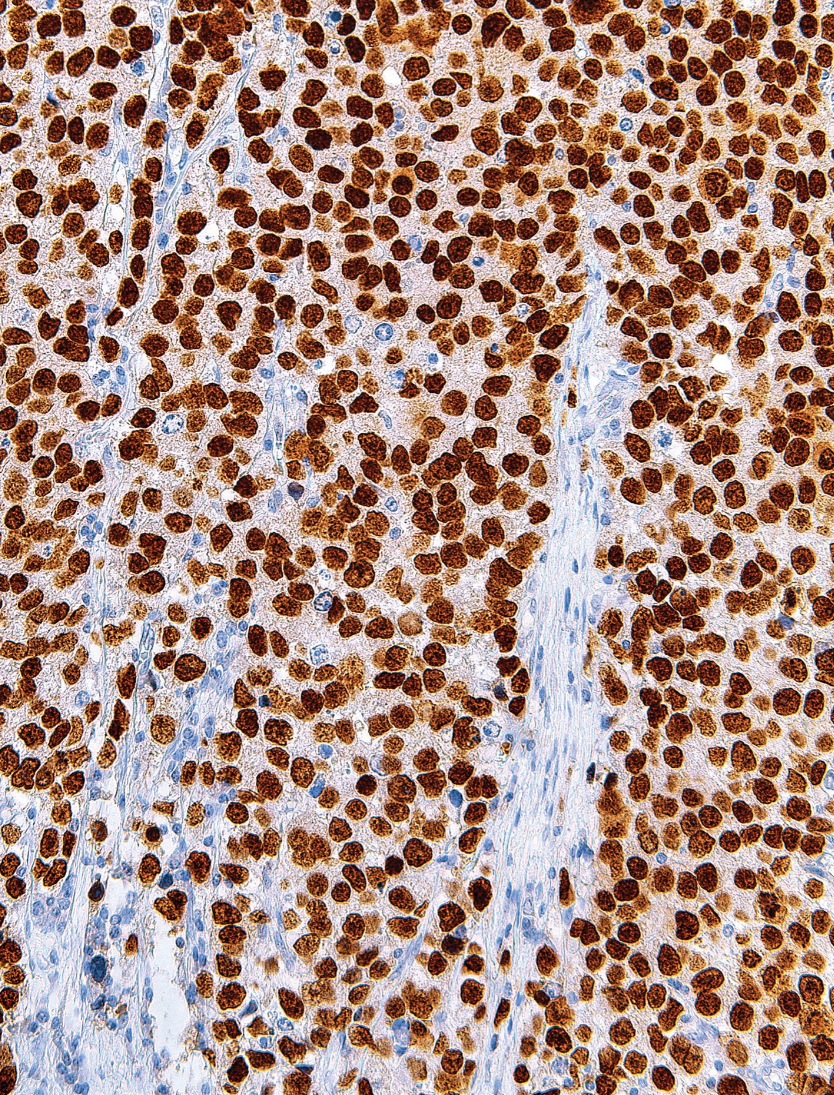
Sal-Like Protein 4 (SALL4), is a zinc finger transcription factor found in germ cells and human blood progenitor cells, with functional involvement in modulating Oct-4 to maintain embryonic stem cell pluripotency. SALL4 is a useful marker for acute myeloid leukemia, B-cell acute lymphocytic leukemia, intratubular germ cell neoplasia, seminomas/dysgerminomas, and yolk sac tumors (both pediatric and postpubertal). Anti-SALL4 is used to detect embryonal carcinomas, hepatocellular carcinoma (HCC), gliomas, ovarian primitive germ-cell tumors, choriocarcinomas, spermatogonia, teratoma, gastric cancer, breast cancer, and lung cancer. Expression of SALL4 is often associated with poor prognosis in HCC, and with metastasis in endometrial cancer, colorectal carcinoma, and esophageal squamous cell carcinoma.

| Clone | IHC659 |
| Source | Mouse Monoclonal |
| Positive Control | Seminoma, Dysgerminoma |
| Dilution Range | 1:200 |
Product Description
Kit Storage and Term of Validity
Storage term: stored at ≤-20℃,keep away from light, avoid heavy weight and repeated freezing and thawing.
Term of Validity: 14 months
Isothermal Nucleic Acid Principle Summary
This kit is based on a rapid nucleic acid amplification technology at room temperature and constant temperature: at room temperature and constant temperature (generally 39 ºC~42 ºC), reverse transcriptase uses specific primers and template RNA to synthesize cDNA strands, and binds the auxiliary protein and single strand With the help of the protein, the recombinase and the primer form a complex; perform a homology search and bind the target homology domain, at this time a D-loop region is formed at the homology position and strand exchange begins; accompanied by the recombinase from the complex Upon dissociation, the polymerase also binds to the 3′ end of the primer, initiating chain extension. Relying on the action of nfo enzyme, adding specific molecular probes designed according to the template, and using colloidal gold technology (sandwich method) can detect the final result.
Isothermal Nucleic Acid Product Features
1/ High sensitivity and specificity, short reaction time.
2/ The reagent form is freeze-dried, stable and easy to operate.
3/ The reaction can be operated by metal bath and water bath pot without purchasing expensive PCR apparatus.
Technical Parameters:
| Parameters | Details |
|---|---|
| Product Name | RNA Isothermal Amplification Kit NFO |
| Manufacturer | Amp-future |
| Storage Temperature | -20°C |
| Kit Components | Enzymes, Buffers ,Reagents |
| Packaging | 48 Tests/box |
| Detection Limit | 500-1000copies/µL |
| Shipping | ICE |
| Test Time | 5-20mins |
Isothermal Nucleic Acid Applications
Suitable for RNA isothermal rapid amplification kit(NFO type)
Primer: Require pair of nucleotide primers with the length of 25-35 bp.
RNA NFO kit reaction temperature is 39 to 42℃ and time is 5-20 minutes.
Notes
1/ Please avoid nucleic acid contamination and set blank control during reaction due to the high sensitivity of the kit.
2/ Please take out the required quantity of MIRA reaction units for the experiment, and put the rest under storage conditions when performing the experiment.
Bisulfite seq is a well know technology to detect DNA methylation and several technologies such as WGBS, RRBS, MeDIP-Seq, and MSBS are used for whole genome DNA methylation analysis. DNA methylation is important for regulation of cell development, differentiation and gene expression in molecular biology, genetics and epigenetics. Most methylated cytosines are found at CpG sites, and 70-80% of cytosines are methylated. The number of CpG sites in human genome is around 28 million, which is less than 1% of the genome compared with 4.4% expected.
Whole genome bisulfite sequencing (WGBS) is the most effective method of DNA methylation analysis. The only limitation is the sequencing cost is very high because the whole genome is sequenced including all the non-methylated regions.
Reduced Representation Bisulfite Sequencing (RRBS) is the reduced representation of a smaller fraction of the methylated CpG sites. RRBS combines restriction enzyme digestion and bisulfite sequencing, and enriches the sequencing for methylated CpG sites. It is an efficient technology for estimate the whole genome methylation patterns at the single base level. Although this allows a higher coverage depth and reduces the sequencing cost, the limitation is only 10% of the methylated CpG sites are covered.
Methylated DNA Immunoprecipitation Sequencing (MeDIP-Seq) is another whole genome enrichment technique used for selection of methylated DNA. Using antibodies against 5-methylcytosine, methylated DNA is enriched from whole genomic DNA via immunoprecipitation. 5-methylcytosine antibodies are incubated with fragmented genomic DNA and precipitated, followed by DNA purification and sequencing. There are several drawbacks of MeDIP-Seq: 1. Low resolution (150~200 bp) as opposed to the single base resolution; 2. Non-specific interaction due to antibody specificity and selectivity. 3. Bias towards hypermethylated regions.
The Methylation Specific Bisulfite Seq (MSBS) Library Prep Kit (illumina platform) was developed for construction of NGS libraries for methylated CpG sites using bisulfite treated DNA (20 ng – 500 ng) as input. The kit enriches methylated CpG regions, thus significantly reduce the sequencing cost. The kit estimates the whole genome methylation patterns at the single base level since it is based on a bisulfite-seq technology.
It is known that bisulfite treatment of completed NGS libraries causes tremendous damage to the libraries. By using bisulfite treated DNA as input, the kit overcomes the significant library loss due to the bisulfite conversion. The kit contains a mixture of PCR polymerases that have high-fidelity amplification and uracil tolerance which is ideal for bisulfite treated DNA.
Methylation Specific Bisulfite Seq Library Prep Kit Workflow
Three index types are available for the kit:
Non-index (Cat.# 30101): Libraries do not have index.
Index (Cat.# 30102): Each primer contains a unique barcode sequence of 6 bases to identify the individual library. Library multiplexing capacity is up to 48 samples. Index information can be downloaded here.
Unique dual index (Cat.# 30103): The multiplexing of bisulfite sequencing library is up to 96 samples with unique dual indexes. We used a Four-Base Difference Index System to generate indexes that have at least 4 bases different from each other in the 8-base index. The index primers remove NGS errors including index cross-contamination, index hopping, reads mis-assignment etc. Index information can be downloaded here.
MSBS Library Prep Kit enriches CpG sites
High methylation regions and low methylation regions in human genome.
High methylation region in human genome.
Low methylation region in human genome.
Sequencing setting: Single-end 35 cycles (Read 1, 35 bases) recommended
To maximize the methylated CpG enrichment, we recommend to sequence the MSBS libraries with single end 35 cycles (read1, 35 bases). This is because the enriched methylated CpG sites are mainly located around the beginning of read 1 sequences. Shorter single end reads tend to have better methylated CpG enrichment.
Bisulfite seq is a well know technology to detect DNA methylation and several technologies such as WGBS, RRBS, MeDIP-Seq, and MSBS are used for whole genome DNA methylation analysis. DNA methylation is important for regulation of cell development, differentiation and gene expression in molecular biology, genetics and epigenetics. Most methylated cytosines are found at CpG sites, and 70-80% of cytosines are methylated. The number of CpG sites in human genome is around 28 million, which is less than 1% of the genome compared with 4.4% expected.
DBCO-PEG13-DBCO is a long chain click chemistry reagent DBCO will react with azide-bearing compounds or biomolecules without copper catalyst. The hydrophilic PEG spacer arm can increase water solubility and membrane permability. Reagent grade, for research purpose. Please contact us for GMP-grade inquiries.