
Description
Specifications
| Clone | IHC672 |
| Source | Mouse Monoclonal |
| Positive Control | Testes, Melanoma, Xp11.2 Translocation Renal Cell Carcinoma |
| Dilution Range | 1:200 |

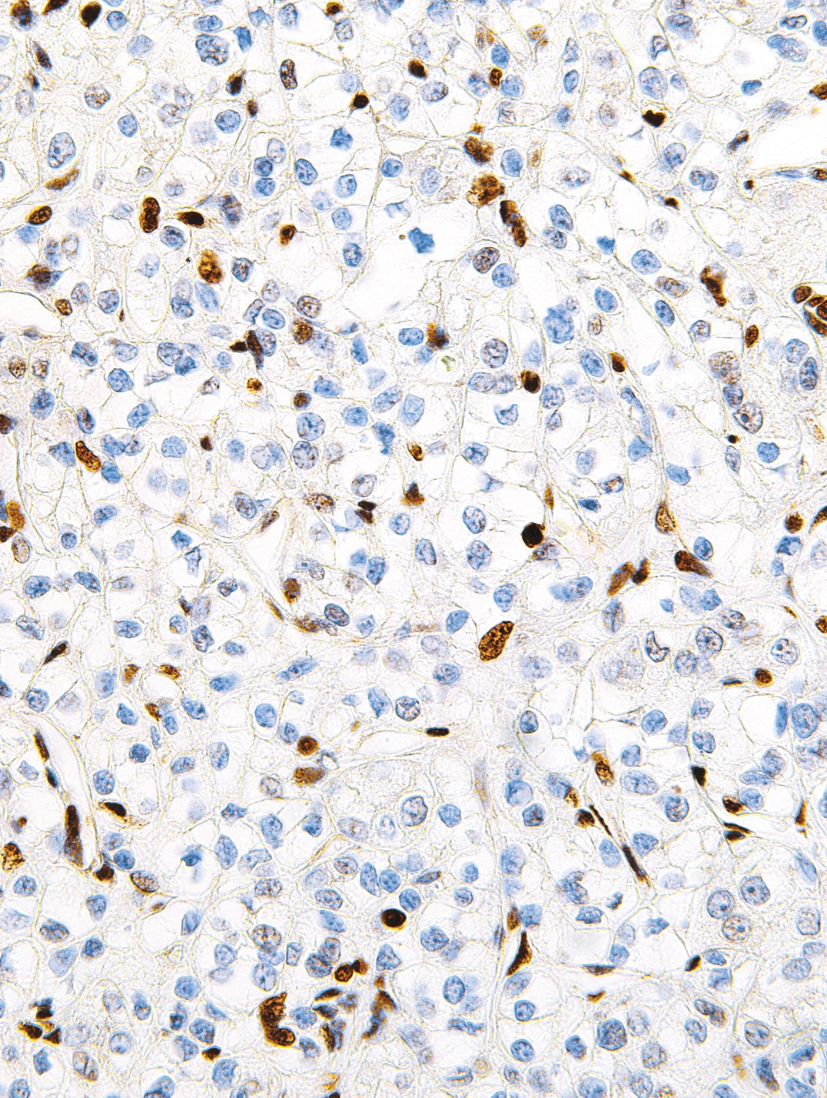
| Clone | IHC672 |
| Source | Mouse Monoclonal |
| Positive Control | Testes, Melanoma, Xp11.2 Translocation Renal Cell Carcinoma |
| Dilution Range | 1:200 |

Features
1.Brushless frequency motor,in great torque, free maintenance, no powder pollution, quick in speed up and down.
2.Microprocessor control
3.Digital display in time, speed and RCF.
4. 10 kinds of program stored in the memory, 10 kinds of accelerating and decelerating speed for your choice.
5. Automatically electric lid lock, over speed, over temperature protection and imbalance protection.
6.High quality steel centrifuge body , stainless steel chamber, 3 tiers protection,safe and reliable.
7. Rotor is connected to spindle by specialized taper sleeve, loading simple and quick, no direction
TG16 Technical Parameter:
| Max. Speed | 16000rpm |
| Max. RCF | 20600×g |
| Max. Capacity | 6×100ml |
| Time Range | 0~99min |
| RPM/RCF Convert | Yes |
| Noise (dB) | ≤ 65 |
| Acc/Dec | 10 Kinds |
| Speed Accuracy | ±20r/min |
| Temperature Accuracy | ±1℃ |
| Voltage(V/Hz) | AC 220V/110V 50HZ/60HZ |
| Size (L x W x Hmm) | 513×370×320mm |
| Net Weight/Gross weight(Kg) | 48KG/55kg |
| Certificates | CE,ISO & Calibration report are available |
Matched Rotor for TG16
| Order No | Rotor | Max speed (rpm) | Max Volume(ml) | Max RCF (g) |
| G16-1 | Angle rotor | 14000 | 4×8PCR | 12070 |
| G16-2 | Angle rotor | 13000 | 6×8PCR | 16080 |
| G16-3 | Angle rotor | 14000 | 8×8PCR | 13390 |
| G16-4 | Angle rotor | 13000 | 12×8PCR | 17220 |
| G16-5 | Angle Rotor | 15000 | 30×0.5ml | 18510 |
| G16-6 | Angle Rotor | 14000 | 40×0.5ml | 19970 |
| G16-7 | Angle Rotor | 16000 | 12×1.5/2ml | 17940 |
| G16-8 | Angle Rotor | 15000 | 24×1.5/2ml | 20600 |
| G16-9 | Angle Rotor | 13500 | 30×1.5/2ml | 19340 |
| G16-10 | Angle Rotor | 11000 | 48×1.5/2ml | 12840 |
| G16-11 | Angle Rotor | 15000 | 16×5ml | 19350 |
| G16-12 | Angle Rotor | 14000 | 12×7ml | 16370 |
| G16-13 | Angle Rotor | 14000 | 6×10ml | 16460 |
| G16-14 | Angle Rotor | 13000 | 12×10ml | 14510 |
| G16-15 | Angle Rotor | 10000 | 12×15ml | 11840 |
| G16-16 | Angle Rotor | 5000 | 24×15ml | 3080 |
| G16-17 | Angle Rotor | 5000 | 30×15ml | 3830 |
| G16-18 | Angle Rotor | 12000 | 8×20ml | 14510 |
| G16-19 | Angle Rotor | 12000 | 6×30ml | 14000 |
| G16-20 | Angle Rotor | 11000 | 6×50ml | 13480 |
| G16-21 | Angle Rotor | 12000 | 6×70ml | 10810 |
| G16-22.1 | Angle Rotor | 12000 | 4x100ml | 14850 |
| G16-22 | Angle Rotor | 8000 | 6×100ml | 7280 |
| G16-23 | Angle Rotor | 12000 | 24 pieces capillary vessel | 15800 |
| G16-24 | Microplate rotor | 4000 | 2×3×48 Well | 2300 |


Europium Chelate Microspheres Nanoparticle Streptavidin Conjugate for Lateral Flow
Our Streptavidin Europium Chelate Microspheres conjugate is manufactured using special conjugation technology and functonally tested by lateral flow. We have coated our high quality nanoparticles with a proprietary surface coat that covalently binds the biotin forming ultra stable conjugates. The resulting Streptavidin Europium Chelate Microspheres can irreversibly bind biotin.
Europium dyed polystyrene beads conjugated to streptavidin
250ul of a 1mg/ml stock ready to use for Lateral Flow
50mL Lateral FLow Running Buffer designed for Streptavidin Europium Chelate Microspheres
Inquire for Larger Volumes: [email protected]
Excitation max: 365nm
Emission max: 610nm

Europium Chelate Microspheres Nanoparticle Streptavidin Conjugate for Lateral Flow
Our Streptavidin Europium Chelate Microspheres conjugate is manufactured using special conjugation technology and functonally tested by lateral flow. We have coated our high quality nanoparticles with a proprietary surface coat that covalently binds the biotin forming ultra stable conjugates. The resulting Streptavidin Europium Chelate Microspheres can irreversibly bind biotin.