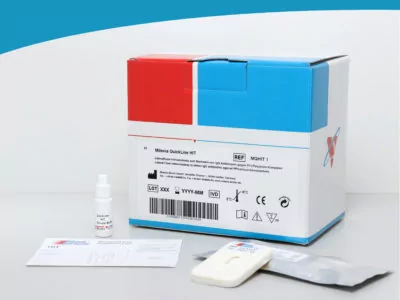
0 tests Lateral Flow Assay designed for the detection of IgG antibodies against PF4/polyanion-complexes in human citrated plasma or Serum
Detail
Name of Product
HIT – Heparin-Induced Thrombocytopenia Test (20)
Catalog Number
MQHIT 1
Short Info
Lateral Flow Assay designed for the detection of IgG antibodies against PF4/polyanion-complexes in human citrated plasma or Serum
This product is only available in Germany!
Method/Platform
lateral flow, immunoassay
Range/Assay Sensivity
Test Principle
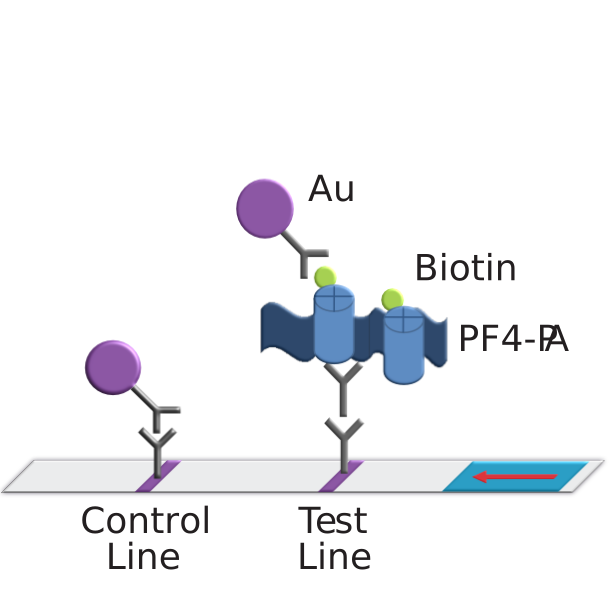
IgG antibodies are resposible for the heparin induced thrombocytopenia.
Immobilized anti-human IgG on the membrane of the test unit binds patients IgG-antibodies which are previously captured by the PF4/polyanion-complex which is detected by intensely colored gold nanoparticles.
The presence of PF4/polyanion-complex becomes visible at a colored test line. The surplus of gold particles continues to migrate through the membrane and is captured at the control line by specific antibodies.
Ractopamine ELISA Test Kit is a competitive enzyme immunoassay for detection in meat, feed, liver, kidney, milk, urine, serum and plasma. Ractopamine has been banned for use as a livestock growth promoter in many countries around the world. To prevent ractopamine residues from entering the food chain, both producers and government surveillance agencies need technologies and methods that can provide rapid, accurate and reliable detection at specific sensitivities. This kit enables government agencies, food manufacturers, as well as quality assurance organizations, to detect ractopamine as low as 0.1 ng/g or ppb level in a variety of sample types.
We accelerate RT-PCR for SARS-CoV-2 detection and make Covid-19 research easier!
The Volcano product family supports this goal with optimized reaction components for sensitive and reliable results. The key driver is an engineered, truly thermostable Taq DNA polymerases with reverse transcriptase activity. Have a look at the products or contact us directly for support optimizing your products:
Volcano3G® RT-PCR Probe 2x Master Mix Volcano3G® RT-PCR Probe 2x Master Mix contains all components required for general RT-qPCR. (to the product)
RevTaq RT-PCR DNA polymerase RevTaq RT-PCR DNA polymerase has RNA-dependent (reverse transcriptase) and DNA-dependent DNA polymerase activity. It is a thermostable DNA polymerase suitable for RT-PCR. (to the product)
Volcano3G® RT-PCR Probe 2x Master Mix (with SARS-CoV-2 Research Components) If you are interested in sourcing a Volcano3G® RT-PCR Probe 2x Master Mix with components needed for SARS-CoV-2 research, please contact us.
Document
The Volcano product family supports this goal with optimized reaction components for sensitive and reliable results. The key driver is an engineered, truly thermostable Taq DNA polymerases with reverse transcriptase activity. Have a look at the products or contact us directly for support optimizing your products:
Dietary fiber can generally be described as the carbohydrate content of food that is not digested in the human small intestine. It passes into the large intestine where it is partially or fully fermented. These characteristics of dietary fiber are associated with its numerous well documented health benefits.
Dietary Fiber is a mixture of complex organic substances, including hydrophilic compounds, such as soluble and insoluble polysaccharides and non-digestable oligosaccharides, as well as a range of non-swellable, more or less hydrophobic, compounds such as cutins, suberins and lignins. The procedures for the determination and analysis of total dietary fiber as outlined in our assay protocol are based on the methods of Lee et al.1 and Prosky et al.2,3 (AOAC 991.43, AOAC 985.29, AACC 32-07.01 and AACC 32-05.01). However, the enzymes in the Megazyme Total Dietary Fiber Kit can also be used in other dietary fiber analytical methods such as AACC Method 32-21.01 and AACC Method 32-06.01.
1. Association of Official Analytical Chemists. (1985). Official Methods of Analysis, 14th ed., 1st suppl. Secs. 43, A14-43, A20, p.399. 2. Association of Official Analytical Chemists. (1986). Changes in methods. J. Assoc. Off. Anal. Chem., 69, 370. 3. Association of Official Analytical Chemists. (1987). Changes in methods. J. Assoc. Off. Anal. Chem., 70, 393.
See General Referee Reports: Journal of AOAC INTERNATIONAL, Vol. 81, No. 1, 1998.
Two separate methods are described in the associated assay protocol:
METHOD 1: DETERMINATION OF TOTAL, SOLUBLE AND INSOLUBLE DIETARY FIBER Based on AOAC Method 991.43 “Total, Soluble, and Insoluble Dietary Fiber in Foods” (First Action 1991) and AACC Method 32-07.01 “Determination of Soluble, Insoluble, and Total Dietary Fiber in Foods and Food Products” (Final Approval 10-16-91).
METHOD 2: DETERMINATION OF TOTAL DIETARY FIBER Based on AACC method 32-05.01 and AOAC Method 985.29.
Note that a letter of endorsement from the original method developer, Dr. Leon Prosky, is included in the Documents Tab.