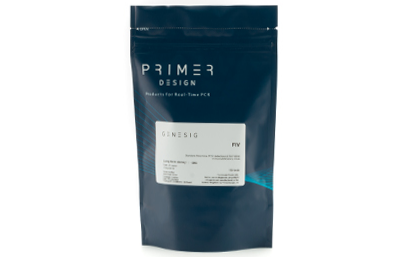
Primer and probe mix (150 reactions) Reverse Transcription, target specific primers (RNA genome viruses only) Copy number standard curve (sufficient for multiple standard curves) Internal extraction control – Read through VIC channel* Endogenous control (150 tests) RNAse/DNAse free water *alternative fluorophores available on request
Nucleic acid testing (NAT) is the method of choice for detection and quantification of a wide range of micro organisms. Primerdesign manufactures and supplies high quality quantitative real-time PCR kits for the detection and simultaneous quantification of numerous significant pathogens . A copy number standard curve is provided for quantification and an the internal extraction template (DNA or RNA), controls for the quality of the nucleic acid extraction and eliminates false negative results.
The kit is designed with the broadest possible detection profile to ensure that all clinically relevant strains and subtypes are detected. Target sequences are selected by working with data from key opinion leaders in the field. Multiple sequence alignments and unprecedented real-time PCR expertise in design and validation ensure the best possible kit. Details of the target and priming specificity are included in the individual handbooks above.
Packaged, optimised and ready to use. Expect Better Data.
Lyophilized High Sensitivity RNA Amplification Kit Fast Accurate Results
Product Info
Document
Product Info
Product Description
High-Sensitivity RNA Amplification Kit: Fast & Accurate Results
Product Detail
Kit Storage and term of Validity
Storage term: stored at ≤-20℃,keep away from light, avoid heavy weight and repeated freezing and thawing.
Term of Validity: 14 months
Isothermal nucleic acid Principle Summary
This kit is based on a rapid nucleic acid amplification technology at room temperature and constant temperature:at room temperature and constant temperature(generally 39℃~42℃),reverse transcriptaseuses specific primers and template RNA tosynthesize cDNA strands,and binds the auxiliary protein and single strand with the help of the protein, the recombinase and the primer form a complex; perform a homology search and bind the target homology domain, at this time a D-loop region is formed at the homology positionand strand exchange begins; accompanied by the recombinase from the complex upon dissociation,the polymerase also bindsto the 3′ end of the primer,initiating chainextension.It is suitable for laboratory-level RNA amplification and RNA amplification for other detection purposes.
Isothermal nucleic acid Product Features
1/ High sensitivity and specificity, short reaction time.
2/ The reagent form is freeze-dried, stable and easy to operate.
3/ The reaction can be operated by metal bath and water bath pot without purchasing expensive PCR apparatus.
Technical Parameters:
Parameters
Details
Product Name
RNA Isothermal Amplification Kit Basic
Manufacturer
Amp-future
Storage Temperature
-20°C
Kit Components
Enzymes, Buffers ,Reagents
Packaging
48 Tests/box
Detection Limit
500-1000copies/µL
Shipping
ICE
Test Time
5-20mins
Isothermal nucleic acid Applications
Suitable for RNA isothermal rapid amplification kit(BASIC type)
Primer: Require pair of nucleotide primers with the length of 25-35 bp.
RNA basic kit reaction temperature is 39 to 42℃ and time is 5-20 minutes.
Notes
1/ Please avoid nucleic acid contamination and set blank control during reaction due to the high sensitivity of the kit.
2/ Please take out the required quantity of MIRA reaction units for the experiment, and put the rest under storage conditions when performing the experiment.
The SMO-HiFi™ DNA Polymerase is a new genetically modified, recombinant DNA polymerase with fidelity 70 times higher than Taq DNA polymerase during amplification, as well as very high elongation rate. Being highly thermostable, SMO-HiFi™ DNA Polymerase can remain viable even after being subjected to boiling for 2 minutes. The SMO-HiFi™ DNA Polymerase is also designed to operate in much lower Mg2+ concentration as compared to other DNA polymerase products.
Features
5’→3′ DNA polymerase activity
3’→5′ exonuclease (proofreading) activity
High reaction rate (up to 1 kb/10 seconds)
High fidelity, 70 times higher than Taq DNA polymerase
Blunt end amplicons
Thermo-stable: half-life is more than 10 hrs at 95°C
Storage
[TF1000] SMO-HiFi™ DNA Polymerase
-20°C for 24 months
Document
The SMO-HiFi™ DNA Polymerase is a new genetically modified, recombinant DNA polymerase with fidelity 70 times higher than Taq DNA polymerase during amplification, as well as very high elongation rate. Being highly thermostable, SMO-HiFi™ DNA Polymerase can remain viable even after being subjected to boiling for 2 minutes. The SMO-HiFi™ DNA Polymerase is also designed to operate in much lower Mg2+ concentration as compared to other DNA polymerase products.