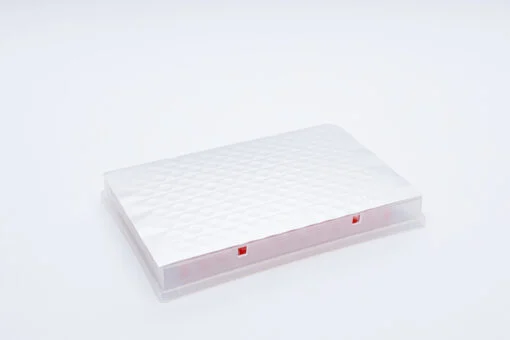
Heavy duty heat sealing foil which is peelable; suitable for long term storage and transportation.
Detail
Overview
Heavy duty heat sealing foil which is peelable; suitable for long term storage and transportation.
Heat sealing offers a 100% effective method of plate sealing, for complete seal integrity, as well as being quick and cost effective
Our ThermASeal Heat Seal is a heavy duty laminate foil seal suitable for providing a very strong, but peelable seal
The seal is compatible with polypropylene plates to provide a high degree of sample protection
It demonstrates very good solvent resistance and can be used for very low temperature compound storage, in DMSO and organic solvents, and long term room temperature storage such that it is recommended as suitable for sample transportation
The seal can be pierced only by using a blade
The seal is available as sheets, for use with manual and semi-automated sealers, such as our HeatASeal 500 Sealing Machine
Also available in multiple roll formats compatible with specified automated heat sealers, such as our Wasp or Chameleon XT
Other Products
Highly Sensitive Isothermal RNA Amplification Kit With Fast Reaction Time
Product Info
Document
Product Info
Product Description
Highly Sensitive Isothermal Amplification Kit with Fast Reaction Time
Product Detail
Kit Storage and term of Validity
Storage term: stored at ≤-20℃,keep away from light, avoid heavy weight and repeated freezing and thawing.
Term of Validity: 14 months
Isothermal nucleic acid Principle Summary
This kit is based on a rapid nucleic acid amplification technology at room temperature and constant temperature: at room temperature and constant temperature (generally 39 ºC~42 ºC), reverse transcriptase uses specific primers and template RNA to synthesize cDNA strands, and binds the auxiliary protein and single strand With the help of the protein, the recombinase and the primer form a complex; perform a homology search and bind the target homology domain, at this time a D-loop region is formed at the homology position and strand exchange begins; accompanied by the recombinase from the complex Upon dissociation, the polymerase also binds to the 3′ end of the primer, initiating chain extension. Relying on the action of nfo enzyme, adding specific molecular probes designed according to the template, and using colloidal gold technology (sandwich method) can detect the final result.
Isothermal nucleic acid Product Features
1/ High sensitivity and specificity, short reaction time.
2/ The reagent form is freeze-dried, stable and easy to operate.
3/ The reaction can be operated by metal bath and water bath pot without purchasing expensive PCR apparatus.
Technical Parameters:
Parameters
Details
Product Name
RNA Isothermal Amplification Kit NFO
Manufacturer
Amp-future
Storage Temperature
-20°C
Kit Components
Enzymes, Buffers ,Reagents
Packaging
48 Tests/box
Detection Limit
500-1000copies/µL
Shipping
ICE
Test Time
5-20mins
Isothermal nucleic acid Applications
Suitable for RNA isothermal rapid amplification kit(NFO type)
Primer: Require pair of nucleotide primers with the length of 25-35 bp.
RNA NFO kit reaction temperature is 39 to 42℃ and time is 5-20 minutes.
Notes
1/ Please avoid nucleic acid contamination and set blank control during reaction due to the high sensitivity of the kit.
2/ Please take out the required quantity of MIRA reaction units for the experiment, and put the rest under storage conditions when performing the experiment.
Respiratory Syncytial Virus A (RSV-A) TaqMan RT-PCR Detection Kits
Product Info
Document
Product Info
Overview
Detection kits for RSV-A
Available in TaqMan format for analysis
Norgen’s Respiratory Syncytial Virus A (RSV-A) TaqMan RT-PCR Detection Kit is designed for the detection of RSV-A specific RNA in a real-time PCR based on the use of TaqMan technology. This kit is designed for research use only and not for use in diagnostic procedures. The detection of RSV-A specific RNA is based on TaqMan one-step RT-PCR providing a simple, reliable and rapid result for the detection of RSV-A infection. Norgen’s TaqMan RT-PCR Kit includes a PCR control to monitor for PCR inhibition, and to validate the quality of the sample and the detection result. The RSV-A TaqMan RT-PCR Kit comprises Master Mix for the target and PCR control detection, Primer & Probe Mix, as well as a positive control and a negative control (nuclease-free water) to confirm the integrity of the kit reagents.
RSV-A TaqMan RT-PCR Kit, 100 reactions
Ready to use format, including Master Mix for the target and PCR control to monitor for PCR inhibition and validate the quality
Specific Primer and Probe mix for the pathogen/virus/viroid of interest
Primer and Probe mix
Positive and negative control to confirm the integrity of the kit reagents
RSV-A TaqMan RT-PCR Probe/Primer Set and Controls, 100 reactions
Specific Primer/Probe mix and Positive Control for the pathogen/virus/viroid of interest
Nuclease-free water
Can be used together with Norgen’s RT-PCR Master Mix (#28113) or customer supplied master mix
For research use only and NOT intended for in vitro diagnostics.
Storage Conditions and Product Stability All kit components can be stored for 1 year after the date of production without showing any reduction in performance.
All kit components should be stored at -20°C upon arrival. Repeated thawing and freezing (> 2 x) of the Master Mix and Positive Control should be avoided, as this may affect the performance of the assay. If the reagents are to be used only intermittently, they should be frozen in aliquots.