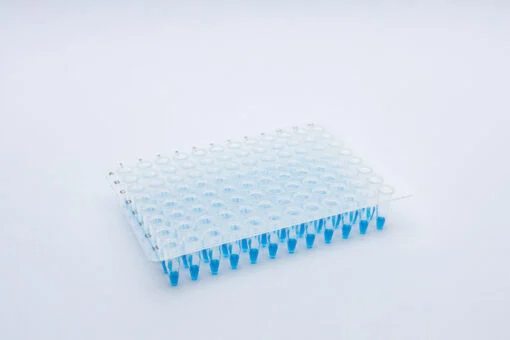
IST-122 QuickSeal qOpticTM Self Adhesive Sealing Film
Facebook
X
Pinterest
Email
Adhesive film with 96 optically clear windows. This seal is peelable, suitable for qPCR and optical applications.
Detail
Overview
Adhesive film with 96 optically clear windows. This seal is peelable, suitable for qPCR and optical applications.
These unique seals combine the strong sealing integrity of our QuickSeal PCR Seal with improved optical properties, thanks to the 96 adhesive-free windows
The seal is made of a durably transparent polyester film, and a strong adhesive is applied across the seal, apart from the 96 round windows
The QuickSeal qOptic seal is recommended for qPCR and other optical applications, such as fluorescence or colorimetric measurements
For all adhesive seals, the best sealing results are achieved using our Hand Roller or KAPS 500 Auto Sealer
Other Products
D3311 SolPure Blood DNA Kit
Product Info
Document
Product Info
Introduction
This product is designed for purification of high-molecular-weight genomic or mitochondrial DNA from a variety of blood samples. High-quality DNA can be purified from sample types including whole blood, buffy coat, bone marrow, body fluids in as little as 25 minutes. The convenient, scalable purification procedure removes contaminants and enzyme inhibitors such as proteins and divalent cation, and purified DNA is ready for immediate use in sensitive downstream applications or for archiving.
Details
Specifications
Features
Specifications
Main Functions
Isolation total DNA from whole blood using economic salt out method
Cells are lysed with ananionic detergent in the presence of a DNA stabilizer. The DNA stabilizer limits the activity of intracellular DNases and also DNases found elsewhere in the environment. RNA is then removed by treatment with an RNA digesting enzyme. Other contaminants, such as proteins, are removed by salt precipitation. Finally, the genomic DNA is recovered by precipitation with alcohol and dissolved in Buffer TE. Purified DNA typically has an A260/A280 ratio between 1.7 and 1.9, and is up to 200 kb in size. The DNA can be safely stored at 2-8°C, -20°C, or -80°C.
Advantages
Safe – without phenol chloroform extraction
Environment friendly – the reagents used are safe, non-toxic and without pollution
High molecular weight – the molecular weight of genomic DNA is about 50-150kb
High purity – the purified DNA has A260/280=1.8-1.9, A260/230=2.0-2.5
Unlimited sample size – solution type operation, sample volume can be adjusted at will
Cost performance – the most economical nucleic acid extraction technology
Kit Contents
Contents
D331101
D331102
D331103
Purification Volumes
50 ml
300 ml
1000 ml
10 x Buffer RBC
20 ml
100 ml
3 x 100 ml
Buffer WTL
60 ml
350 ml
1000 ml
Buffer PPS
20 ml
120 ml
350 ml
RNase Solution
300 µl
1.8 ml
6 ml
Buffer TE
10 ml
30 ml
120 ml
Storage and Stability
RNase Solution should be stored at 2-8°C upon arrival. However, short-term storage (up to 24 weeks) at room temperature (15-25°C) does not affect their performance. The remaining kit components can be stored dry at room temperature (15-25°C) and are stable for at least 18 months under these conditions. The entire kit can be stored at 2-8°C, but in this case buffers should be redissolved before use. Make sure that all buffers are at room temperature when used.
Document
This product is designed for purification of high-molecular-weight genomic or mitochondrial DNA from a variety of blood samples. High-quality DNA can be purified from sample types including whole blood, buffy coat, bone marrow, body fluids in as little as 25 minutes. The convenient, scalable purification procedure removes contaminants and enzyme inhibitors such as proteins and divalent cation, and purified DNA is ready for immediate use in sensitive downstream applications or for archiving.
Digital incubator for the Gel cards. Blood card/ID card incubator holds 2 independent incubation zones with a capacity for 12 Gel cards, It can be suitable for many types of gel cards from different manufacturers.
Features
1. Keep 24-Gel Cards in temperature of 37 degree. 2. 2 independent incubation zones with a capacity for 12 Gel cards 3. Digital display to set up time and keep the temperature 4. Audible programmable alarm to notify end of incubation period
HL-SAN efficiently removes nucleic acids from buffers typically used in protein purification. Due to its high salt tolerance, it is the obvious choice for host-cell DNA removal in settings where salt is added to reduce aggregation. Especially efficient for removing nucleic acids from proteins with high affinity for DNA and RNA. Proven performance during lysis and early stages of protein purification processes, as well as high-salt eluates. Cold-adapted enzyme with excellent performance also at ambient temperatures and during over-night digestion at 4°C.
Optimum activity at high salt concentration (0.5 M NaCl)
Active at low temperatures (20% at 6ºC)
Easily inactivated
Broad pH range
Temperature stable
Figures
Figure 1. Optimum activity in solutions with high salinity
HL-SAN has optimum activity at ∼0.5 M NaCl, but operates at a broad range of [NaCl] and [KCl]. The activity of HL-SAN was tested in a 25 mM Tris-HCl buffer, pH 8.5, 5 mM MgCl2 with varying [NaCl] or [KCl]. The maximum activity was set to 100%.
Figure 2. Temperature and activity
HL-SAN has optimum activity at ~35°C, but works over a broad temperature range (20% activity at 10°C and 50°C). The activity of HL-SAN was tested in a 25 mM Tris-HCl buffer, pH 8.5 containing 5 mM MgCl2 and 0.5 M NaCl.
Fig 3. The effect of MgCl2 and MnCl2 concentration on the HL-SAN activity.
The activity of HL-SAN was tested in a 25 mM Tris-HCl buffer, pH 8.5, 0.5 M NaCl and with varying concentrations of MgCl2 or MnCl2. The activity of the sample containing 5 mM MgCl2 was set to 100%.
Figure 4. HL-SAN activity vs pH/[NaCl]
The activity of HL-SAN was tested in a 25 mM Tris-HCl buffer with different pHs and different concentrations of NaCl. All buffers contained 5 mM MgCl2. The nature of the buffer was pH-dependent, but generally the NaCl-optimum was the same in all buffers/pHs. The exception was etanolaminbuffer at pH 9 and pH 9.5 in which the NaCl-optimum was shifted to the left (not shown).
Without NaCl, the specificity towards ssDNA and dsDNA is similar. At 0.5 M NaCl, the activity towards dsDNA increases, while the activity towards ssDNA is unaffected.
Figure 6. HL-SAN digests ssDNA to ~5-13 nt, and dsDNA to ~5-7 nt
The size of the end products from ssDNA varies from ~5-13 nt, while dsDNA is digested to around ~5-7 nt. The size of the end products seems to depend on the DNA sequence. Substrates 1 and 2 were ssDNA with different sequences and substrates 3 and 4 were dsDNA with similar sequences but with a FAM-label at different ends. Substrate 5 was dsDNA with the same sequence as substrate 3 and 4 but with a FAM-label at both ends.
Figure 7. HL-SAN activity decreases with increasing concentrations of glycerol
The activity of HL-SAN was tested in a 25 mM Tris-HCl buffer, pH 8.5, 5 mM MgCl2, 0.5 M NaCl and with increasing concentrations of glycerol. The activity of the control not containing glycerol was set to 100%.
Figure 8. The activity of HL-SAN at different concentrations of imidazole
The activity of HL-SAN was tested in a 25 mM Tris-HCl buffer, pH 8.5, 5 mM MgCl2, 0.5 M NaCl and with varying concentrations of imidazole. The activity of the control not containing imidazole was set to 100%.
Document
HL-SAN efficiently removes nucleic acids from buffers typically used in protein purification. Due to its high salt tolerance, it is the obvious choice for host-cell DNA removal in settings where salt is added to reduce aggregation. Especially efficient for removing nucleic acids from proteins with high affinity for DNA and RNA. Proven performance during lysis and early stages of protein purification processes, as well as high-salt eluates. Cold-adapted enzyme with excellent performance also at ambient temperatures and during over-night digestion at 4°C.