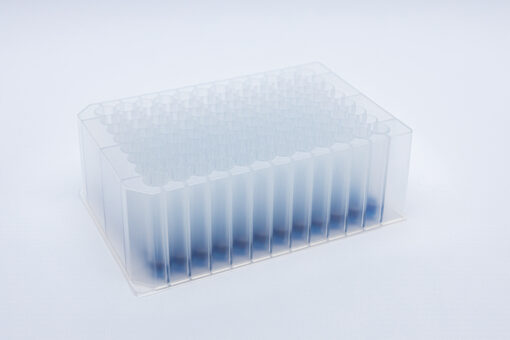
Working Volume of 2.0ml Round well with ‘U’ bottom to aid mixing, pelleting and washing High uniformity from well to well Raised well rims for reliable closing with heat sealing. Easy and reliable stacking Good centrifugation stability up to 6,000 × g for faster protocols and improved sample quality Manufactured under DNase/ RNase free environment without slip agents, plasticizers or biocides – Materials which could have a negative effect on bioassays Pure, virgin polypropylene guarantees good extractible performance, high resistance to chemicals, good mechanical stress and working with temperature extremes Autoclavable (121 °C, 20 min)
Detail
Overview
Working Volume of 2.0ml
Round well with ‘U’ bottom to aid mixing, pelleting and washing
High uniformity from well to well
Raised well rims for reliable closing with heat sealing.
Easy and reliable stacking
Good centrifugation stability up to 6,000 × g for faster protocols and improved sample quality
Manufactured under DNase/ RNase free environment without slip agents, plasticizers or biocides – Materials which could have a negative effect on bioassays
Pure, virgin polypropylene guarantees good extractible performance, high resistance to chemicals, good mechanical stress and working with temperature extremes
Autoclavable (121 °C, 20 min)
Other Products
C13111 HiPure RNA Mini Column
Product Info
Document
Product Info
Introduction
Magen’s HiPure columns are prepared by high quality glass fiber filter membrane as raw materials through membrane cutting, membrane release, ring release, ring pressing, gland, weighing and other processes. HiPure nucleic acid adsorption columns have the characteristics of long-term stability and high binding capacity. Experiments show that the highest binding capacity and binding efficiency of HiPure nucleic acid adsorption columns are basically unchanged when stored at room temperature for 4 years.
The series of nucleic acid columns produced by Magen Biotech are based on carefully selected imported glass fiber membranes (GF/B, GF/D, GF/F). Columns production processes such as polypropylene injection molding materials, injection molding process, and downstream membrane packing and compression rings are strictly controlled. This is to ensure that the column has extremely high adsorption capacity and long-term stability. Compared with conventional products on the market, Magen’s columns are with varieties, and binding rate will not change when stored at room temperature for 4 years.
Details
Specifications
Features
Specifications
Recommended application
Plasmid Mini Preparation, gDNA/ RNA Extraction,DNA/RNA Clean Up
Preservation conditions
Room temperature
Stability
Up to 4 years
Filter membrane
High quality glass fiber filter GF/B, 3 layers
Membrane aperture
1.0μm
Maximum binding yield of plasmid
30 μg
Maximum yield of alcohol mediated Binding
200 μg
Single liquid carrying capacity of column
800 μl
Minimum elution volume
30 μl
Withstand centrifugal force
16,000 x g
Centrifuge
Small high speed centrifuge (2ml)
Adsorption Mechanism
Based on the negatively charged DNA skeleton, it has a high affinity for positively charged glass fibers. In high salt and ethanol solutions, DNA/RNA binds to glass fiber and interacts with hydrophilic matrix on silica through hydrogen bond. DNA/RNA is tightly bound. All pollutants can be removed by washing solution. At high salt concentration, nucleic acids selectively bind to silicagel membrane, while other pollutants, mainly proteins, are removed by membrane washing.
Ordering information
CAT.No.
Product Name
Package
C13111
HiPure RNA Mini Column (3 x GF/B)with 2ml Collection Tubes
1000/Bag
Purchase Guide
Item No.
Product Name
Membrane type/number of layers
Collection tubes
Plasmid DNA binding capacity (Physical adsorption)
Note: GF/B pore size is for 1.0μM glass fiber membrane; GF/F pore size is for 0.7μm glass fiber membrane.
Document
Magen’s HiPure columns are prepared by high quality glass fiber filter membrane as raw materials through membrane cutting, membrane release, ring release, ring pressing, gland, weighing and other processes. HiPure nucleic acid adsorption columns have the characteristics of long-term stability and high binding capacity. Experiments show that the highest binding capacity and binding efficiency of HiPure nucleic acid adsorption columns are basically unchanged when stored at room temperature for 4 years.
2-(Propargyl-PEG4-amido)-1,3bis(PEG1-methyl ester) is a crosslinker that can react with azide compounds or biomolecules via copper catalyzed Click Chemistry to form a stable triazole linkage. The methyl ester groups can be hydrolyzed, reduced, or substituted under different conditions.
Document
2-(Propargyl-PEG4-amido)-1,3bis(PEG1-methyl ester) is a crosslinker that can react with azide compounds or biomolecules via copper catalyzed Click Chemistry to form a stable triazole linkage. The methyl ester groups can be hydrolyzed, reduced, or substituted under different conditions.
Attogene’s Microcystin Test Kit (Rapid – Lab) can be used to detect microcystins in liquid samples.
• Format: 10 tests
• Run Time: 10 Minutes
The most frequently reported cyanobacterial toxins are the hepatotoxic microcystins (MCs). MCs are peptides with a molecular weight ranging from 900 to 1,100 Da. They consist of seven amino acids of which the two terminal amino acids of the linear peptide are condensed to form a cyclic compound.
A tiered notification system which takes different actions based on different numeric thresholds for microcytin-LR concentrations in recreational waters has been developed. This is guidance that allows states to take various actions—such as posting information about harmful algal blooms (HABs), issuing a recreational public health advisory, or temporarily closing recreational waters through a no contact advisory—depending on the severity of the bloom event.
Microcystin-LR
Informational sign postings about HABs at recreational waters: < 6 μg/L Recreational public health advisory: 6 μg/L Elevated recreational public health advisory (e.g. no contact): 20 μg/L