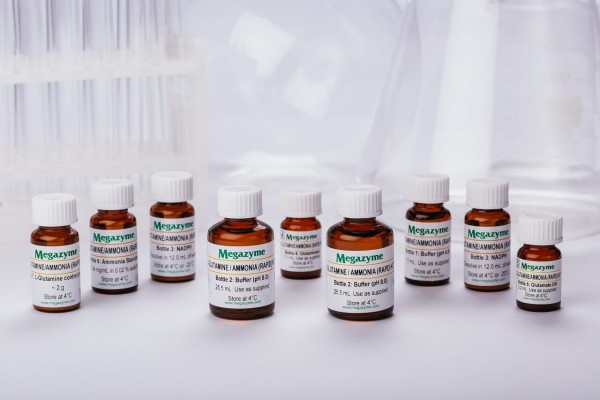
The L-Glutamine/Ammonia (Rapid) test kit is a novel method for the specific, convenient, cost effective and rapid measurement and analysis of L-glutamine and ammonia in culture media/supernatants and other materials.
Detail
K-GLNAM
SKU: 700004295
50 assays of each (manual) / 500 assays of each (microplate)
Content:
50 assays of each (manual) / 500 assays of each (microplate)
Shipping Temperature:
Ambient
Storage Temperature:
Short term stability: 2-8oC, Long term stability: See individual component labels
Stability:
> 2 years under recommended storage conditions
Analyte:
Ammonia, L-Glutamine
Assay Format:
Spectrophotometer, Microplate
Detection Method:
Absorbance
Wavelength (nm):
340
Signal Response:
Decrease
Linear Range:
1 to 40 µg of L-glutamine per assay
Limit of Detection:
0.54 mg/L (L-glutamine), 0.06 mg/L (ammonia)
Reaction Time (min):
~ 10 min
Application examples:
Cell culture media and cultures, dietary supplements, vegetables and other materials (e.g. biological samples, etc.).
Method recognition:
Novel method
This product has been discontinued.
The L-Glutamine/Ammonia (Rapid) test kit is a novel method for the specific, convenient, cost effective and rapid measurement and analysis of L-glutamine and ammonia in culture media/supernatants and other materials.
Note for Content: The number of manual tests per kit can be doubled if all volumes are halved. This can be readily accommodated using the MegaQuantTM Wave Spectrophotometer (D-MQWAVE).
Extended cofactors stability. Dissolved cofactors stable for > 1 year at 4oC.
Very rapid reaction due to use of high activity glutaminase and uninhibited glutamate dehydrogense
All enzymes supplied as stabilised suspensions
Only enzymatic kit available
Very cost effective
All reagents stable for > 2 years after preparation
Mega-Calc™ software tool is available from our website for hassle-free raw data processing
Standard included
Other Products
Available Carbohydrates Assay Kit
Product Info
Document
Product Info
K-AVCHO
SKU: 700004267
100 Assays of each per kit
Content:
100 assays of each per kit
Shipping Temperature:
Ambient
Storage Temperature:
Short term stability: 2-8oC, Long term stability: See individual component labels
Stability:
> 2 years under recommended storage conditions
Analyte:
Available Carbohydrates, Dietary Fiber
Assay Format:
Spectrophotometer
Detection Method:
Absorbance
Wavelength (nm):
340
Signal Response:
Increase
Linear Range:
4 to 80 μg of D-glucose, D-fructose or D-galactose per assay
Limit of Detection:
1.475 g/100 g
Reaction Time (min):
~ 5 h
Application examples:
Food ingredients, food products and other materials.
Method recognition:
AOAC Method 2020.07
The Available Carbohydrates Assay Kit method is suitable for the determination of available carbohydrates (AVCHO) comprising *total digestible starch (TDS) plus maltodextrins, sucrose, D-glucose, D-fructose and lactose. New Improved method receiving ‘First Action’ status: AOAC 2020.07. This method is designed to simulate in vivo conditions in the human small intestine (i.e. a 4 h incubation time with PAA + AMG) in parallel with recent advances in Dietary Fiber (DF) methodology (K-RINTDF: AOAC Method 2017.16) and in accordance with the new (physiological based) definition of DF announced by Codex Alimentarius in 2009. Also, sucrose is hydrolysed with a specific “sucrase” enzyme which (unlike invertase which has been used traditionally for this reaction) has no action on fructo-oligosaccharides (FOS).
* Total digestible starch (TDS) is defined as starch that is digested in a 4 h period and is part of the carbohydrate that is available for digestion and absorption in the human small intestine.
The Available Carbohydrates Assay Kit method is suitable for the determination of available carbohydrates (AVCHO) comprising *total digestible starch (TDS) plus maltodextrins, sucrose, D-glucose, D-fructose and lactose. New Improved method receiving ‘First Action’ status: AOAC 2020.07. This method is designed to simulate in vivo conditions in the human small intestine (i.e. a 4 h incubation time with PAA + AMG) in parallel with recent advances in Dietary Fiber (DF) methodology (K-RINTDF: AOAC Method 2017.16) and in accordance with the new (physiological based) definition of DF announced by Codex Alimentarius in 2009. Also, sucrose is hydrolysed with a specific “sucrase” enzyme which (unlike invertase which has been used traditionally for this reaction) has no action on fructo-oligosaccharides (FOS).
The HiPure Plant RNA Midi Kit provides fast purification of high-quality RNA from plants, cell, tissues, and yeast using silica-membrane spin columns with a binding capacity of 1mg RNA. There is no need for phenol / chloroform extractions and time-consuming steps such as CsCl gradient ultracentrifugation or precipitation with isopropanol or LiCl. RNA purified using the RaPure Total RNA Purification System can be used for applications such as RT-PCR, Northern blotting, poly A+ RNA (mRNA) purification, nuclease protection, and in vitro translation.
Details
Specifications
Features
Specifications
Main Functions
Isolation total RNA from <1g simple plant sample without chloroform
Applications
RT-PCR, qPCR, Northern hybridization, second generation sequencing, nucleic acid protection, in vitro translation
Purification method
Midi spin column
Purification technology
Silica technology, DNA filtration technology
Process method
Manual (centrifugation or vacuum)
Sample type
Plant leaves, roots, stems, fruits, fungi, etc.
Sample amount
0.5-1 g
Elution volume
≥400μl
Time per run
≤40 minutes
Liquid carrying volume per column
4ml
Binding yield of column
1mg
Principle
The Kit isolates total RNA from up to 1g plant tissue. A short workflow enables RNA isolation with genomic DNA removal in less than 40 min. Samples are first lysed and homogenized. The lysate is passed through a DNA Mini column, ethanol is added to the flow-through, and the sample is applied to a RNA column. RNA binds to the membrane and contaminants are washed away. High-quality RNA is eluted in as little as 400µl water using the Kit.
Advantages
Efficient removal of DNA – unique genomic DNA removal column without DNase treatment
High quality – high purity total RNA can be directly used in various sensitive downstream applications
Fast – medium isolation of several samples can be completed in 40 minutes
Safe – no phenol chloroform extraction required
Sensitive – RNA can be recovered at the level of PG
Broad spectrum – various types of plant samples can be processed by diversity of operating procedures
Kit Contents
Contents
R415202
D415203
Purification Times
20 Preps
100 Preps
HiPure DNA Midi Column II
20
100
HiPure RNA Midi Columns II
20
100
15ml Collection Tubes
40
200
Buffer RLC
120 ml
550 ml
Buffer PRC1
120 ml
550 ml
Buffer RW1
70 ml
400 ml
Buffer RW2*
20 ml
100 ml
RNase Free Water
30 ml
120 ml
Storage and Stability
The Kit can be stored dry at room temperature (15-25°C) and are stable for at least 18 months under these conditions. Make sure that all buffers are at room temperature when used. During shipment, crystals or precipitation may form in the Buffer RLC/PRC1. Dissolve by warming buffer to 37°C.
Purchase Guide
1. When dealing with woody or uncommon samples, R4150 is recommended first. R4150 contains two polysaccharide/polyphenol lysis buffer, which is the most universal product.
2. R4151 is recommended for handling common economic crop samples for the first time. Strong lysis solution can be used to process easy-extraction samples. The amount of corn or rice leaves samples can reach up to 300mg.
3. R4165 adopts CTAB/chloroform method, which can also handle a large number of difficult-to-extraction plants, but requires contact with chloroform substitutes, which is less safe than other kits. This kit uses DNase Ⅰ to remove DNA, which is also a good choice for extracting polysaccharide/polyphenol-rich plant samples.
4. R4014 is recommended for fruit/starch plant samples, which uses improved trizol pre-treatment, single column operation and is more economical.
Select the right purification kit to get impactful results:
The HiPure Plant RNA Midi Kit provides fast purification of high-quality RNA from plants, cell, tissues, and yeast using silica-membrane spin columns with a binding capacity of 1mg RNA. There is no need for phenol / chloroform extractions and time-consuming steps such as CsCl gradient ultracentrifugation or precipitation with isopropanol or LiCl. RNA purified using the RaPure Total RNA Purification System can be used for applications such as RT-PCR, Northern blotting, poly A+ RNA (mRNA) purification, nuclease protection, and in vitro translation.
Quantify DNA of a wide spectrum of concentrations, including the lower ng per µL, pg per µL and sub-pg per µL range
Compatible with any Real-Time PCR system
DNA is accurately quantified using a standard curve constructed from the provided DNA standard
Norgen’s Low Abundance DNA Quantification Kit offers a PCR-based detection procedure to quantify DNA of a wide spectrum of concentrations, including the lower ng per µL, pg per µL and sub-pg per µL range. The kit consists of a specially designed primer mix, that is used in conjunction with the provided 2x PCR Master Mix, to amplify human DNA from different types of inputs (such as various liquid biopsies). The kit is compatible with any Real-Time PCR system with the addition of fluorescent nucleic acid stains such as SYBR Green. The unknown DNA is accurately quantified by using a standard curve constructed from the provided DNA Standard.
Storage Conditions Upon receipt, store Norgen’s Low Abundance DNA Quantification Kit at -20°C or lower. Avoid multiple freeze-thaw cycle. If needed, prepare smaller working aliquots and store at -20°C or lower.