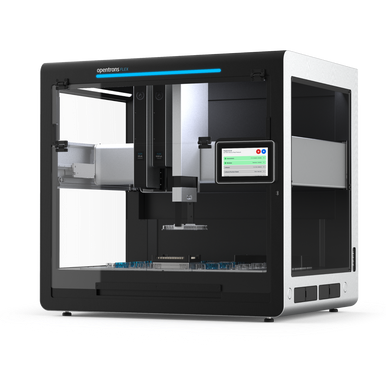
Opentrons Flex is a liquid-handling robot designed for high throughput and complex workflows. The Flex robot is the base of a modular system that includes pipettes, a labware gripper, on-deck modules, and labware — all of which you can swap out yourself. Flex is designed with a touchscreen so you can work with it directly at the lab bench, or you can control it from across your lab with the Opentrons App or our open-source APIs.
Detail
The future of lab automation is here.
Opentrons Flex is a liquid-handling robot designed for high throughput and complex workflows. The Flex robot is the base of a modular system that includes pipettes, a labware gripper, on-deck modules, and labware — all of which you can swap out yourself. Flex is designed with a touchscreen so you can work with it directly at the lab bench, or you can control it from across your lab with the Opentrons App or our open-source APIs.
Biotin is extensively used in combination with streptavidin in biological assays. Our biotin detection kits have multiple applications in detecting biotin attachment and efficiency of conjugation during biotinylation processes. These kits are perfect for understanding the efficiency of the reaction and free biotin in your solutions that can interfear with Streptavidin-biotin interactions.
Attogene offers three kits to detect and quantify biotin using three different technologies including Lateral Flow, ELISA and Chemical. these kits are accurate and sensitive compared with common instrumental analysis.
Can be used to calculate the amount of biotin in liquid samples including biological samples including biotinylated antibody, free biotin in solution, foods, plasma and serum as needed. Also, can be used to quantify the % biotinylation following standard biotinylation reactions.
Highly Sensitive, rapid, robust screening kit for Biotin Useful for detecting and quantifying biotin in biological samples Adaptable for detecting biotin in food samples
The MBG4 reagent contains a single substrate, namely 4,6-O-benzylidene-2-chloro-4-nitrophenyl-β-(31-β-D-cellotriosyl-glucoside) (BCNPBG4). The benzylidene acetal group prevents any hydrolytic action by exo-acting hydrolytic enzymes such as β-glucosidase or cellobiohydrolase.
Mixed linkage β-glucanase (endo-1,3:1,4-β-glucanase) / lichenase (EC 3.2.1.73) acts specifically to release 2-chloro-4-nitrophenol (CNP) from this substrate. The rate of release of CNP is directly related to the β-glucanase/lichenase activity in a sample. The reaction is terminated and the phenolate colour is developed on addition of Tris buffer solution (pH = 10.0).
Note that the substrate is not hydrolysed by β-glucosidase or cellobiohydrolase. The substrate can be hydrolysed by certain endo-cellulases (e.g. Trichoderma sp.) but this does not result in an increase in absorbance.
Discover more assay kits for enzyme activity measurement.
Data calculators are located in the Documents tab.
Advantages
Very cost effective
All reagents stable for > 2 years
Specific for endo-1,3:1,4-β-glucanase/lichenase
Simple, convenient, rapid assay
Well suited to automation
Malt flour standard and lichenase standard included
Document
The MBG4 reagent contains a single substrate, namely 4,6-O-benzylidene-2-chloro-4-nitrophenyl-β-(31-β-D-cellotriosyl-glucoside) (BCNPBG4). The benzylidene acetal group prevents any hydrolytic action by exo-acting hydrolytic enzymes such as β-glucosidase or cellobiohydrolase.
CE-IVD marked version available for in vitro diagnostic use
Available in TaqMan format for analysis
Bacillus cereus is a rod-shaped, gram-positive bacterium. Some strains of B. cereus cause foodpoisoning and other diseases such as keratitis. B. cereus grows at a wide range of temperature, from 4°C to 37°C. In fact, many foodborne illnesses caused by B. cereus are a consequence of improperly cooked or improperly stored food, including dairy products and meats. The majority of food poisoning by B. cereus could be divided into two types of symptoms – the emetic type and the diarrheal type, both of which are caused by the enterotoxin produced by the bacteria.
Bacillus cereus TaqMan PCR Kit, 100 reactions
Ready to use format, including Master Mix for the target and PCR control to monitor for PCR inhibition and validate the quality
Specific Primer and Probe mix for the pathogen/virus/viroid of interest
Primer and Probe mix
Positive and negative control to confirm the integrity of the kit reagents
Bacillus cereus TaqMan PCR Probe/Primer Set and Controls, 100 reactions
Specific Primer/Probe mix and Positive Control for the pathogen/virus/viroid of interest
Nuclease-free water
Can be used together with Norgen’s PCR Master Mix (#28007) or customer supplied master mix
Storage Conditions and Product Stability All kit components can be stored for 2 years after the date of production without showing any reduction in performance.
All kit components should be stored at -20°C upon arrival.