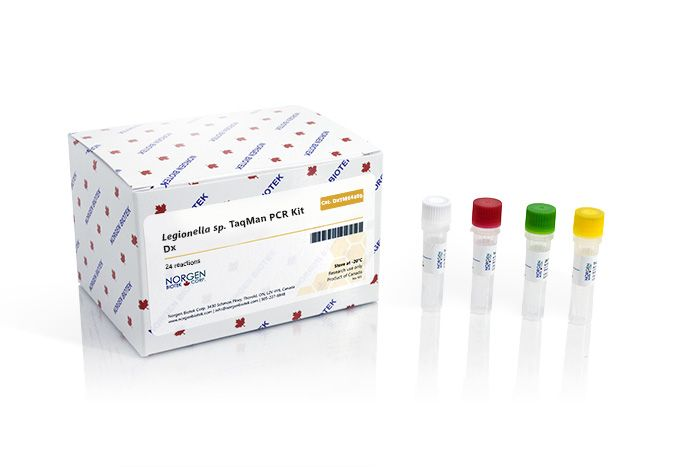
Norgen’s Legionella sp. TaqMan PCR Kit is designed for the detection of Legionella sp. specific DNA in a real-time PCR based on the use of TaqMan technology. This kit is designed for research use only and not for use in diagnostic procedures. The detection of Legionella sp. specific DNA is based on TaqMan PCR providing a simple, reliable and rapid result for the detection of Legionella sp. infection. Norgen’s Legionella sp. TaqMan PCR Kit includes a PCR control to monitor for PCR inhibition, and to validate the quality of the sample and the detection result. The Legionella sp. TaqMan PCR Kit comprises Master Mix for the target and PCR control detection, Primer & Probe Mix, as well as a positive control and a negative control (nuclease-free water) to confirm the integrity of the kit reagents.
Legionella sp. TaqMan PCR Kit, 100 reactions
Ready to use format, including Master Mix for the target and PCR control to monitor for PCR inhibition and validate the quality
Specific Primer and Probe mix for the pathogen/virus/viroid of interest
Primer and Probe mix
Positive and negative control to confirm the integrity of the kit reagents
Legionella sp. TaqMan PCR Probe/Primer Set and Controls, 100 reactions
Specific Primer/Probe mix and Positive Control for the pathogen/virus/viroid of interest
Nuclease-free water
Can be used together with Norgen’s PCR Master Mix (#28007) or customer supplied master mix
For research use only and NOT intended for in vitro diagnostics.
Storage Conditions and Product Stability All kit components can be stored for 2 years after the date of production without showing any reduction in performance.
All kit components should be stored at -20°C upon arrival.
Component
Cat. TM64450 (100 rxns)
Cat. TM64410 (100 rxns)
MDx TaqMan 2X PCR Master Mix
2 x 700 mμL
–
Legionella sp. Primer & Probe Mix
280 μL
3 x 70 μL
Legionella sp. Positive Control
150 μL
3 x 50 μL
Nuclease-Free Water (Negative Control)
1.25 mL
1.25 mL
Product Insert
1
1
Other Products
AAV Purification Kits
Product Info
Document
Product Info
Overview
AAV Purification from any input – cell fraction or media fraction
High AAV recovery, up to 90%
No specialized equipment needed
Purification from a variety of AAV serotypes (including AAV6 and AAV9)
Yields highly active AAV for in vivo and in vitro experiments
Purification is based on spin column chromatography that uses Norgen’s resin separation matrix
Recombinant adeno-associated virus (AAV) vectors are highly promising tools for both in vitro and in vivo gene transfer. Norgen’s AAV Purification Kits provide fast and simple procedures for concentrating and purifying AAV vectors from cell lysate and cell culture media. Purification is based on precipitation onto Norgen Biotek’s proprietary resin. Contaminating cellular debris is largely removed from the sample via a centrifugation step, while contaminating DNA and RNA is reduced using enzymatic digestion. AAV vector purified in this manner is highly active for use in in vitro and in vivo transduction experiments.
AAV Purification Kit
Norgen’s AAV Purification Kit contains sufficient materials for 15 preparations (33.5 mL per prep of supernatant (SN) or a total of 500 mL of supernatant input). Approximately 1 mL of cell pellet can be purified per prep, up to a maximum of 15 mL of cell pellet in total for the entire kit. Up to 33X sample concentration.
AAV Purification Mini Kit
Each spin column is able to concentrate and purify AAV from 0.5-8 mL of cell pellet, cell culture media, or cells and culture media mixed together. Up to 50X sample concentration. AAV vector purified in this manner is highly active for use in in vitro transduction experiments, and is eluted into a small volume (200 µL). Preparation time for 4 samples is 1.5 hours, with 45 minutes of hands-on time.
AAV Purification Midi Kit
Each spin column is able to concentrate and purify AAV from 8 mL up to 45 mL of input consisting of cell pellet, cell culture media, or cells and culture media mixed together. Up to 50X sample concentration. AAV vector purified in this manner is highly active for use in in vitro transduction experiments, and is eluted into a small volume (1 mL). The kit may be used to purify up to 8 x 25 mL or 4 x 45 mL of samples using the included columns. Preparation time for 4 samples is approximately 2 to 2.5 hours, with 1.5 hours of hands on time.
AAV Purification Maxi Kit (Slurry Format)
Each spin column is able to concentrate and purify AAV from 45 mL to 90 mL of input consisting of cell pellet, cell culture media, or cells and culture media mixed together. Up to 200X sample concentration. AAV vector purified in this manner is highly active for use in in vitro transduction experiments, and is eluted into a small volume (1-10 mL) using the optional concentration step. The kit may be used to purify up to 1 x 900 mL samples or 10 x 45-90 mL samples using the included columns. Preparation time for 1 x 900 mL sample is approximately 2.5 to 3.5 hours, with an optional concentration step requiring an additional 30 min.
At least 5 x 10¹⁰ AAV particles as determined by qPCR
AAV Vector Serotype
AAV6, AAV9 and others
Input Type
Cells, media
Input Volume (AAV supernatant)
1 – 33.5 mL SN per prep (500 mL SN in total)
Input Volume (AAV cell pellet)
1 mL cell pellet per prep (15 mL in total)
Time to Complete Purifications
2.5 to 4.5 hours with 1 hour hands on time
In vivo transduction
Yes
Storage Conditions and Product Stability
HL-SAN Nuclease should be stored at -20°C upon arrival. Elution Buffer O should be stored tightly capped at 4°C upon arrival. All other solutions should be kept tightly sealed and stored at room temperature. Once opened, the solutions should be stored at 4°C. This kit is stable for 2 years after the date of shipment.
Component
Cat. 66100 (15 preps)
Cat. 63200 (20 preps)
Cat. 63300 (4-8 preps)
Cat. 63250 (1-10 preps)
Lysis Buffer S
5.5 mL
5.5 mL
5.5 mL
20 mL
DNAse I
–
2 x 25 uL
2 x 25 uL
210 μL
RNAse A
–
60 μL
60 μL
240 μL
HL-SAN Nuclease
102 μL
–
–
–
Binding Buffer A
20 mL
4 mL
4 mL
2 x 8 mL
Purification Solution C
60 mL
–
–
–
Purification Solution D
130 mL
–
–
–
Wash Solution C
2 x 130 mL
60 mL
60 mL
3 x 60 mL
Slurry E
12.5 mL
–
–
2 x 14.5 mL
Elution Buffer O
66 mL
8.5 mL
8.5 mL
66 mL
Protein Neutralizer
4 mL
4 mL
4 mL
4 mL
Spin Columns
–
20
–
–
Mini Spin Columns
–
20
–
–
Midi Spin Columns (grey contents) with Collection Tubes
–
–
8
10
Midi Spin Columns (white contents) with Collection Tubes
–
–
8
–
Maxi Spin Columns (grey contents) with Collection Tubes
–
–
–
10
Maxi Spin Columns (white contents) with Collection Tubes
Short term stability: 2-8oC, Long term stability: See individual component labels
Stability:
> 2 years under recommended storage conditions
Analyte:
Lactose
Assay Format:
Spectrophotometer
Detection Method:
Absorbance
Wavelength (nm):
340
Signal Response:
Increase
Linear Range:
1 to 50 µg of lactose (or 0.50 to 25 µg of D-glucose)
Limit of Detection:
1.62 mg/L
Reaction Time (min):
~ 10 min
Method recognition:
AOAC Method 2020.08
The K-LOLAC test kit offers a rapid, novel, sequential measurement of free-glucose and lactose in conventional, low-lactose and lactose-free dairy products. This sequential assay format reduces the manual input required by an analyst when compared to traditional lactose assay formats and therefore improves both accuracy and efficiency. When used in combination with the Megazyme Creep Calculator provided, the β-galactosidase employed in this kit allows for the selective measurement of lactose in the presence of galacto-oligosaccharides (GOS) which are commonly found in lactose-free dairy products. This constitutes a significant improvement over existing commercially available lactose assay kits which typically overestimate lactose content in lactose-free samples due to the unselective hydrolysis of GOS by β-galactosidase. Lastly, the sensitivity of the K-LOLAC assay kit has been doubled through the use of a cascade biochemical pathway, helping to significantly reduce the LOD and LOQ for the assay.
Peelable heat sealing foil which seals to polystyrene plates. This seal is resealable, pierceable and suitable for compound storage too.
Heat sealing offers a 100% effective method of plate sealing, for complete seal integrity, as well as being quick and cost effective
Our PierceASeal Foil PS Heat Seal produces a strong seal to polystyrene plates
It is compatible with polypropylene and polystyrene plates
This seal demonstrates moderate solvent resistance and can be used for low temperature compound storage, in DMSO and organic solvents, and short term room temperature storage
PierceASeal Foil PS Heat Seal can be pierced with a pipette tip manually, by a liquid handling robot, or it can be removed by peeling (from polystyrene only). It can be resealed by applying another Polystyrene Foil Heat Seal directly on top of a previously pierced seal
This seal is available as sheets, for use with manual and semi-automated sealers, such as our HeatASeal 500 Sealing Machine
Also available in multiple roll formats compatible with specified automated heat sealers, such as our Wasp or Chameleon XT
Document
Peelable heat sealing foil which seals to polystyrene plates. This seal is resealable, pierceable and suitable for compound storage too.